Document Fraud Detection: A Practical Guide for Modern Teams
Document fraud detection explained: types of fraud, technical approaches, KPIs, and a layered workflow teams can run in production today.

Digital forgery is no longer a niche problem limited to altered identity cards. Digital forgeries represented 57.46% of all document fraud in 2024, and digital forgery increased 244% year over year according to Entrust's 2025 Identity Fraud Report. For teams handling KYC files, invoices, payslips, bank statements, or logistics documents, document fraud detection must examine more than whether OCR can read the page.
What Document Fraud Detection Actually Means in 2026
Entrust analyzed tens of millions of identity-verification attempts across more than 30 industries and 195 countries from September 1, 2023, through August 31, 2024. Its report found that digital forgeries had become more common than physical counterfeits for the first time. The average document-fraud rate measured 4.5%, while biometric fraud remained below 2%, as documented in the Entrust identity fraud research.
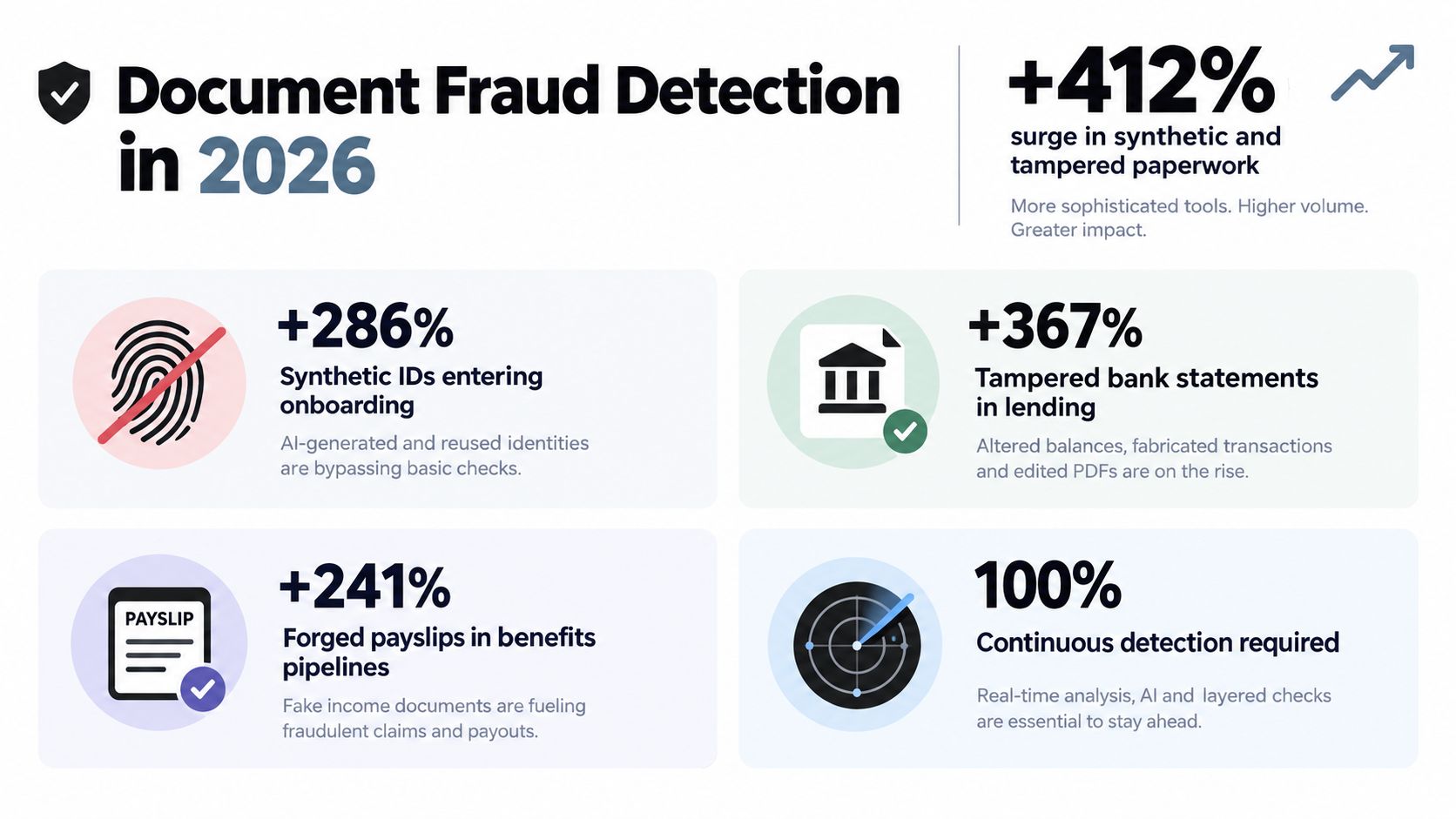
Document fraud detection is a layered process for deciding whether a submitted file is authentic, unaltered, current, and issued by a trustworthy source. OCR supplies readable text, much like transcribing a form. It cannot establish that the form itself is genuine.
A file may contain coherent, high-quality text after someone replaces a photograph, changes an account balance, modifies a tax value, reuses an old utility bill, or generates a synthetic document. The visible fields and underlying data can be altered together, leaving OCR with nothing suspicious to read.
Detection is a decisioning system
A production workflow examines several evidence layers:
- Document signals: Image quality, layout, typography, field relationships, security features, metadata, and file structure.
- Issuer signals: Whether the file matches a known template, certificate, barcode format, employer, supplier, bank, or government authority.
- Behavioral signals: Whether submission patterns, device context, duplicate use, or applicant history add risk.
These layers should feed explicit thresholds and review queues. A low-risk invoice may pass automatically, a payslip with conflicting totals may go to an analyst, and a file with a broken barcode plus issuer mismatch may be rejected. The result should record the evidence, rule outcomes, confidence, and reviewer action.
A platform such as Matil.ai can sit between document intake and business operations, coordinating extraction, validation checks, risk scoring, human review, and audit records. Its role is to make the workflow consistent and traceable. Compliance, finance, lending, insurance, payroll, procurement, and operations teams can then reconstruct why a file was accepted, reviewed, or rejected.
Practical rule: Treat a fraud score as evidence for a decision, not as the decision itself.
The Main Types of Document Fraud Teams Face
Fraud patterns become easier to understand when documents are grouped by how businesses use them. A passport, payslip, invoice, and bank statement may all arrive as PDFs or images, but the relevant controls are different.
Identity documents are commonly attacked through photo substitution, MRZ tampering, altered personal data, and replicated security features. The business loss can include account opening with a false identity, regulatory exposure, or unauthorized access. The strongest signals often come from inconsistencies between the printed fields and the machine-readable zone, missing document structure, invalid barcodes, or a mismatch between the presenter and the document.
Proof-of-income documents create a different risk. Payslips, bank statements, and tax forms can be changed to inflate income, balances, or employment history. Attackers may use a familiar template, create a synthetic employer, pad a number, or alter only one field while leaving the rest of the file unchanged. Cross-field calculations and issuer or employer validation are usually more useful than OCR confidence alone.
Commercial records have their own attack surface. Fraudsters may impersonate a supplier, submit duplicate invoices, change line totals, or alter payment details in a purchase order or contract. A document may look visually correct while the supplier identity, tax value, bank account, or invoice history conflicts with trusted business records.
Supporting records, such as utility bills and self-employed proofs, are often reused or modified to establish an address, business activity, or income source. Date validity, address consistency, duplicate detection, and comparison with external records can expose these cases.
| Document family | Primary attack | Strongest detection signal |
|---|---|---|
| Passports, national IDs, driver licences | Photo, MRZ, barcode, or field alteration | Cross-field consistency, document structure, liveness, and issuer validation |
| Payslips, bank statements, tax forms | Template forgery, number changes, synthetic employer data | Balance and salary logic, employer checks, and anomaly detection |
| Invoices, purchase orders, contracts | Vendor impersonation, duplicate billing, altered totals | Supplier matching, arithmetic validation, and duplicate detection |
| Utility bills and self-employed proofs | Address manipulation and dated reuse | Date, address, source, and document-history checks |
Government enforcement data shows why the problem can't be dismissed as an occasional anomaly. A U.S. Government Accountability Office report recorded more than 100,000 fraudulent documents intercepted annually during fiscal years 1999, 2000, and 2001. More recently, U.S. Customs and Border Protection identified more than 6,800 counterfeit, fraudulent, stolen, or criminally associated documents during fiscal year 2023, a 219% increase over fiscal year 2022, according to the Department of Homeland Security inspector general.
How Detection Actually Works Under the Hood
A reliable system moves through several layers. Each layer answers a different question, so removing one creates a blind spot.
OCR and classification
OCR documents technology converts pixels into text. Modern extraction also identifies where each value appears, which label belongs to it, and what type of value it represents. A classifier can route a file to the correct schema, such as distinguishing a UK bank statement from a US W-2 before extraction begins.
The result should include structured fields, coordinates, confidence values, and page-level context. That information makes later checks possible. A date, account identifier, employer name, or invoice total has meaning only when the system knows its location and relationship to nearby fields.
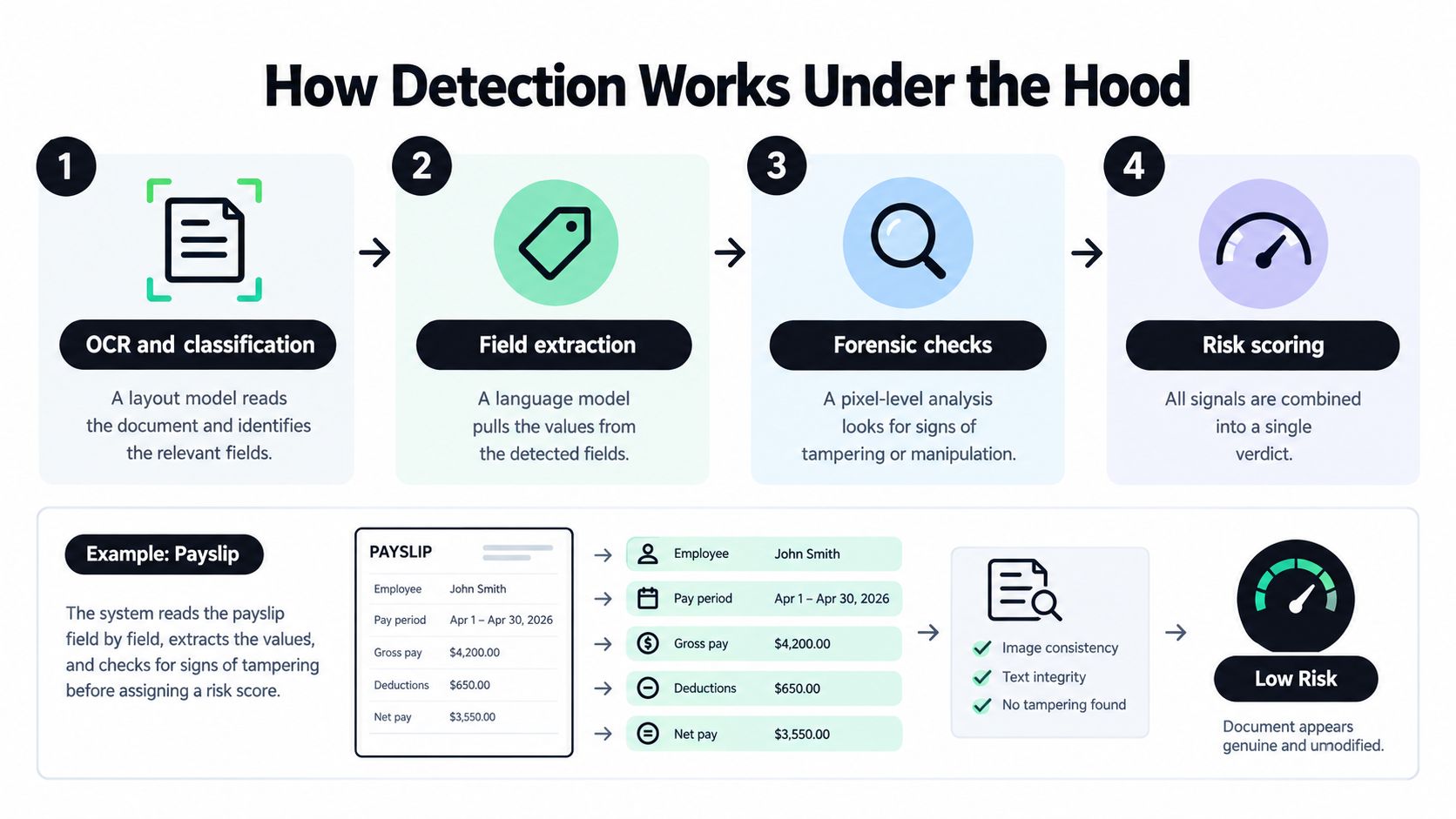
Field validation and anomaly detection
Validation asks whether the extracted values make sense together. A payslip might contain a gross salary that doesn't reconcile with deductions and net pay. An invoice might show line items whose totals don't match the stated subtotal or tax. A bank statement might contain a running balance that fails to follow from the transactions.
Anomaly detection adds context. A payroll code that doesn't match the employer, an unfamiliar bank layout, or a supplier account that differs from approved records can increase risk without proving fraud on its own.
Image forensics and provenance
Image forensics examines evidence that isn't visible as ordinary text. Noise residuals, JPEG ghosting, font geometry, spacing, cloned regions, inconsistent edges, and resampling artifacts can reveal editing. Metadata checks can inspect PDF producer chains, Exif data, and creation timestamps, although metadata is supporting evidence rather than a verdict because legitimate workflows can remove or rewrite it.
Generative inpainting makes this harder. The AIForge-Doc benchmark reported that the strongest detector, TruFor, achieved an AUC of 0.751, while DocTamper achieved 0.563 and zero-shot GPT-4o achieved 0.509 on AI-generated document forgeries. The same benchmark contrasts these results with at-least-0.95 AUC commonly reported on traditional Photoshop-tampered benchmarks. A detector that performs well on legacy edits may therefore fail when an altered region has been generated with locally consistent texture, lighting, and character edges.
Cryptographic and issuer checks
Some documents offer stronger evidence than visual analysis. A system can verify certificate chains on e-invoices, barcodes and 2D-Doc data on tax receipts, or digital signatures on signed PDFs. For identity documents, it can compare printed data with the MRZ or barcode and check whether the document was captured live.
Teams working with passports can also use this guide to MRZ data on passports to understand why the machine-readable zone is valuable. The central principle is simple: extraction tells you what the file says, while validation tests whether the file deserves trust.
Designing a Layered Detection Workflow
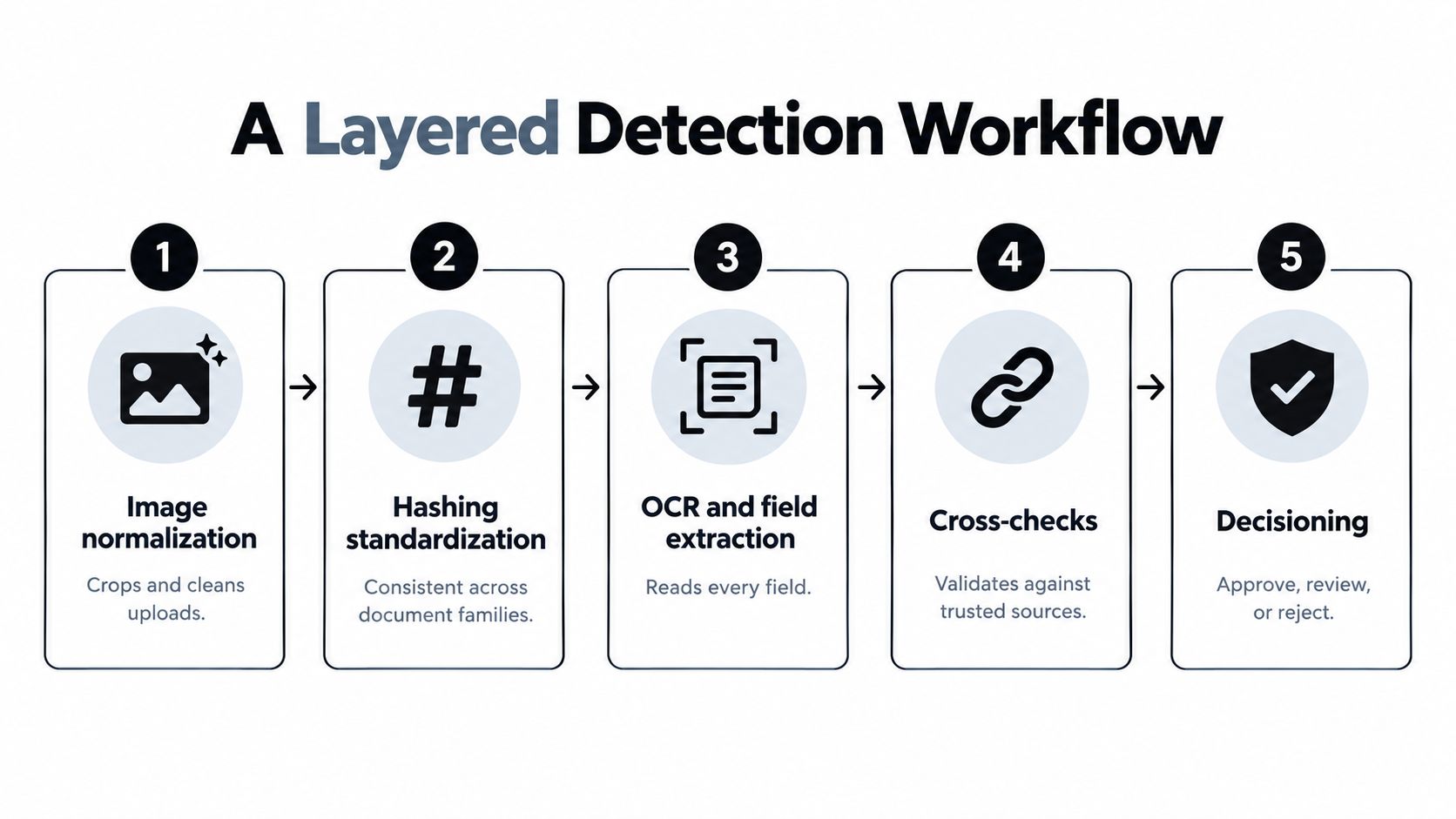
Production workflows should turn evidence into a controlled path, not a pile of disconnected alerts. The following sequence works across identity, finance, payroll, and logistics documents.
Normalize the input. Crop borders, correct rotation, improve legibility, and separate pages when a file contains several documents. Preserve the original upload so investigators can compare the normalized image with the source.
Standardize and hash the file. Generate consistent fingerprints across document families and retain them with the case record. This supports duplicate detection and helps identify a file that has been submitted repeatedly.
Extract and classify. Run OCR, identify the document family, map values to fields, and record field-level confidence. A poor scan shouldn't be automatically treated as a clean document. It should enter an exception path.
Run cross-checks. Apply business rules such as IBAN format checks, date consistency, VAT arithmetic, employer registry matching, supplier verification, balance continuity, and duplicate-document detection.
Route the decision. Combine signals into an outcome such as accept, manual review, or reject. Store the individual reasons, rule versions, model versions, reviewer actions, and timestamps.
Confidence needs boundaries
A confidence score becomes useful only when the team defines what happens at different levels. High-confidence, low-risk cases may be eligible for automatic acceptance. Ambiguous cases should go to a queue that shows the triggering page, field, rule, and evidence. Low-confidence or contradictory cases may require rejection or additional evidence.
Avoid one global threshold. A photographed identity card, a digitally signed invoice, and a low-quality receipt have different error profiles. The DocForge-Bench research evaluated methods across eight datasets and 14 publicly available methods, including synthetic tampering, receipt forgery, identity-document manipulation, and real-world scene-text alterations. Its findings support evaluating performance separately by document family, capture channel, language, and manipulation type.
A review queue isn't a failure of automation. It is the control that prevents uncertain predictions from becoming irreversible decisions.
Rules should be versioned. If an IBAN rule, supplier list, or document template changes, the system should preserve which version produced the decision. That audit trail lets investigators explain an outcome months later, including whether the issue involved a visual anomaly, inconsistent fields, missing provenance, or a business-rule conflict.
Why Document Fraud Creates Measurable Financial and Compliance Exposure
Manipulated documents can affect payments, credit decisions, employee benefits, insurance claims, and customer onboarding. At high volume, reviewers cannot consistently compare every field, image artifact, duplicate file, and external record without layered controls. The risk is a decisioning problem: each case needs a traceable reason for acceptance, escalation, or rejection.
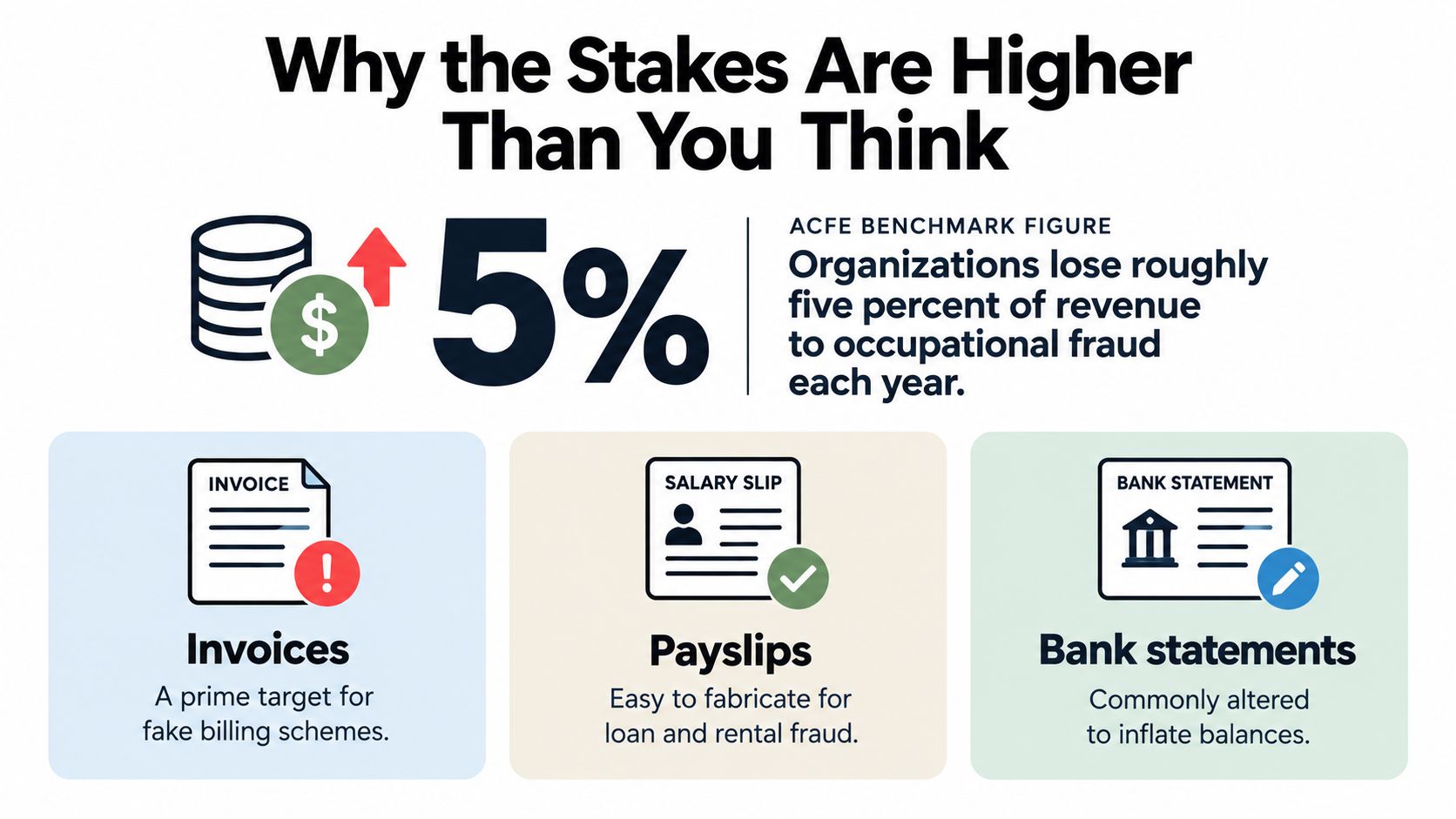
The Association of Certified Fraud Examiners' 2024 Report to the Nations estimates that organizations lose approximately 5% of annual revenue to occupational fraud. It analyzed 1,921 fraud cases, representing approximately $3.1 billion in identified losses. The median loss was $145,000, and 22% of cases involved losses of at least $1 million.
Why OCR alone misses the business risk
Asset misappropriation, including false billing and inflated expense reports, was the most common category in the ACFE report. It appeared in 86% of cases, with a median loss of $120,000, according to the same ACFE Report to the Nations.
OCR works like a reader, not an investigator. It can accurately extract a supplier name, line items, tax value, and bank account from a false invoice while missing impersonation or duplicate submission. Validation must compare those fields with accounting records, approved vendors, payment history, and arithmetic rules.
A layered workflow sends only explainable exceptions to reviewers. A platform such as Matil.ai can support that routing by attaching evidence, such as a balance discontinuity, failed signature, mismatched identity field, or suspicious duplicate, to each review case. That record helps compliance and operations teams connect the document signal to the business decision.
Matching Controls to Each Document Family
A single detection rule creates two predictable failures. It misses fraud that requires document-specific checks, and it generates false positives when a control does not fit the evidence being reviewed. Treat each document family as its own decision problem, with authoritative fields, supporting signals, and a defined path to review.
Bank statements call for transaction and balance analysis. Compare opening and closing balances with the listed transactions, check whether the running balance reconciles, inspect account identifiers for edits, and compare the layout with known issuer characteristics. Readable text is not enough. A statement with an impossible balance sequence should enter review even when OCR succeeds.
Invoices require business and payment controls. Check supplier identity, VAT arithmetic, purchase-order references, payment details, and duplicate submissions. A genuine supplier template can still support a fraudulent payment when the bank account has been replaced. Account-history changes therefore deserve a separate review signal.
Payslips depend on employment and payroll logic. Compare employer information, salary components, tax identifiers, deductions, and dates. Examples include a payroll code that does not match the employer, a net salary that fails to reconcile with deductions, or compensation that conflicts with the declared employment record.
KYC documents combine identity resolution, validation, and verification. NIST's identity evidence guidance distinguishes these controls clearly, as explained in this overview of what identity verification entails. Resolution asks whether the evidence identifies one unique person. Validation checks whether the document and its data are authentic, accurate, and valid. Verification confirms that the presenter is the person to whom the evidence was issued.
| Document family | Primary checks | Secondary checks | Review trigger |
|---|---|---|---|
| Bank statements | Balance continuity, transaction logic, issuer matching | Duplicate detection, metadata, account identifier checks | Balance conflict or unfamiliar issuer structure |
| Invoices | Supplier verification, VAT arithmetic, duplicate detection | Purchase-order matching, payment-detail history, metadata | New supplier account or inconsistent totals |
| Payslips | Employer validation, salary logic, tax-ID format | Date checks, template comparison, duplicate detection | Unrecognized employer data or unexplained pay mismatch |
| KYC documents | MRZ and barcode comparison, document authenticity, presenter linkage | Liveness, chip or signature validation, image analysis | Field conflict, failed liveness, or invalid document structure |
The matrix should remain configurable. A Bill of Lading may require container identifiers, ports, quantities, and carrier data. A DUA may require customs-specific fields. The governing question is: which evidence is authoritative for this document and decision? A platform such as Matil.ai can help apply these family-specific checks, preserve the signals behind each result, and route threshold exceptions to an auditable review queue.
KPIs, Thresholds, and Compliance Anchors
A fraud-aware team needs more than an accuracy claim. Track the rate of false positives, confirmed false negatives, time to decision, manual-review ratio, and precision by document family. A single aggregate number can hide the fact that a system performs well on invoices but poorly on photographed identity documents.
| KPI | Suggested starting threshold | Why it matters | Compliance anchor |
|---|---|---|---|
| False-positive rate | Set a documented baseline by document family, then reduce it without weakening confirmed-fraud detection | Excessive alerts overwhelm reviewers and delay legitimate cases | GDPR data minimization and operational fairness |
| False-negative rate | Measure against confirmed fraud and review the result by attack type | Accepted fraud creates financial, regulatory, and reputational exposure | Risk-based controls and internal audit |
| Time to decision | Define a service target for automatic and manual paths | Slow review can delay onboarding, payments, or claims | Operational resilience and case management |
| Manual-review ratio | Monitor by document family and reason code | A high ratio may indicate poor thresholds or weak extraction | Auditability and reviewer capacity |
| Family-level precision | Report separately for KYC, invoices, payslips, and statements | Aggregate performance can conceal dangerous gaps | Model governance and control testing |
NIST provides concrete acceptance criteria for automated identity-evidence validation. Its requirements specify a document false-acceptance rate of 0.1 or less and a document false-rejection rate of 0.1 or less. Where one-to-one biometric comparison is used, the false-match rate must be 1:10,000 or better and the false-non-match rate 1:100 or better. For one-to-many identification, the false-positive identification rate must be 1:1,000 or better, as described in NIST's identity assurance requirements.
These figures apply to the relevant NIST identity-evidence context, not automatically to every invoice or receipt workflow. Teams should document which requirements apply, define their own risk tolerances for other document families, and test independently over time.
Every decision should retain the input, extracted fields, confidence values, triggered rules, external checks, model or rule versions, reviewer notes, and final outcome. That record supports GDPR accountability, ISO 27001 control evidence, SOC reporting, and customer due diligence obligations associated with FATF Recommendation 10.
A platform that combines advanced OCR, classification, validation, workflow routing, pre-trained models, rapid customization, an API, and traceable logs can expose these controls in one pipeline. It should also make its security posture clear, including GDPR, ISO 27001, SOC coverage, and zero data retention where those commitments apply.
A Practical Path Forward and Where Matil.ai Fits
Start with two high-volume document families rather than trying to automate every workflow at once. Payslips and bank statements are useful pilots because they combine structured fields, business logic, and meaningful review signals. Define acceptance, review, and rejection conditions before measuring performance.
A practical rollout looks like this:
- Choose the scope: Select document families with enough volume and a clear business owner.
- Capture the baseline: Measure extraction quality, review time, false positives, and confirmed fraud before changing the process.
- Add layered checks: Combine OCR, classification, field validation, issuer checks, duplicate detection, and provenance signals.
- Create review reasons: Show analysts the exact page, field, rule, or external mismatch that triggered escalation.
- Expand carefully: Add invoices, KYC documents, contracts, Bills of Lading, or customs declarations after the first workflow is stable.
An intelligent document processing platform can serve as the execution layer for this approach. Matil.ai combines OCR, classification, validation, and workflow orchestration through an API, with pre-trained document models and options for custom structures. Its stated capabilities include accuracy above 99% in multiple use cases, GDPR, ISO 27001, and AICPA SOC coverage, plus a zero data retention policy. The intelligent document processing platform overview describes how these capabilities can support PDFs, images, multi-page files, structured outputs, and automated routing.
The important distinction is that OCR alone only reads a document. A production workflow must also validate the extracted values, identify anomalies, preserve evidence, and send uncertain cases to a human reviewer. That is the difference between automated transcription and auditable document fraud detection.
If you're evaluating document fraud detection, Matil can help you combine OCR, document classification, validation, and workflow routing in an API-based pipeline. Start with a focused payslip or bank-statement pilot, define the review reasons and audit fields, then expand once the controls perform consistently.


