Zero Data Retention AI: Privacy and Compliance
Zero data retention AI ensures data is never stored, supporting privacy compliance and user trust. Learn how this framework works in practice.

Zero data retention AI means prompts and outputs are processed without persistent storage after the response is produced. In practice, that claim is valid only when teams verify the request-routing and storage layers together, not when they rely on a vendor policy page alone.
A compliance officer at a European fintech receives a request to process employee expense reports containing salary information. The AI provider says it offers ZDR. Procurement sees a reassuring checkbox, but compliance asks harder questions: does the endpoint qualify, do logs contain document content, can support tools access the request, and what happens to metadata or safety copies?
That is the true zero data retention AI problem. The policy sounds simple. The implementation rarely is.
What Zero Data Retention Actually Means for AI Systems
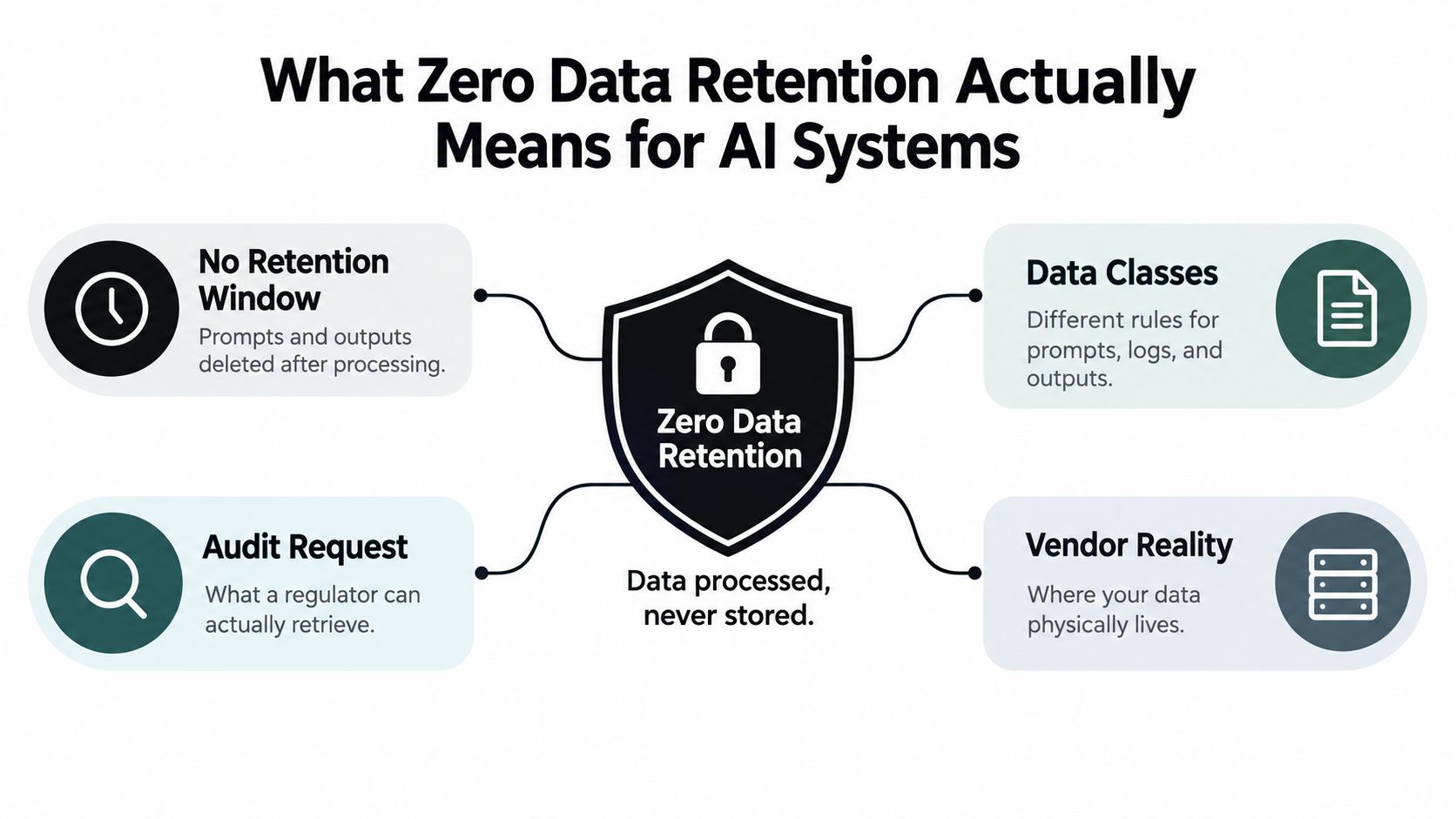
Zero data retention, or ZDR, is a stateless processing pattern. The provider handles prompts, context, uploaded files, and outputs only long enough to produce the result, then excludes those payloads from persistent storage. A strict interpretation also covers logs, databases, support systems, analytics stores, and shadow archives that could reconstruct the interaction, as explained in this engineering analysis of how to prove zero data retention.
The distinction matters during document processing. An expense report may enter an API gateway, pass through a routing service, reach an OCR or language model, trigger validation, and generate a structured response. If the gateway writes the original file to a debugging table, the provider's downstream deletion policy doesn't make the overall deployment zero-retention.
The control has two boundaries
The first boundary is request routing. Your application must send sensitive traffic only to eligible organizations, projects, endpoints, and capabilities. The second is storage behavior. Every subsystem that receives the payload must either process it transiently or apply an explicitly documented retention rule.
Practical rule: If an intermediate service can persist the prompt or output, the deployment doesn't meet a zero-retention claim, even if the model provider deletes its copy.
ZDR also isn't the same as keeping data inside your own network. The request still reaches the provider and is processed there. It also doesn't automatically control what your application, a connected tool, an error tracker, or a third-party workflow stores. Teams looking for a plain-language comparison can also review understanding Ciphar's no logs policy, while treating the provider's exact scope as the controlling document.
What to define before procurement
Ask vendors to define these data classes separately:
- Input content: prompts, images, PDFs, and extracted text.
- Output content: completions, structured fields, classifications, and generated files.
- Operational records: identifiers, timestamps, usage data, and error details.
- Derived artifacts: embeddings, caches, safety signals, and indexes.
- Human-access paths: support consoles, abuse review, and incident tooling.
A useful ZDR contract should state which classes are deleted, which are retained, where they are processed, and under what exceptions. “No training” is insufficient by itself. A provider can avoid training while temporarily retaining content for abuse prevention or legal review. The engineering question is not whether the vendor uses a reassuring label. It is whether the complete data path supports the promise.
The Gap Between Vendor Claims and Technical Reality
ZDR usually isn't a universal on/off switch. Major AI APIs commonly make it available only to eligible endpoints, organizations, projects, or model classes. OpenAI's documentation says approved organizations can select Zero Data Retention at the organization or project level, while also warning that some capabilities and endpoints can retain application state. Anthropic likewise describes organization-level activation and retention exceptions for some model classes in its API data controls documentation.
That creates a route-level procurement problem. A company may approve a vendor globally, configure ZDR for one project, and then accidentally send document traffic through an ineligible endpoint. The request succeeds. The dashboard looks normal. The retention posture has changed without the business user noticing.
Test the route, not the slogan
A serious evaluation should combine contract review with controlled testing:
- Map the request path. Identify gateways, model endpoints, OCR services, caches, queues, monitoring tools, support systems, and subprocessors.
- Separate content from metadata. Confirm whether raw files, extracted text, outputs, identifiers, latency records, and safety signals follow different rules.
- Exercise every capability. Test file uploads, streaming, batch processing, tool calls, multi-turn state, retries, and fallback routing.
- Review exception language. Look for abuse monitoring, legal preservation, safety review, debugging, and support access.
- Request evidence. Ask for retention schedules, deletion procedures, access controls, audit records, and endpoint eligibility lists.
The difficult question is often not “does the provider retain data?” It is “which exact fields are retained, by which system, for how long, and under whose control?” Recent coverage of private safety processing shows why that distinction matters. A provider can pair ZDR with limited safety processing, meaning the raw prompt, output, operational metadata, and safety signal may not share the same lifecycle. The discussion of Private Safety Processing and frontier-model retention is useful background for this distinction.
What fails in production
The weakest implementations treat ZDR as a dashboard preference. They don't restrict routes, they leave verbose application logging enabled, and they assume a provider's privacy setting covers plugins or connected tools.
A stronger design makes the policy executable. Sensitive traffic has a dedicated route, ineligible features are blocked, payload logging is disabled, and the deployment records only the trace needed to prove what happened. That trace can include a request identifier, schema version, validation status, processing outcome, and timestamps, without retaining the document itself.
ZDR Versus Finite Retention, Which Compliance Strategy Fits
Zero retention is not automatically the right answer for every workflow. Some teams need a short, controlled evidence window to investigate abuse, reproduce failures, or answer an audit request. Independent legal analysis describes finite options such as 30 days, 90 days, or up to 12 months, while also noting that some services retain conversations for 18 months or indefinitely unless users opt out or delete them. These ranges are discussed in this analysis of AI product data retention and deletion.
The decision should follow the data and the operational purpose, not a blanket preference.
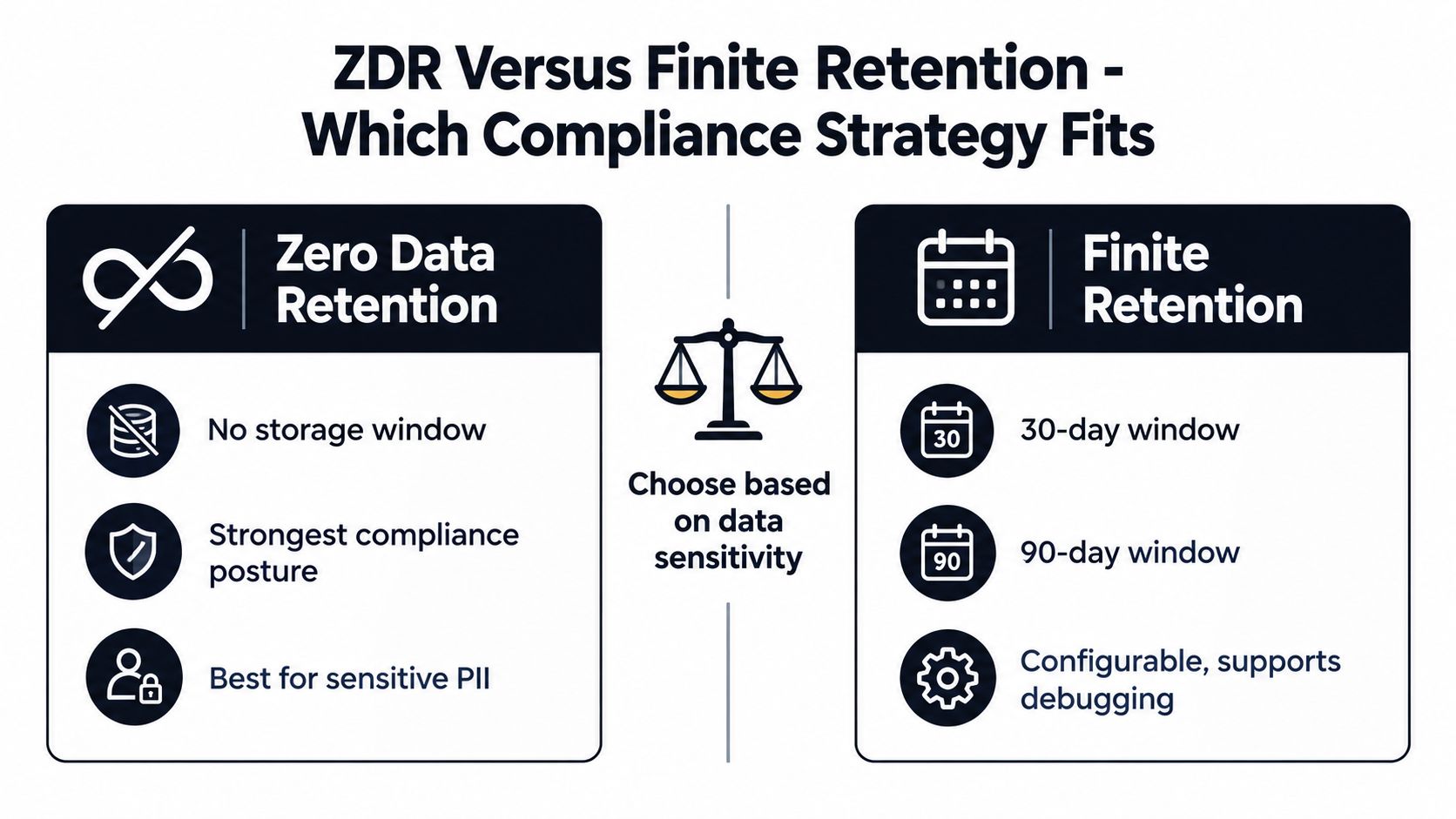
| Strategy | Where it fits | What it gives up |
|---|---|---|
| Zero Data Retention | KYC documents, legal contracts, sensitive payroll, and high-risk personal data | Less provider-side evidence for debugging and incident investigation |
| Finite retention | Workflows that require abuse monitoring, controlled troubleshooting, or operational review | A larger exposure window and more deletion governance |
| Customer-controlled records | Audited processes where the business must preserve evidence | More responsibility for access, encryption, retention, and segregation |
Choose based on the purpose
ZDR is a strong fit when the vendor doesn't need to inspect historical content and the organization can maintain its own traceability. KYC processing is a clear example. The provider can classify an identity document, extract fields, validate the result, and return structured data without retaining the original file.
Finite retention can make sense when an operations team must investigate a suspicious request or reproduce a production defect. In that case, retention should be narrow, documented, access-controlled, and automatically deleted. A short window isn't a license to keep everything. It is a deliberately limited operational control.
Regulated organizations also face competing obligations. The EU AI Act requires technical documentation for high-risk systems to be retained for 10 years after market placement, while GDPR requires personal data to be deleted once it is no longer needed. The practical answer may be to preserve system documentation, decision records, and validation evidence without retaining the underlying personal documents with a third-party model provider.
The best architecture often separates content retention from audit retention. Keep proof of the process, not an unnecessary copy of the sensitive payload.
How ZDR Interacts with GDPR and Sector Compliance
GDPR's storage-limitation principle requires personal data to be kept only as long as necessary. ZDR supports that objective by reducing a processor's persistent copy of prompts, files, and outputs. It doesn't remove the controller's other duties, such as defining purpose, limiting access, documenting processing, managing subprocessors, and protecting data in transit.
The governance gap remains significant. A 2026 industry analysis says nearly 60% of companies using AI still lack clear retention rules for data used in training or inference, as reported in this overview of AI data retention practices. Without an internal rule, a ZDR-enabled provider can coexist with a customer application that stores every prompt in logs and every output in an analytics database.
Apply the rule to the workflow
A finance team processing invoices may need extracted supplier details and validation results in its accounts-payable system. It may not need the original invoice stored by the AI provider. A logistics team handling Bills of Lading may need a shipment reference and quantity record for operations, while the uploaded document follows a separate retention schedule. A legal team may need a contract review decision and reviewer identity, without creating another uncontrolled copy of the contract.
This is why compliance teams should document the complete lifecycle:
- Purpose: why the document is processed.
- Minimization: which fields are necessary.
- Location: where processing and operational records occur.
- Access: who can inspect content or metadata.
- Deletion: when each data class disappears.
- Evidence: what proves the workflow ran correctly.
For teams dealing with multiple jurisdictions, a practical resource on navigating dual privacy compliance can help frame the interaction between overlapping obligations. For a focused explanation of the European framework, see what GDPR compliance means for document processing.
Build an auditable control
A compliance review should request the vendor's data-flow diagram, subprocessor list, endpoint-specific retention terms, deletion procedure, incident process, and access records. Technical teams should then test the declared behavior with synthetic documents and inspect their own infrastructure for accidental persistence.
ZDR is becoming a governance milestone because it addresses a specific risk, provider-side storage. It doesn't replace privacy architecture. It makes privacy architecture easier to enforce when the organization connects the policy to routes, schemas, logs, access reviews, and documented deletion.
How Matil Implements Zero Data Retention with Traceability
Document automation creates a specific tension. Finance and compliance teams need reliable extraction and a defensible processing trail, but they may not want a third party retaining the source invoice, payslip, identity document, or bank statement. A workable design keeps traceability about the process while avoiding persistent storage of the content by the extraction provider.
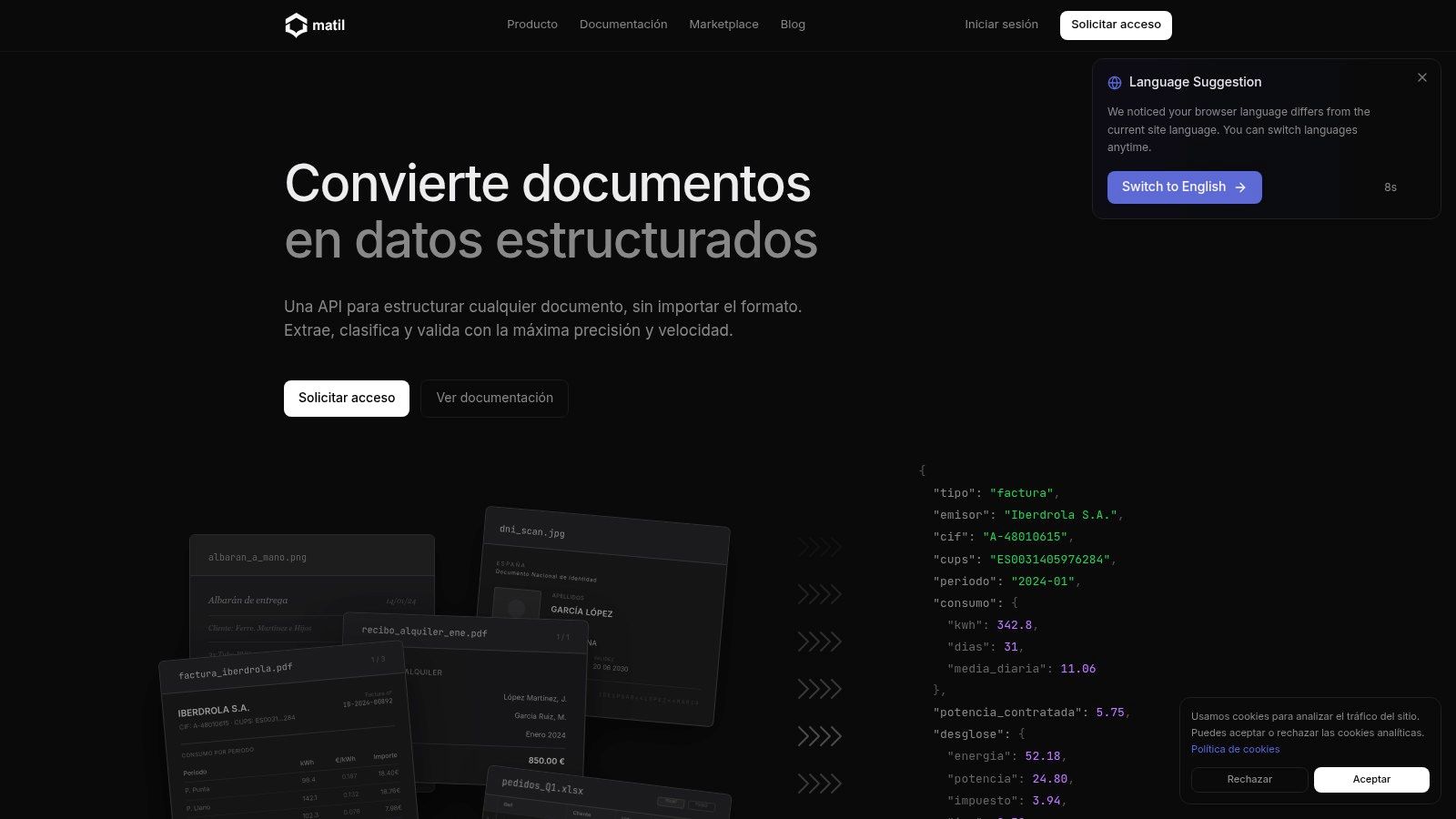
Matil.ai combines advanced OCR, classification, validation, and workflow orchestration through a single API endpoint. It processes PDFs, images, and multi-page documents, then returns structured JSON that downstream systems can consume. The approach isn't limited to reading characters. It identifies document types, maps fields to a defined data structure, validates values, and supports automated routing.
Separate the document from the evidence
A production workflow can follow this sequence:
- Receive the file. The customer sends an invoice, payslip, KYC document, or logistics file through the API.
- Classify and extract. OCR reads the content, while document models identify the relevant fields.
- Validate. Rules check formats, required values, totals, identifiers, and workflow conditions.
- Return structured output. The customer receives JSON and records the result in its own controlled system.
- Preserve a minimal trace. The application keeps status, schema, validation outcome, and request identifiers according to its own governance policy.
In this case, OCR documents differs from a complete document process. Traditional OCR may return text while leaving classification, field mapping, exception handling, and validation to separate systems. A combined pipeline is more useful when the objective is to extract data from PDF files automatically and send trusted fields into an ERP, CRM, case-management platform, or spreadsheet workflow.
Matil's described controls include precision above 99% in multiple use cases, with source details available in the publisher information supplied for this article. Its pre-trained document models cover electricity and gas bills with CUPS codes, delivery notes with SKU quantities, payslips, identity documents for KYC, bank statements, receipts, insurance policies, Bills of Lading, customs declarations, and ocean freight rates. Custom structures and validations can be adapted to specific document types without long training cycles.
The platform also states that it supports GDPR, ISO 27001, AICPA SOC standards, and zero data retention. Those claims still need to be assessed against the buyer's contract, route, data-flow review, and internal logging design. No vendor policy can control a customer's own storage layer.
The difference between content retention and workflow evidence is covered in more detail in this guide to document traceability. A trace can prove that a file was classified, a field was validated, and an exception was routed without preserving the source content at the extraction provider.
The following video gives additional product context for teams evaluating document extraction workflows.
Questions to Ask Before Signing Any ZDR Contract
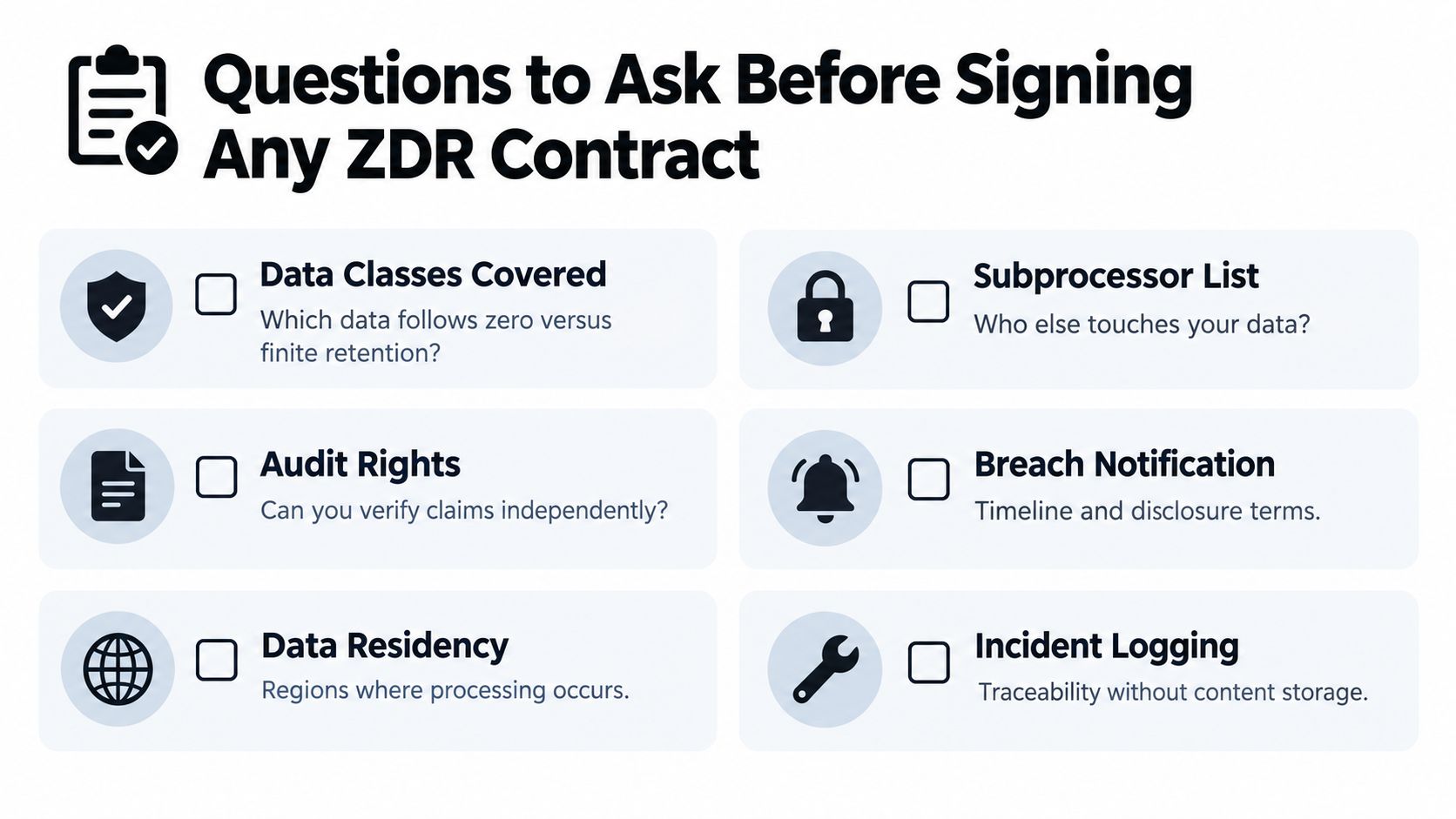
A ZDR contract should answer operational questions, not just repeat a privacy slogan. Buyers need to know whether the promise applies to uploaded files, prompts, outputs, logs, caches, support tools, batch jobs, and connected services.
Use this procurement checklist
- Data classes covered: Does ZDR include raw documents, extracted text, prompts, outputs, logs, metadata, caches, safety signals, and derived artifacts?
- Endpoint eligibility: Is the policy enforced per organization, project, model, route, or capability? What happens when a request falls outside the eligible set?
- Subprocessors: Which companies, regions, OCR services, tools, and support teams can receive the data?
- Retention exceptions: Can the provider retain content for abuse prevention, legal review, safety investigations, debugging, or incident response?
- Customer logging: Does the contract distinguish provider storage from the logs and databases operated by your organization?
- Verification rights: Can you inspect audit records, deletion evidence, access history, and current endpoint policy?
A useful contract also explains how the provider treats metadata. “No prompts stored” doesn't necessarily mean no request identifiers, timestamps, model information, or operational signals are retained. Ask how long each field remains available and whether personnel can associate it with a customer request.
For broader third-party risk controls, teams can use these vendor management best practices as a starting point. The same discipline applies to an AI extraction provider, an OCR subcontractor, and an incident-monitoring service.
Ask the vendor to demonstrate the route with a test payload. A written promise and an executable control are not the same thing.
Building a ZDR Strategy That Scales Across Your Organization
Different departments will ask for different safeguards. Compliance may require no provider-side content retention. Operations may need evidence when a document fails validation. Engineering may want logs for troubleshooting. The solution is not to make one policy serve every workflow. It is to separate sensitive content, operational metadata, and customer-controlled evidence.
Start with the workflows where the exposure is hardest to justify:
- KYC and identity documents: Route only to verified ZDR-capable processing and retain approved customer records in the system of record.
- Legal and payroll documents: Minimize fields, restrict access, and avoid content-rich application logs.
- Invoices and receipts: Preserve accounting outputs and validation results while applying the organization's document schedule to originals.
- Logistics files: Keep shipment and customs data needed for operations without assuming the AI provider should retain the source document.
Then formalize the control. Assign an owner for endpoint eligibility, review vendor changes, test fallback behavior, and document what happens when a route is unavailable. A ZDR setting that falls back to a retaining endpoint without warning is not a reliable control.
Production teams should also define an incident model. If the provider retains no content, the customer needs enough internal metadata to identify the request, reproduce the workflow with approved test data, and investigate failures without recreating sensitive documents in unapproved tools. That balance is the practical meaning of traceability without content storage.
Zero data retention AI isn't a one-time procurement checkbox. It is a continuing governance practice that connects API routing, storage controls, contract terms, application logging, and compliance evidence. Document extraction platforms such as Matil can fit that model when buyers verify the exact retention scope and design their own surrounding systems accordingly.
Matil offers API-based document extraction that combines OCR, classification, validation, workflow orchestration, structured JSON output, and a zero data retention option for enterprise document workflows. If you're evaluating secure automation for invoices, KYC files, payslips, or logistics documents, Matil is a practical solution to assess alongside its contract and technical controls.


