Account Number Validation: A Complete 2026 Guide
Learn account number validation best practices for OCR pipelines. Improve accuracy and reduce errors with this practical 2026 guide.

You approve a supplier invoice, the OCR has captured the account number, and the checksum passes. The payment still fails, or worse, reaches an account controlled by the wrong party. Account number validation is only useful when it connects document extraction, structural checks, operational verification, and payment authorization.
The Hidden Cost of Invalid Account Numbers
Manual invoice processing creates a measurable burden before a payment is even released. Ardent Partners' 2025 State of ePayables data, summarized by FinTask's manual data-entry research, puts the average all-inclusive processing cost at $9.84 per invoice. Best-in-Class organizations process an invoice for approximately $2.65, while other organizations average $12.42.
Exceptions consume even more attention. The same source reports that 18.4% of invoices require human intervention, and supplier-related exception handling uses 21.9% of AP staff time. Those figures make account number validation a financial-control problem, not just a developer task. Every rejected payment creates investigation work, supplier communication, reconciliation effort, and pressure to bypass controls.
OCR introduces a different failure mode from manual typing. The characters may be recognized correctly while the system assigns the number to the wrong field, merges it with nearby text, misreads a decimal separator, or extracts an account from the wrong document in a mixed batch. A checksum can then validate the wrong value perfectly.
Why a regular expression isn't enough
A regular expression can confirm that a string contains permitted characters and appears to have a plausible length. It can't determine whether the country uses that length, whether the bank identifier is in the correct position, or whether the account is open and able to receive funds.
Invoice extraction has the same distinction. A vendor-agnostic academic framework evaluated heterogeneous invoices and reported 94.3% character accuracy, 91.2% field-extraction accuracy, and an 88.5% validation-success rate, as documented in this academic invoice-processing framework. Character recognition alone isn't enough when a field is mapped incorrectly or arithmetic relationships fail.
Practical rule: Treat a checksum as a rejection filter, not an approval decision.
A safer pipeline normalizes the extracted value, identifies the country or domestic scheme, applies the exact format rules, calculates the checksum, and then checks authoritative records where available. It should also preserve the original OCR text, normalized value, extraction confidence, validation result, and review decision.
For cross-border workflows, the surrounding payment design matters too. Teams building an end-to-end process can use this payments API integration guide to think through payment initiation, data handling, and control points beyond the account field itself.
Understanding Validation Algorithms and Formats
Account number validation works best when the algorithm matches the payment scheme. IBAN, United States routing numbers, and domestic BBAN or sort-code formats don't share one universal rule.
IBAN and MOD-97-10
ISO 13616:1997 established the common IBAN structure in September 1997. An IBAN combines a country code, two check digits, and the relevant national bank and account identifier, rather than replacing every domestic numbering system with one global format. ISO describes IBAN as a universally agreed account-identification method used in almost 100 countries and territories in its ISO 13616 standard information.
A practical IBAN validation sequence is:
- Remove spaces and standardize case.
- Confirm the two-letter country code.
- Enforce the country's exact length and BBAN structure.
- Move the first four characters to the end.
- Convert letters to numbers using A=10 through Z=35.
- Calculate the decimal string modulo 97.
The result is valid only when the remainder is 1. The method catches many single-character errors and transpositions, but it doesn't prove that the account exists, belongs to the beneficiary, or can receive the intended payment.
The implementation detail matters. An IBAN can contain up to 34 characters, and its expanded numeric representation can exceed native integer limits. Use streaming remainder arithmetic instead of converting the entire value into one integer. The ISO 13616 implementation documentation describes the calculation approach and supports preserving intermediate validation data for auditability.
United States routing numbers
The United States uses a different foundational identifier, the nine-digit ABA routing number, to direct ACH and other payments to a financial institution. Its checksum uses repeating weights of 3, 7, and 1 across the positions. The first eight digits are weighted, the products are summed with the ninth digit, and the total must be divisible by 10.
The first two digits also identify a Federal Reserve routing range. Ranges 01–12 correspond to the twelve Federal Reserve Banks from Boston through San Francisco. A checksum failure rejects many transcription errors, but a passing checksum doesn't prove that the account is active or belongs to the intended customer.
Teams can verify routing numbers against the Federal Reserve's official E-Payments Routing Directory. That directory check is separate from checksum validation, which is precisely why production workflows need more than one gate.
BBAN and domestic schemes
A BBAN is the national bank account component inside an IBAN. Domestic schemes may use bank identifiers, branch identifiers, account digits, and local check rules. Sort codes are an example of a domestic bank-and-branch identifier used in the United Kingdom, but the exact validation logic depends on the relevant scheme and account type.
Don't apply an IBAN rule to a domestic number, and don't assume that a plausible string is valid because it matches a regular expression. For field-level controls that connect extracted values with type, format, and business rules, see field-level validation in document workflows.
From Checksum to Ownership, A Multi-Layered Approach
A payment can pass every format and checksum rule, then still fail at the point that matters. The account may be closed, restricted, unsupported for the payment type, or held by someone other than the named beneficiary. In production, that gap between syntactic validity and operational validity is where expensive errors survive.
The safest design is layered. Start with cheap deterministic checks, then spend time and API calls only where the earlier signals justify it. That matters even more in OCR-driven flows, where a visually plausible account number can come from low-confidence extraction, character substitution, or a mislabeled field.
- Normalize and classify. Remove presentation characters, standardize case, and identify the payment country or domestic scheme.
- Validate structure. Check permitted characters, exact length, bank and branch positions, and BBAN composition.
- Run the scheme algorithm. Apply MOD-97-10 for IBAN or the relevant domestic checksum.
- Verify institutional data. Compare bank and branch identifiers with an authoritative directory where available.
- Match the beneficiary. Use account-status, ownership, or Verification of Payee evidence when permitted and appropriate.
- Route uncertainty. Send mismatches, unavailable responses, low-confidence extraction, and unresolved name variations to review.
Validation depth decision matrix
| Validation Level | Mechanism | Detects | Limitation |
|---|---|---|---|
| Basic structural validation | Character, length, country, and scheme-format checks | Malformed or misclassified values | Doesn't prove mathematical validity or account existence |
| Checksum validation | MOD-97-10 or a domestic checksum | Many transcription and keying errors | Doesn't prove ownership, activity, or beneficiary identity |
| Directory verification | Authoritative bank or branch directory | Unsupported or inactive institutional identifiers where directory data covers them | Directory coverage and response availability vary |
| Beneficiary verification | Name and account matching, including Verification of Payee where available | Some beneficiary mismatches and payment redirection risks | Legal names, trading names, transliteration, and unavailable responses create ambiguity |
Binary accept or reject logic creates avoidable failures. A legitimate supplier may appear under a legal entity name, abbreviation, trading name, transliteration, or joint-account convention that does not exactly match the invoice. Treat a mismatch as a workflow state, not as proof of fraud.
The practical question is not whether the checksum passed. It is whether the extracted value is reliable enough to authorize money movement without human review. If OCR confidence is weak, a name match failure should carry more weight. If OCR confidence is strong but ownership evidence is missing, the system should hold the payment for a narrower review focused on beneficiary controls.
Verification of Payee requirements are expanding across Europe, as reflected in IBAN.com's coverage of Verification of Payee developments. The operational lesson is straightforward. Account-number validation belongs inside a beneficiary-control process that combines extraction quality, scheme validation, directory checks, and payee matching before release.
For teams handling public funding or regulated financial operations, the same control logic should govern rejection paths, exception queues, and audit trails. Guidance on how to protect CEF operations with validation is useful when setting those rules around sensitive records.
Implementing Validation in OCR Workflows
An OCR pipeline should never treat the printed account number as the final system value. Store the raw text, its location, the normalized candidate, extraction confidence, detected scheme, checksum remainder, directory result, and final status as separate fields.

A practical pipeline
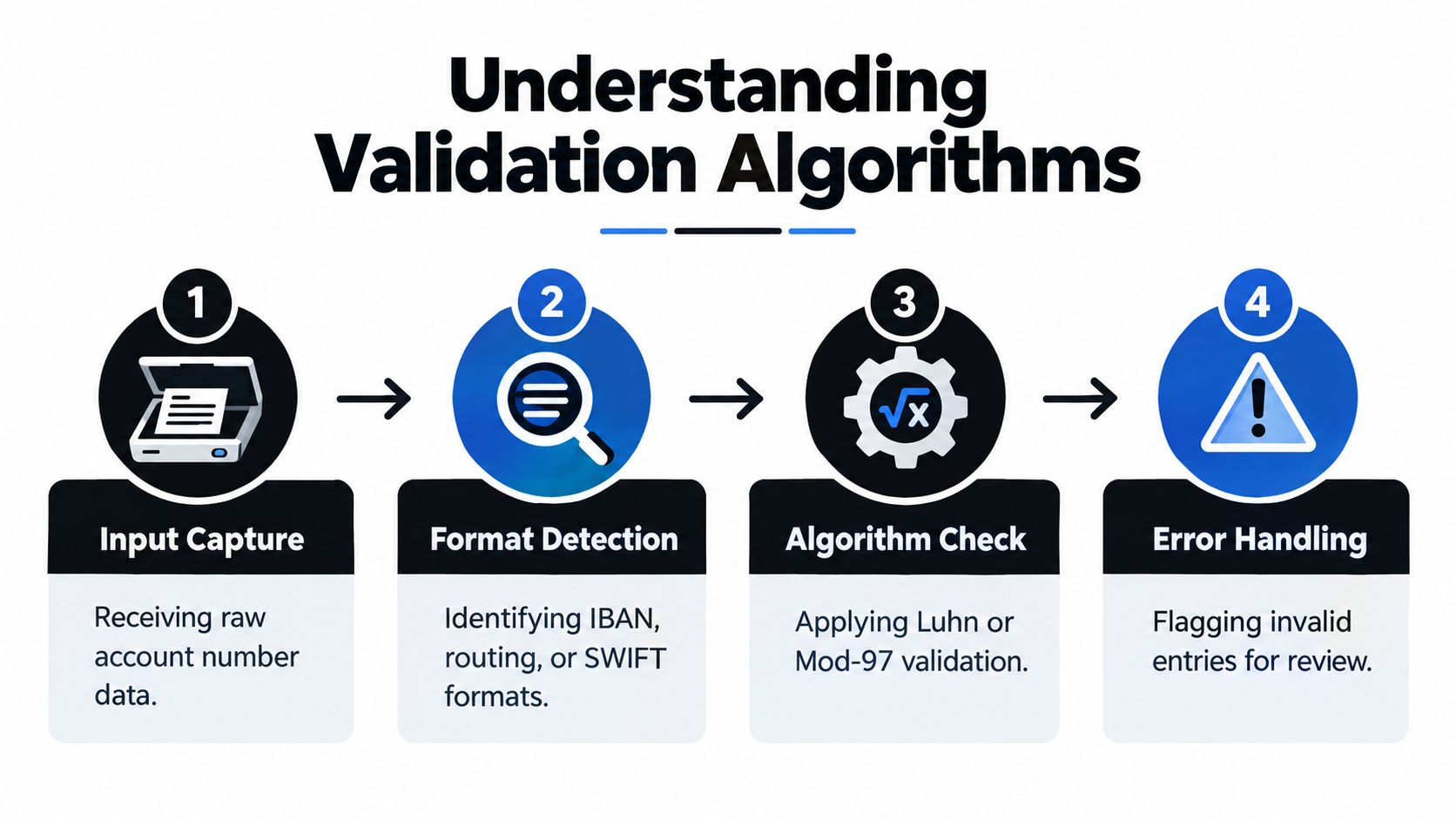
Step 1, capture raw evidence. Extract the account number together with the page, bounding box, document identifier, and surrounding label. “Beneficiary account,” “IBAN,” and “routing number” provide useful semantic context, especially when documents contain several financial identifiers.
Step 2, normalize without destroying provenance. Remove spaces from IBAN candidates and standardize alphabetic characters to uppercase. Keep the original OCR string unchanged, because an auditor or reviewer must be able to compare the system value with the source document.
Step 3, classify the payment scheme. Use the country code and document context to select the relevant validator. Don't infer a universal length. ISO 13616 requires country-specific formats, so the parser must load the exact country rule before it checks the BBAN.
Step 4, reject illegal values early. Flag unexpected punctuation, ambiguous characters, impossible lengths, and unsupported countries before performing arithmetic. Early rejection keeps malformed data out of downstream systems and makes error reporting easier to understand.
Step 5, calculate with streaming arithmetic. For IBAN, move the first four characters, convert letters with A=10 through Z=35, and process the resulting digits incrementally. At each stage, retain only the current remainder. This avoids fixed-width integer overflow while producing the same MOD-97-10 result.
Step 6, separate outcomes. “Checksum passed” should be one field, not the final status. A useful status model distinguishes structurally invalid, checksum valid, directory verified, beneficiary matched, unavailable, inconclusive, and manual review.
Handling OCR uncertainty
A checksum can pass even when OCR selected the wrong account from a document or mapped a valid account to the wrong supplier. Combine the checksum with extraction confidence, field position, nearby labels, supplier identity, and historical change detection.
Low confidence plus a passing checksum should be inconclusive, not approved. The record belongs in a review queue where a user can compare the source image, extracted value, beneficiary name, and prior approved details. If a bank response is unavailable, preserve that response state instead of converting it into “invalid.”
Review queues should explain the reason for escalation. “Checksum passed, beneficiary match unavailable” is actionable. “Validation failed” is not.
Regression tests should cover country-specific lengths, illegal characters, transpositions, OCR substitutions, edge-case check digits, and special calculation conditions. The ISO implementation material notes special handling for check-digit values and identifies values such as 00 and 01 as invalid in the relevant calculation context.
A video walkthrough can help technical teams visualize how extraction, normalization, and review states fit together:
Integrating Matil.ai for Automated Extraction
A custom validation engine gives you control, but it also leaves your team responsible for document classification, OCR quality, schema management, exception routing, and audit storage. The practical alternative is an intelligent document-processing layer that combines those functions while keeping payment-specific controls explicit.
Matil.ai combines OCR, classification, validation, and workflow automation through an API. It supports pre-trained document models for invoices, payslips, identity documents, bank statements, receipts, delivery notes, Bills of Lading, and customs declarations. Teams can also define custom structures and validation rules, including checks against expected formats, business rules, or records in another system.
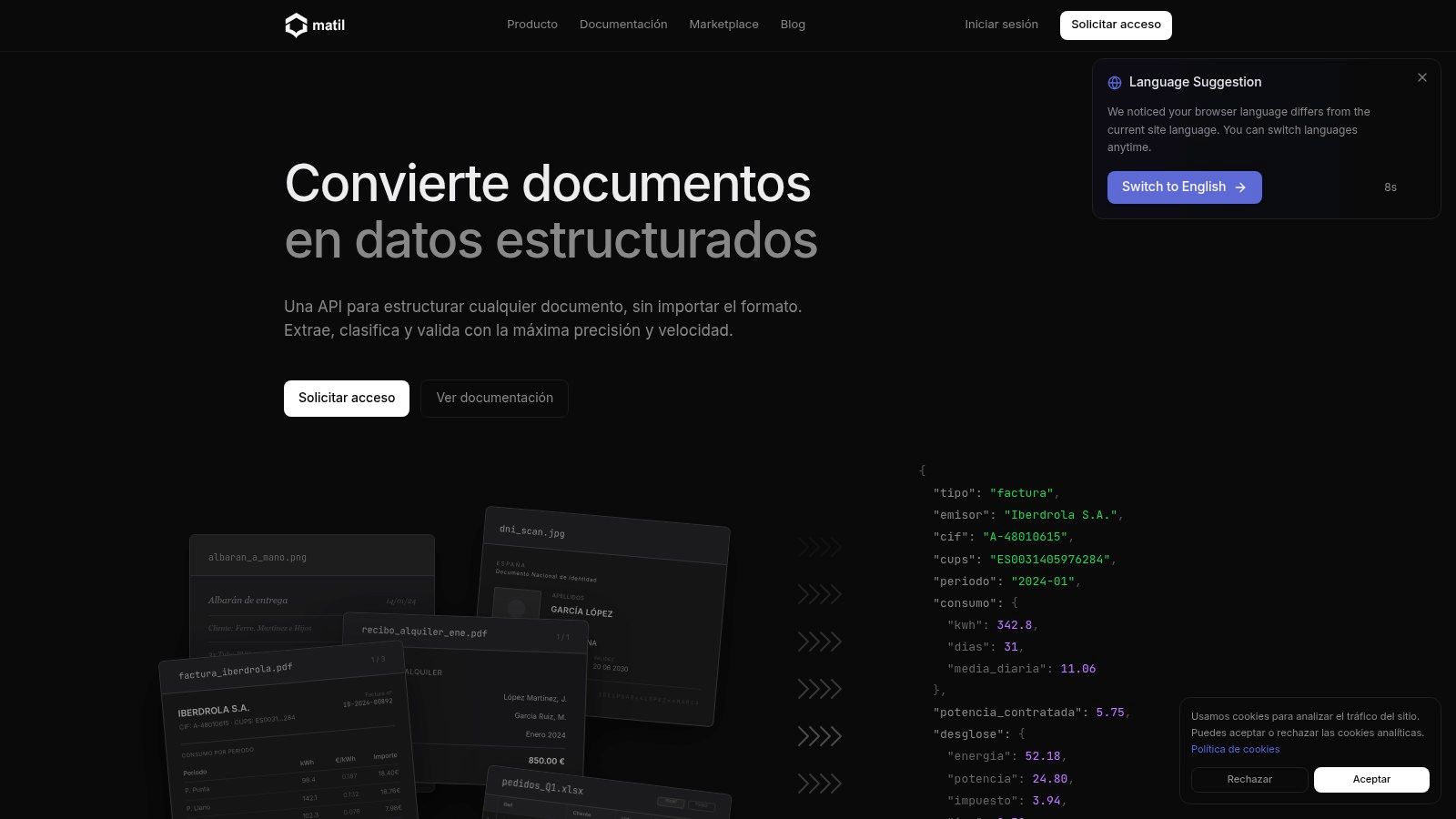
The important distinction is that Matil.ai isn't only OCR. Its document workflow connects extraction confidence with field validation, classification, PDF splitting, and downstream orchestration. The platform states accuracy above 99% in multiple use cases, alongside models that can be customized quickly rather than requiring long training cycles.
For account data, the output should include both the extracted identifier and the evidence needed to decide what happens next. Preserve the original OCR text, normalized account number, country-specific parsing result, checksum result, directory response, and review status. That traceability helps finance teams distinguish an extraction error from a legitimate account change.
This approach also applies beyond invoices. A team processing bank statements can use a structured bank statement checker workflow to connect account identifiers with transaction and document context instead of treating each number as an isolated string.
Matil.ai offers an API and no-code options, with security controls including GDPR, ISO 27001, AICPA SOC, and zero data retention. Those controls don't replace your own beneficiary-approval policy, but they can reduce the amount of infrastructure your team must assemble before document validation becomes operational.
Compliance and Future-Proofing Your Pipeline
A payment can pass format checks, survive OCR normalization, and still be the wrong destination. That is the compliance gap that causes the most expensive errors. Rules keep shifting, bank lookup services are not always available, beneficiary names arrive with abbreviations or transliteration differences, and providers are increasingly expected to verify more than whether an account number looks valid.
The EU's Verification of Payee requirements make that shift clear. From 9 October 2025, payment-service providers must support beneficiary-name matching with the IBAN for instant payments. Your pipeline should therefore treat exact match, close match, no match, unavailable, and inconclusive as separate operational states, each with its own release rule.
Store the full decision trail. Keep the request, response, timestamp, source system, match result, reviewer action, and final payment decision. Without that record, it is hard to explain why a transfer was released when the checksum passed but the payee signal was weak or missing.
Identity and document assurance
Account data rarely arrives alone. It often sits next to KYC files, tax IDs, contracts, and logistics paperwork. Under the European Commission's eIDAS overview, electronic identification, authentication, and trust services are part of a common EU framework, with recognition across the 27 EU Member States under the conditions set by the regulation.
That matters in production. Extracting a name or registration number from a document is one control. Proving who signed, submitted, or owns that document is a different control. Keep extracted fields, OCR confidence, identity-assurance method, verification result, and audit evidence as separate objects in your workflow. The same design choice improves tax ID validation in document workflows, where a clean extraction should not be treated as proof that the identifier is valid for the legal entity in the file.
Security also needs explicit design decisions. Set retention, access, encryption, incident handling, and deletion rules before financial documents leave your environment. A zero-data-retention option can fit teams that need document extraction but do not want source files stored beyond processing.


