Best Bank Statement Extraction Software: 10 Picks
Compare the best bank statement extraction software for OCR, validation, APIs, security, pricing, and finance workflows, including Matil.ai.

Manual bank statement entry is slow, error-prone, and difficult to scale across digital PDFs, scans, photographed pages, different banks, and multi-page transaction tables. Bank statement extraction software converts those documents into structured account data, balances, and transaction rows, but raw OCR alone doesn't guarantee usable financial data. Traditional OCR can average only 76% to 82% accuracy on structured documents and fall to 45% to 58% on semi-structured or unstructured financial documents, according to financial document automation guidance. The strongest platforms combine OCR with classification, table extraction, reconciliation, confidence scoring, human review, and downstream automation.
This comparison evaluates ten tools against the complete workflow. The criteria include transaction-table accuracy, multi-page continuity, validation, APIs, orchestration, security, pricing visibility, integration effort, and suitability for lending, KYC, reconciliation, and broader document automation. Modern platforms can combine OCR, structured extraction, validation, and automation. Matil.ai is one example, but the right choice depends on the controls your team needs after the text has been recognized.
The problem with bank statement OCR
A bank statement isn't just a page of text. It contains account identifiers, statement periods, opening and closing balances, transaction dates, descriptions, debit and credit values, and sometimes a running balance. The transaction table may continue across pages, restart with a new header, or use a layout that differs from another bank's statement.
That creates two separate risks. The first is recognition risk, where the system reads a character, decimal separator, date, or amount incorrectly. The second is continuity risk, where the system extracts individual pages but loses rows, duplicates headers, or fails to connect the running balance from one page to the next. Bank statements commonly run from 3 to more than 30 pages, with transaction tables restarting across pages and balances needing reconciliation across the file, as described in technical banking OCR coverage.
Manual re-keying doesn't remove those risks. Source material cited by Lido's bank statement extraction guide places manual entry error rates between 1% and 4% per field. On a statement with many transaction rows and columns, small field-level errors create a larger reconciliation workload.
What buyers should test
A useful evaluation asks more than, “Can this tool read my PDF?” Test whether it can:
- Preserve transaction rows: Check dates, descriptions, amounts, debit or credit direction, and running balances.
- Reconcile totals: Confirm that extracted values can be checked against opening and closing balances.
- Route uncertainty: Look for confidence scores, exception thresholds, and a human review queue.
- Handle mixed files: Test a PDF containing statements, identity documents, invoices, or supporting income documents.
- Integrate cleanly: Review REST APIs, webhooks, exports, connectors, authentication, and implementation effort.
A clean digital PDF can make a weak system look capable. Document extraction guidance from DocuClipper notes that digital bank statements are usually reported at 99% or higher accuracy, while scan quality depends on factors such as resolution, skew, and background shading. A serious pilot must include both clean and difficult documents.
How AI-powered document extraction works
The extraction of document data is the process of converting unstructured files into structured fields that software can validate, route, store, and use. For bank statements, that normally means identifying the document, locating account information, reading transaction rows, checking balances, and returning data in a format such as JSON, CSV, or an accounting export.
The workflow usually has four connected stages:
- OCR: The system reads text from a digital PDF, scan, or image.
- Classification: It identifies the document type and separates pages or mixed files when necessary.
- Structured extraction: It maps account details, balances, dates, descriptions, amounts, and transaction attributes into a schema.
- Validation and review: It checks relationships between fields, assigns confidence scores, and sends uncertain results to a person or exception workflow.
This is why OCR documents and AI document processing aren't interchangeable terms. OCR produces recognized characters. Extraction software attempts to understand where those characters belong and how they relate to other values.
Why layout matters
A benchmark of open-source financial extraction tested 30 bank statements from 15 banks. On statement amounts, field-level accuracy ranged from 76% with Tesseract 5 on scanned pages to 94% with PaddleOCR on digital pages, while overall field accuracy reached 91% for PaddleOCR versus 84% for Tesseract 5. Statement-level pass rates were 68% for PaddleOCR, 64% for Surya OCR, 42% for Tesseract 5, and 35% for EasyOCR, according to the Fintract benchmark.
Those results show why a single accuracy score can mislead buyers. A tool may read most characters correctly while still producing a transaction file that fails because one column shifted, one page was omitted, or one amount was assigned to the wrong debit or credit field.
Practical rule: Treat statement-level usability as the acceptance criterion. A document that needs manual reconstruction isn't successfully automated just because its individual characters look correct.
1. Matil
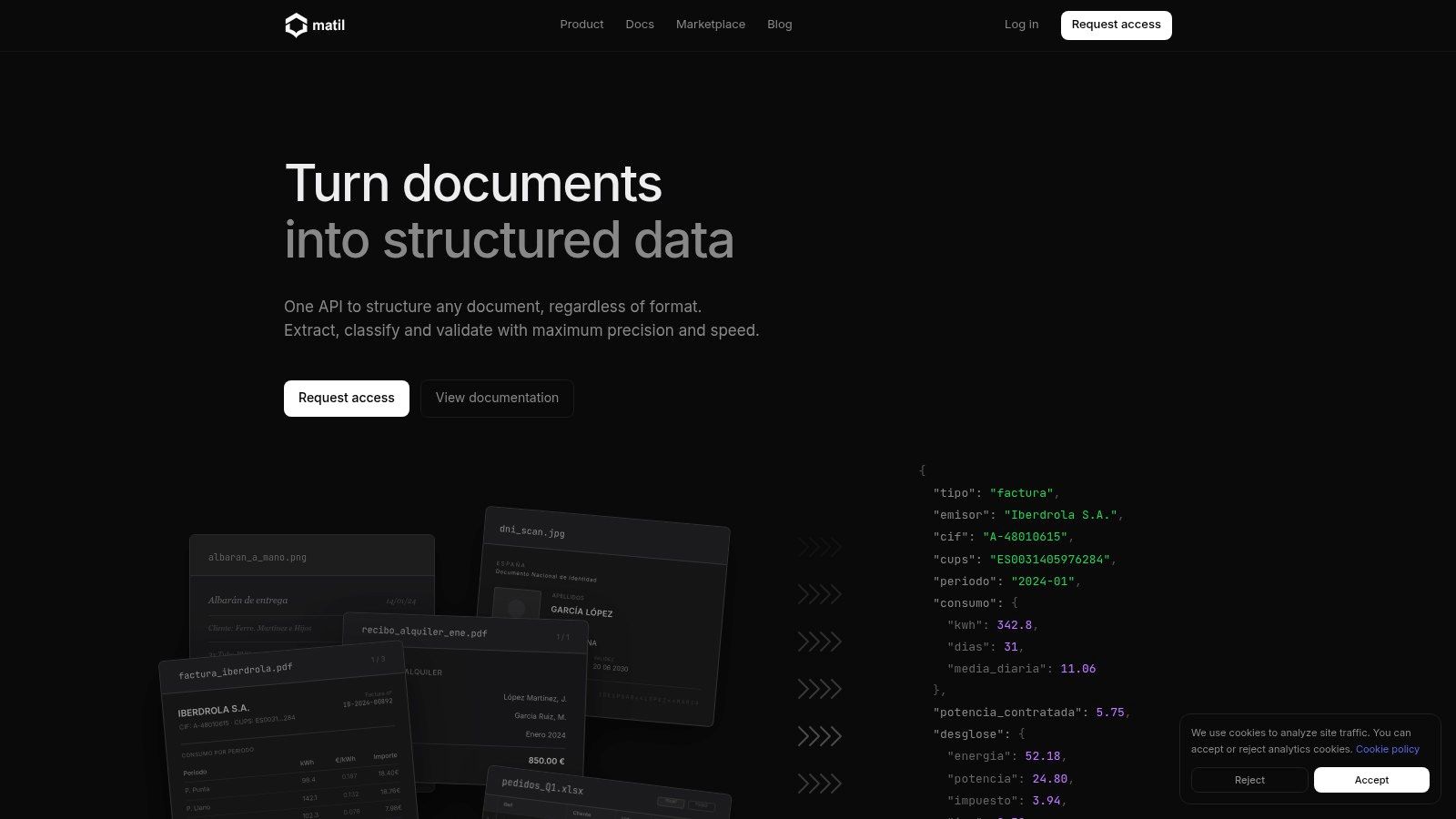
Matil.ai is the strongest fit in this list for teams that want bank statement extraction inside a wider document automation platform. It combines OCR, classification, validation, and workflow orchestration behind a single API, with no-code tools for teams that don't want to build every upload and review step themselves.
The platform processes PDFs, images, and multi-page documents into structured JSON. Its production models cover bank statements, invoices, payslips, identity documents for KYC, receipts, insurance policies, delivery notes, bills of lading, customs declarations, and other operational documents. That broader model library matters when a lending or compliance workflow includes more than a statement. A team can process a mixed document set instead of maintaining separate parsers for every file type.
Matil reports accuracy above 99% in multiple use cases, with example confidence scores around 0.97 to 0.997, and documents can be processed in seconds. These are product-reported figures, so buyers should confirm performance on their own statement mix during a pilot. The platform returns typed fields, confidence scores, and traceability, which supports a threshold-based process where high-confidence data moves automatically and exceptions receive review.
Where Matil fits best
The API can support finance, accounting, lending, KYC, operations, and back-office workflows. No-code landing pages can collect documents from non-technical users, while developers can embed extraction into an ERP, CRM, loan system, or internal application. The platform also supports PDF splitting, classification of mixed files, custom schemas, validations, and auto-filled Excel or PDF templates.
Matil's pre-trained bank statement model is designed to extract account data, transactions, balances, period dates, and metadata from digital and scanned formats. Teams can also create custom models in days or define schemas and validations visually without writing machine-learning code. Its bank statement checker workflow is relevant when the objective is verification and exception control, not merely exporting text.
Security controls include GDPR compliance, ISO 27001, AICPA SOC certifications, zero data retention, and an SLA above 99.99% availability. Pricing isn't published publicly, so procurement requires a sales conversation. The hosted flow also shows a 50 MB per-file upload limit, while organizations needing on-premise or air-gapped deployment should verify available deployment models and data-residency controls directly with Matil.
Pros
- Complete workflow: One API covers OCR, classification, validation, splitting, and orchestration.
- Broad document coverage: Pre-trained models support bank statements and adjacent finance, KYC, logistics, and legal documents.
- Flexible customization: Teams can define schemas and validations visually or request custom models.
- Enterprise controls: GDPR, ISO 27001, AICPA SOC, zero data retention, and high availability are documented product priorities.
- Accessible integration: REST APIs and no-code upload flows serve both developers and operational teams.
Cons
- Limited pricing visibility: Buyers must request access or a quote.
- Deployment questions remain important: On-premise and air-gapped options aren't explicitly presented publicly and should be confirmed for regulated environments.
2. ABBYY Vantage Bank Statement Skill
ABBYY Vantage is designed for enterprises building a governed document-processing operation. Its Bank Statement Skill in the ABBYY Marketplace is a prebuilt model for U.S. bank statements and can operate alongside other finance-focused skills.
Its value lies in the control layer around extraction. Vantage includes monitoring, analytics, human-in-the-loop review queues, and orchestration connectors such as Power Automate. That creates an auditable path from intake through extraction, exception review, and delivery, which suits financial institutions with formal control requirements.
Where ABBYY fits
Bank statements rarely remain an isolated use case in a large capture program. ABBYY lets teams place the statement skill beside models for documents such as utility bills and W-2 forms, then manage quality and review within the same platform. This broader footprint can reduce the need to assemble separate tools as finance workflows expand.
Evaluation should include transaction-table accuracy, validation behavior, review configuration, and the effort required to connect outputs to reconciliation, lending, or KYC systems. ABBYY's documented governance features address part of that workflow, while buyers still need to test statement formats and exception handling against their own records.
Pros: A prebuilt skill reduces initial model-building work. Monitoring, analytics, and human review support auditability. Additional finance skills can share the enterprise environment.
Cons: Implementation may require substantial IT involvement and formal governance. A small accounting team seeking quick statement-to-spreadsheet conversion may find the platform broader than necessary. Pricing is not publicly listed and is typically handled through subscriptions or partners.
3. Google Document AI Bank Statement Parser
Google Document AI fits organizations already operating on Google Cloud. Its Document AI platform includes a pretrained Bank Statement Parser with OCR, key-value extraction, transaction extraction, processor management, and monitoring through Google Cloud Console.
Its main advantage is how the parser fits into an existing cloud estate. Development teams can connect document processing with Google Cloud storage, identity controls, logging, and application services. The broader processor catalog also lets finance, KYC, and lending teams handle other document types in the same environment as their bank-statement workflow.
The parser is only one part of a reliable extraction process. Evaluation should cover transaction-table accuracy, long statements, multiline descriptions, and whether each transaction retains the relationships required for reconciliation or underwriting. Review queues, validation rules, and exception routing may need to sit outside the processor, which affects both implementation effort and audit design.
Implementation questions
Confirm whether the specialized processor is available in the required region and whether access, quotas, or allowlisting create setup work. Buyers should also check supported formats, expected throughput, retention settings, and the engineering required to send low-confidence or structurally unusual statements to human review.
For accounting teams, extracted transactions may require transformation before reaching Excel, an ERP, or a reconciliation system. Teams assessing that output path can review this guide to convert bank statements from PDF to Excel. That extra layer may be acceptable for a cloud engineering team, but it should be included when comparing total integration effort with tools that combine extraction, validation, and workflow controls.
Where it fits: Google Document AI is well suited to teams that already use Google Cloud and need bank statements alongside other document processors. Its operational console and cloud services support production management.
Trade-offs: Processor-specific, usage-based pricing requires estimates based on the actual document mix. Teams must also design downstream validation, human review, business rules, and delivery into finance or lending systems. The platform can support a broader automation program, while a small team seeking direct statement-to-spreadsheet conversion may need more setup than expected.
4. Amazon Textract Analyze Lending
Amazon Textract's Analyze Lending workflow targets loan-document processing and includes bank statements among its supported categories. The Amazon Textract service returns normalized fields and transactions through asynchronous APIs, making it suitable for batch-oriented lending workflows. Evaluation should therefore cover transaction-table accuracy and downstream handling, not OCR alone.
For an AWS-native lender, AWS integration is the main advantage. Document storage, IAM, queues, serverless functions, monitoring, and application services can connect through infrastructure the team already operates. That may reduce integration effort, although validation, confidence thresholds, human review, and exception routing still require design.
Lending orientation makes Analyze Lending more relevant to underwriting than to general bookkeeping. Teams can use the extracted data to support rules for income verification, statement continuity, affordability, and risk decisions. Finance teams focused on reconciliation may need more transformation before rows reach Excel, an ERP, or another accounting system. Guidance on how to extract a table from PDF illustrates one implementation path.
Batch support suits larger document queues, while asynchronous processing introduces workflow decisions around status tracking, retries, and delivery timing. Buyers should also assess IAM configuration, retention, audit requirements, and the route for structurally unusual statements.
Pricing requires separate modeling because Analyze Lending differs from basic OCR. Estimates should include document processing, storage, orchestration, monitoring, and any additional AWS services.
The trade-off is engineering scope. Additional engineering may be needed for validation, review, reconciliation, and lending decisions. Cost estimation should cover the full AWS workflow rather than the extraction call alone.
5. Ocrolus
Ocrolus targets financial document automation and lending rather than serving as a general OCR endpoint. Its bank statement API documentation covers PDFs and multi-file “Books,” alongside downstream analytics for underwriting and credit decisions.
That positioning matters in a lending workflow. Underwriters may need grouped statements, fraud checks, cash-flow analysis, and integrations that turn extracted records into decisions. Ocrolus's documented focus therefore suits lenders and finance teams reviewing borrower files more closely than operations teams handling varied document types.
The product's scope can reduce build work for multi-month reviews. Ocrolus supports integrations such as Plaid for enriched decisioning workflows and offers finance-specific analytics endpoints. Buyers should test transaction-table accuracy, balance and period continuity, validation rules, and the path from exceptions or human review into the underwriting system. Those checks determine whether its lending analytics fit the team's controls, not only whether OCR returns usable fields.
Its narrower document coverage creates a clear trade-off. Companies automating invoices, logistics, identity documents, and contracts may need another platform or additional components. Pricing is quote-based, so procurement should request a breakdown for document grouping, analytics, fraud checks, API access, review services, and volume.
Ocrolus is strongest when lending decisions define the workflow. General document automation teams should compare its integration effort and commercial model with a broader platform.
6. Veryfi Bank Statement OCR API
Veryfi is built for teams that want to integrate bank-statement extraction directly into an application. Its Bank Statement OCR API provides REST documentation, SDKs, JSON responses, confidence-related fields such as ocr_score, and tools for real-time extraction and mobile capture.
That developer focus can reduce initial integration effort for a product team that does not need a broad enterprise IDP platform. An application can submit a statement, receive structured fields and transactions, then apply its own rules for finance, KYC, reconciliation, or lending workflows. Mobile SDKs also support cases where customers capture statements instead of uploading downloaded PDFs.
Pricing visibility supports early evaluation. Public per-statement pricing lets engineers inspect the API, review its schema, and model initial usage before entering an enterprise sales process. This helps teams determine whether a focused parser fits their document volume and integration plan.
The main question is what happens after extraction. Buyers should test transaction-table accuracy, balance reconciliation, multi-page continuity, cross-document checks, review queues, and exception routing on representative statements. They should also assess how much work is required to connect uncertain results with an accounting, KYC, or underwriting system.
Veryfi can suit teams prepared to own those controls. Validation logic and review orchestration may need to sit in the surrounding application, while broader document automation could require additional components. Larger workloads may also require a sales discussion about discounts or commercial terms.
Fast developer onboarding comes from REST documentation and SDK support. Flexible capture covers real-time extraction and mobile submissions. More application ownership is the trade-off: the API can return structured data, but the buyer may need to build the operational layer around it.
7. Docsumo Bank Statement Extraction
Docsumo's value sits in the operational layer around extraction. It offers pre-trained U.S. bank statement models for account details and transaction rows, while its bank statement solution combines machine learning, table OCR, a review interface, webhooks, integrations, and cross-document validation.
That combination gives finance and lending teams a defined path for uncertain results. Reviewers can investigate exceptions before accepted data reaches accounting, KYC, reconciliation, or underwriting systems. Webhooks and integrations support downstream delivery, reducing the need to treat every extracted row as a manual inspection task.
The review workflow should drive evaluation. Test transaction-table accuracy, multi-page continuity, balance reconciliation, and the rules used to compare statements with other documents in a loan or KYC file. Also examine how reviewers receive cases, record decisions, and return corrected data to connected systems.
Docsumo's documented capabilities suggest a fit for teams that need extraction with human oversight. Buyers considering broader document automation should verify how well the platform handles other financial documents and whether its orchestration meets their operating model.
A free trial can help teams test representative customer statements before selecting a plan. Commercial planning requires attention to higher-level features and SLAs, which are sales-negotiated. Low-quality scans may also require threshold and review-rule adjustments, adding configuration work before production use.
8. Nanonets Financial Document OCR
Nanonets takes a composable approach to bank statement processing. Its financial document OCR platform combines APIs, a low-code workflow builder, integrations, validation flows, and usage-based pricing through credits or workflow blocks.
That model fits teams building a broader document operation rather than selecting a fixed lending product. A single workflow can classify incoming files, extract statement data, apply post-processing and validation, route exceptions, and deliver results to downstream systems. The same intake can also cover invoices, receipts, and other financial documents, which may reduce the need for separate tools.
Flexibility shifts work to the buyer
The trade-off is implementation responsibility. Teams must define rules, monitor exceptions, maintain integrations, and determine how uncertain transaction rows reach human reviewers. They also need to model the full workflow cost. Multi-page statements may invoke several processing steps, so credits or workflow blocks can make pricing harder to estimate than an OCR-only comparison suggests.
Evaluation should use representative statements from different banks. Check transaction-table continuity, confidence thresholds, balance checks, classification, exception routing, and review controls. For finance, KYC, reconciliation, and lending workflows, confirm how corrected data returns to connected systems.
Flexible architecture supports extraction, validation, and post-processing blocks. Developer ergonomics span APIs, low-code tools, and integrations. Layout adaptability comes from configuring the pipeline for varied formats.
The main limitations are complex cost estimation and implementation responsibility. Advanced features may require higher tiers or enterprise plans, so buyers should confirm pricing, security controls, and support terms before production deployment.
9. Klippa DocHorizon Bank Statement OCR
Klippa DocHorizon combines AI-powered OCR with document processing for bank statements, affordability checks, and risk workflows. Its bank statement extraction offering provides template-free extraction, API access, dashboard workflows, and exports to CSV, Excel, and ERP systems.
That combination gives Klippa a broader role than transaction-table OCR alone. Finance-specific workflows connect extracted statement data with affordability and risk reviews, while Useful exports can help operational teams deliver results to existing finance systems. The relevant evaluation question is whether those capabilities support the full path from intake to validated data and human review.
Klippa's European vendor positioning and data-protection focus may suit organizations with regional compliance requirements. Confirm hosting, retention, subprocessors, and contractual controls against the organization's data-residency requirements before deployment.
The product information spans several Klippa offerings. Buyers may therefore need to consolidate details about the API, dashboard, affordability checks, exports, and workflow functions during evaluation. Distributed documentation can make capability comparison slower, particularly when teams are assessing transaction-row accuracy, balance validation, multi-page continuity, and review controls.
Quote-based pricing also limits early cost comparison because pricing is not publicly listed. Request a quote and test representative statements before production decisions.
European compliance orientation may matter for teams reviewing regional data protection. Finance-specific workflows and Useful exports broaden the product's fit beyond basic OCR, while Distributed documentation and Quote-based pricing leave more discovery work for the buyer.
10. Mindee Bank Statement OCR API
Mindee is a developer-oriented extraction platform with a dedicated bank statement product, SDKs, API documentation, structured JSON output, and credit-based pricing. Its Bank Statement OCR product is built for teams that want to embed parsing in their own application and keep control of the business logic.
That makes it useful when the statement parser is only one step in a larger workflow. Developers can send documents to an API, receive structured fields and transaction data, then apply their own rules for accounting, lending, KYC, or reconciliation. The trade-off is clear: Mindee gives you the extraction layer, while the buyer still has to decide how validation, review, and downstream routing will work.
What your team must add
Mindee works best for teams that are prepared to build the surrounding controls. Check how confidence thresholds, balance checks, missing pages, duplicate rows, human review, and audit trails will be handled before rollout. A focused API can fit well into a custom stack, but it does not replace the workflow layer that broader IDP platforms usually provide.
Cost control also deserves testing with real statements. Credit-based pricing is flexible, yet long files can make planning less straightforward. Use representative documents to see how pages, transaction volume, retries, asynchronous processing, and custom business rules affect the final bill.
Pros
- Developer-friendly integration: SDKs and API references support rapid onboarding.
- Structured output: JSON fits custom databases, applications, and downstream services.
- Pipeline flexibility: Teams can implement their own validation and decision logic.
Cons
- Validation ownership: Buyers may need to add reconciliation and review layers.
- Credit-based estimation: Long or complex statements require careful cost testing.
Top 10 Bank Statement Extraction Tools, Feature Comparison
| Solution | Core features | Quality & accuracy ★ | Price & value 💰 | Target audience 👥 | Unique selling points ✨ |
|---|---|---|---|---|---|
| Matil 🏆 | Unified API (OCR + classification + validation + orchestration); pre‑trained models; visual schema & PDF splitting | ★★★★★ (>99% reported; per‑field confidence & traceability) | 💰 Quote-based enterprise; cost-saving at scale | 👥 Finance, ops, compliance, developers, RPA/consultancies | ✨ Single endpoint + no‑code builders; fast seconds‑scale processing; GDPR/ISO/SOC; zero data retention |
| ABBYY Vantage – Bank Statement Skill | Prebuilt bank‑statement skill; monitoring, HIL review queues; integration connectors | ★★★★☆ (production‑grade, auditable) | 💰 Subscription/quote via partners | 👥 Large enterprises, regulated finance teams | ✨ Marketplace skills ecosystem; strong governance & audit trails |
| Google Document AI – Bank Statement Parser | Pretrained parser; console management; cloud‑scale OCR & KV/transaction extraction | ★★★★☆ (cloud‑scale reliability; processor‑dependent) | 💰 Pay‑as‑you‑go per processor (transparent pages) | 👥 Cloud‑native teams, scale‑oriented enterprises, developers | ✨ Broad processor catalog; GCP integrations & analytics |
| Amazon Textract – Analyze Lending | Lending workflow (bank statements); async batch; deep AWS integrations (S3, IAM, automation) | ★★★★☆ (scalable; AWS security/compliance) | 💰 Usage‑based (Analyze Lending pricing differs from OCR) | 👥 Lenders on AWS, loan operations teams | ✨ Purpose‑built lending pipeline; seamless AWS service stack |
| Ocrolus | Finance‑focused extraction, analytics, fraud checks and "Books" endpoints for underwriting | ★★★★☆ (lending‑specialist, robust APIs) | 💰 Quote-based enterprise pricing | 👥 SMB & consumer lending, underwriting teams | ✨ Downstream analytics for credit decisioning; Plaid & fraud integrations |
| Veryfi – Bank Statement OCR API | Developer‑first REST API, SDKs, mobile capture; JSON outputs with scores | ★★★★☆ (real‑time, fast integration) | 💰 Public per‑statement pricing; transparent tiers | 👥 Developers, SMBs needing quick integration | ✨ Public pricing & mobile SDKs; real‑time extraction |
| Docsumo – Bank Statement Extraction | Table/transaction extraction (ML+OCR); review UI; cross‑document validation & webhooks | ★★★★☆ (strong tabular extraction) | 💰 Free trial; advanced plans via sales | 👥 Finance ops, enterprise workflows | ✨ Excellent table/transaction handling; case management & validation |
| Nanonets – Financial Document OCR | Financial models + low‑code workflow builder; APIs and composable blocks | ★★★☆☆ (flexible for varied layouts) | 💰 Usage/credit‑based (can be complex to estimate) | 👥 Devs/teams needing low‑code flexibility | ✨ Composable pipeline blocks; flexible post‑processing & validation |
| Klippa DocHorizon – Bank Statement OCR | Template‑free extraction; CSV/Excel exports; affordability & KYC/risk workflows | ★★★★☆ (EU‑focused, practical features) | 💰 Quote-based (enterprise) | 👥 European finance teams, risk & lending workflows | ✨ Affordability checks, strong EU data‑protection posture |
| Mindee – Bank Statement OCR API | Bank statement extractor; SDKs & financial endpoints; credit pricing | ★★★☆☆ (developer‑oriented parser) | 💰 Credits/subscription plans | 👥 Developers integrating statement parsing | ✨ Clear docs, quick developer onboarding and SDKs |
Choose the Workflow, Not Just the OCR Engine
The best bank statement extraction software depends on what happens after extraction. A bookkeeper exporting predictable statements to an accounting system has a different requirement from a lender verifying income across several months, a KYC team checking identity and account consistency, or a bank operating a controlled exception queue.
Start with the document mix. Include digital PDFs, scans, photographed pages, different banks, varying table layouts, and multi-page files. Modern tools can report 95% to 99% accuracy on clean digital PDFs and 90% to 95% on scanned or photographed statements, according to independent OCR guidance. That range is useful for framing a pilot, but it isn't a substitute for testing your own documents.
A practical scoring model
Score each shortlisted tool against the same workflow requirements:
- Transaction-row accuracy: Are dates, descriptions, amounts, debit or credit direction, and running balances mapped correctly?
- Statement continuity: Does the system join tables across pages, avoid duplicate headers, and detect missing pages?
- Validation: Can it reconcile opening and closing balances, transaction totals, and cross-document relationships?
- Confidence handling: Are low-confidence fields visible, thresholded, and routed to human review?
- Integration effort: Does the API support your authentication, webhooks, file formats, JSON schema, ERP, CRM, or loan platform?
- Security and deployment: Check GDPR, ISO 27001, SOC controls, retention, hosting region, private deployment, and air-gapped requirements.
- Cost visibility: Model extraction, pages, retries, storage, review, implementation, monitoring, and retraining.
- Broader document fit: Decide whether bank statements are a standalone need or part of invoices, payslips, KYC, logistics, legal, and compliance automation.
Lending-focused platforms such as Ocrolus and Amazon Textract Analyze Lending are logical candidates for underwriting workflows. Google Document AI is a natural fit for teams already invested in Google Cloud. Veryfi and Mindee suit developers who want focused APIs and control over application logic. ABBYY Vantage, Docsumo, Nanonets, Klippa, and Matil are stronger candidates when review, validation, mixed documents, or broader IDP capabilities matter.
Where Matil stands out
Matil's differentiator is the combination of OCR plus classification, validation, workflow orchestration, and document automation. It offers a bank statement model alongside pre-trained models for invoices, payslips, identity documents, receipts, insurance, delivery notes, bills of lading, customs declarations, and other business documents. Teams can use the API or no-code interfaces, define schemas and validations visually, split PDFs, classify mixed files, and create custom models rapidly.
Matil reports accuracy above 99% in multiple use cases, together with confidence scores and traceability. Its enterprise controls include GDPR, ISO 27001, AICPA SOC, zero data retention, and an SLA above 99.99% availability. Those claims should be validated contractually and tested against representative files, especially where lending, compliance, or regulated financial decisions are involved.
Run a pilot before selecting a vendor. Include difficult scans and multi-page statements, then measure field-level accuracy, exception rate, review effort, latency, and cost per document. Add balance reconciliation and missing-page detection to the acceptance criteria. A tool that performs well on clean pages but creates manual cleanup on difficult statements may cost more operationally than its per-document price suggests.
If you're evaluating document automation across finance, KYC, lending, and back-office processes, explore how Matil.ai combines bank statement extraction with classification, validation, custom schemas, and workflow orchestration at Matil.ai.
Matil combines advanced OCR, classification, validation, and workflow orchestration to turn bank statements and other PDFs, images, and multi-page documents into structured JSON. If you want to test a complete extraction workflow rather than raw OCR alone, visit Matil and explore the API and no-code options.


