Cash Flow Classification: From Invoices to Statements
Learn how cash flow classification works from invoices to financial statements. Get clear steps for accurate reporting and better financial insights.

The controller is halfway through the month-end close. A wire confirmation sits beside a supplier invoice, a lease schedule, and a bank statement line. Each document describes money leaving the business, yet the cash flow statement may need to place them in different categories. That's the practical challenge behind cash flow classification, especially when the evidence arrives as PDFs, scans, spreadsheets, and incomplete bank descriptions.
Why Cash Flow Classification Is Harder Than the Textbook Suggests
A textbook usually gives you three clean labels: operating, investing, and financing. Real finance teams don't receive transactions with those labels already attached. They receive a bank line that says “payment,” an invoice with several line items, or a remittance that refers to multiple documents. Someone must connect the cash movement to the underlying economic activity before it can reach the statement of cash flows.
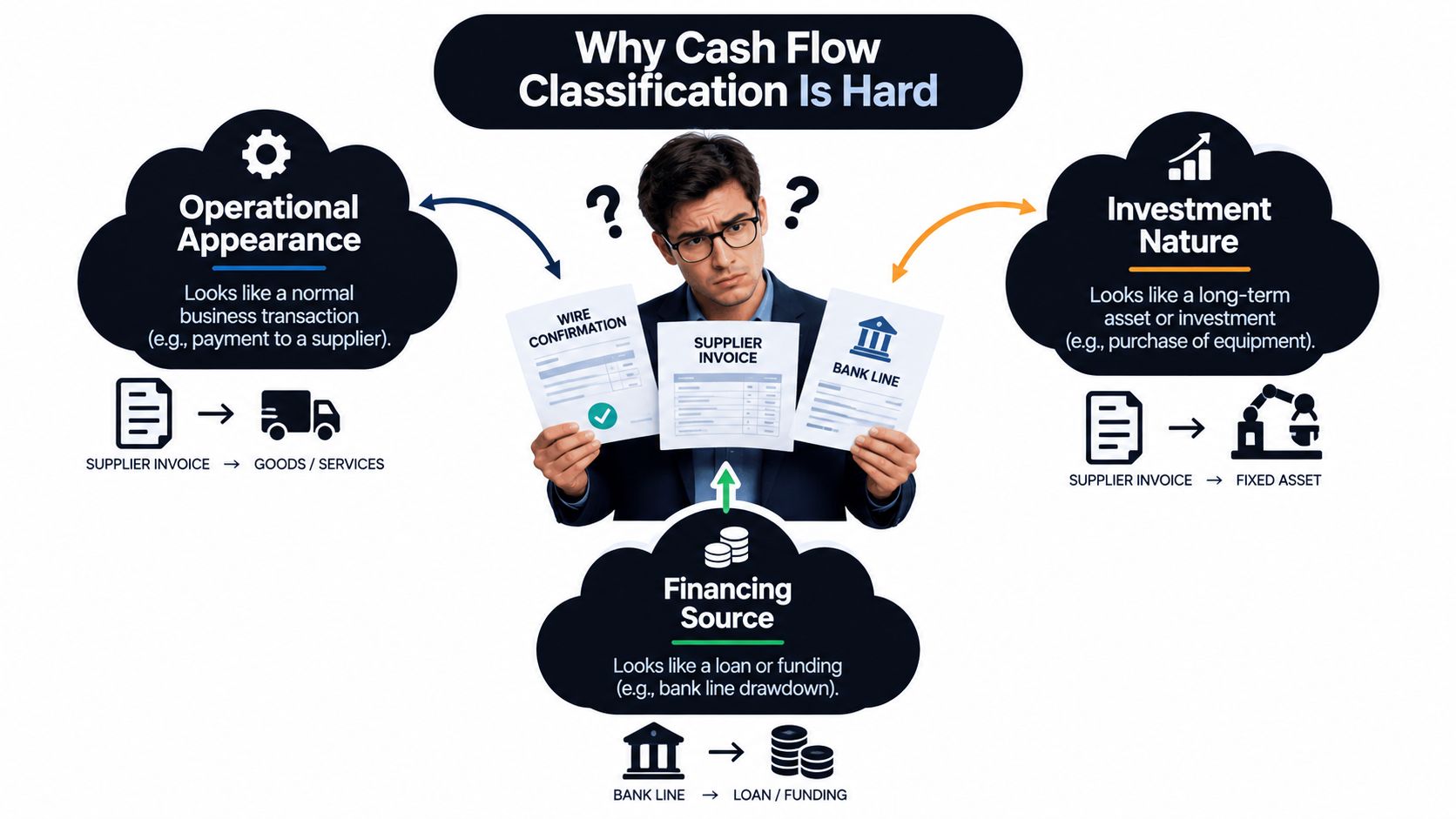
The document rarely tells the whole story
A supplier invoice may relate to ordinary inventory, a new production line, or a service connected to constructing a long-term asset. The bank feed may show the same payment format in each case. The distinction often lives in the purchase order, delivery note, fixed-asset reference, or accounting policy.
Multi-currency files add another layer of friction. Partial payments can settle several invoices at once, while a single invoice can be paid through multiple bank movements. Reverse-factoring arrangements may also make a supplier settlement look operational even when the financing substance requires closer analysis.
Practical rule: A bank statement tells you that cash moved. The supporting document explains why it moved.
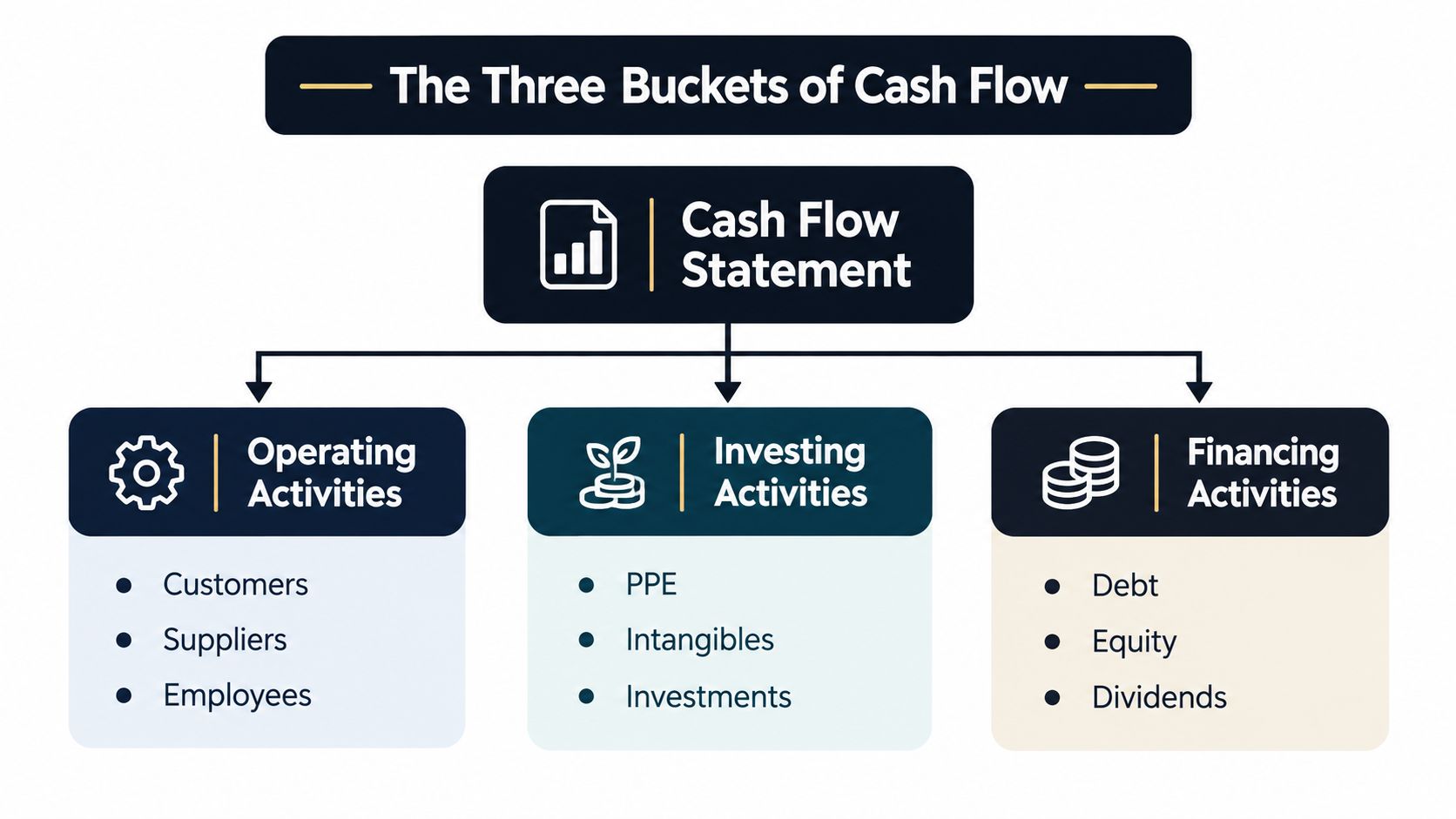
IAS 7 provides the governing structure. Every statement of cash flows reports movements in operating, investing, and financing activities. Operating activities cover the entity's principal revenue-producing activities. Investing activities cover the acquisition and disposal of long-term assets and other investments not included in cash equivalents. Financing activities cover changes in contributed equity and borrowings, as described in the IAS 7 standard.
The close becomes defensible only when the team can trace each material cash-flow line from the statement, to the ledger, to the bank movement, and finally to the document that establishes its nature. This guide follows that path, from the standard's categories to the data pipeline that populates them.
The Three Buckets at the Heart of Cash Flow Classification
A supplier payment reaches the bank feed with a date, amount, and reference. Those fields rarely explain whether the cash funded ordinary operations, a long-term asset, or the company's financing structure. Cash flow classification supplies that missing economic context by assigning each movement to operating, investing, or financing activities.
IAS 7 establishes these three buckets, while U.S. GAAP follows the same broad structure. The categories answer different questions about cash generation and use, so a consistent rule set matters more than the wording on a bank statement. In practice, classification connects invoices, bank records, journal entries, purchase orders, and delivery notes. AI can help extract and compare those records, but the accounting policy still determines the final treatment.
Operating activities
Operating cash flows arise from principal revenue-producing activities. Typical examples include customer receipts and payments to suppliers, employees, and service providers. Taxes generally belong in this bucket unless the payment can be specifically identified with investing or financing activities, as shown in the Deloitte comparison of cash flow requirements.
Operating cash flow can provide a useful view of cash generated by ordinary business activity. The view is reliable only when the source transactions are classified consistently and the company applies its accounting policy correctly. A document pipeline that links a bank movement to its invoice and ledger entry makes exceptions easier to review.
Investing activities
Investing cash flows concern the acquisition or disposal of long-term assets and investments outside cash equivalents. Payments for property, plant, and equipment, purchases of qualifying investments, asset disposals, and qualifying loans to other entities may appear here.
Ask whether the movement changes the company's investment in resources expected to produce returns beyond ordinary trading. That question helps separate an equipment purchase from a routine supplier invoice, even when both appear as similar bank payments.
Financing activities
Financing cash flows change contributed equity or borrowings. Share issues, borrowings, repayments, dividends paid, and lease principal payments by a lessee are examples identified in IAS 7's issued requirements.
IAS 7 allows direct or indirect presentation of operating cash flows. The indirect method reconciles an accounting profit measure by adjusting for non-cash items and working-capital movements. For annual periods beginning on or after 1 January 2025, the starting point changed from profit or loss to operating profit or loss, as described in EY's 2025 IFRS update.
That change affects reporting-system mappings. A reconciliation built around the former starting point may create unexplained variances or weaken comparisons across entities. For a practical companion, see how to read a cash flow statement.
Operating, Investing, and Financing in Practice
The category becomes easier to apply when you connect three things: the cash movement, the source document, and the accounting record. A bank line alone rarely provides enough context. The journal entry and supporting document together explain whether the payment relates to daily operations, a long-term resource, or the capital structure.
A customer receipt usually belongs to operating activities. The source evidence may include a sales invoice, remittance advice, and bank statement entry. The ledger records a reduction in trade receivables and an increase in cash. A payroll payment follows the same operating logic, supported by the payroll register and payment file.
An equipment purchase is different. The bank line may say “supplier payment,” but the invoice, purchase order, and delivery note identify a long-term asset. The accounting record posts the asset to property, plant, and equipment rather than to an ordinary operating expense, so the cash outflow belongs to investing activities.
A practical mapping table
| Transaction Example | Cash Flow Bucket | Typical Source Document |
|---|---|---|
| Receipt from a customer | Operating | Sales invoice, remittance advice, bank statement |
| Supplier payment for ordinary goods | Operating | Supplier invoice, purchase order, delivery note |
| Payroll settlement | Operating | Payroll register, payment file, bank statement |
| Corporate tax payment | Operating unless specifically linked to another category | Tax payment voucher, ledger entry, bank statement |
| Purchase of production equipment | Investing | Capital invoice, purchase order, asset delivery note |
| Proceeds from disposal of equipment | Investing | Disposal invoice, asset register record, bank statement |
| Loan advanced to a subsidiary | Investing | Loan agreement, treasury approval, bank statement |
| Issue of a bond or borrowing | Financing | Loan drawdown notice, facility agreement, bank statement |
| Repayment of borrowed funds | Financing | Amortization schedule, lender statement, bank statement |
| Dividend payment | Financing | Dividend declaration, shareholder approval, payment record |
| Lease principal payment | Financing | Lease contract, payment schedule, bank statement |
Interest and dividends require policy awareness rather than automatic coding. IAS 7 requires interest and dividends received and paid to be disclosed separately and classified consistently from period to period. For most entities, the standard presents interest paid as financing and interest and dividends received as investing, while IFRS permits certain interest classifications to be selected and applied consistently under the applicable policy framework, as detailed in the issued IAS 7 text.
Why the indirect method changes the review
The indirect method does not classify every payment directly from the bank feed. It reconciles an accounting profit starting point to operating cash flow through adjustments for non-cash items and working-capital changes. After the recent change to an operating-profit starting point, finance systems need to preserve the relationship between operating profit, adjustment categories, and the final CFO figure.
A controller reviewing the reconciliation should ask whether each adjustment has an understandable source. If the system can't show the ledger account, document, and policy rule behind a movement, the reconciliation may balance mathematically while remaining difficult to defend.
Borderline Items That Keep Finance Teams Up at Night
The three buckets look settled until a transaction sits between them. Interest, taxes, supplier finance, and leases expose the limits of simplified explainers. The issue isn't merely where a line appears. It's whether the policy reflects the transaction, remains consistent, and preserves comparability across periods.
Interest and dividends
Under IFRS, interest received can be operating or investing, and interest paid can be operating or financing, provided the selected treatment is applied consistently. Dividends received and paid also require separate disclosure and consistent classification. A system that hard-codes one answer for every entity can therefore create a policy error.
Taxes
Tax cash flows are generally operating. The exception matters: a tax payment can be classified as investing or financing when it can be specifically identified with one of those activities. That means the review needs more than a tax-related account code. It needs a documented connection between the tax cash flow and the underlying transaction.
Reverse factoring and supplier finance
Supplier finance arrangements create a frequent review point because the payment may begin with an operating purchase but later involve a financing intermediary. The team must examine the arrangement's terms, the supplier's settlement, the entity's obligation, and whether the transaction changes the nature of the liability.
The IASB has indicated that it will look for ways to improve consistent application of IAS 7 without redefining the three categories. Its discussion of classification challenges highlights why arrangements such as reverse factoring remain a practical FAQ gap rather than a simple textbook exercise, as shown in the IASB staff paper on cash-flow classification.
Leases
For a lessee applying IFRS, lease principal payments are financing cash flows. Interest and certain short-term or low-value lease payments can involve different treatment under the applicable requirements and policy. The lease contract and payment schedule therefore need to accompany the bank line.
| Item | Common Classification | Decision Factor |
|---|---|---|
| Interest received | Operating or investing | Entity policy and consistent application |
| Interest paid | Operating or financing | Entity policy and applicable framework |
| Dividends received | Often investing for many entities | Policy, business model, and consistency |
| Dividends paid | Financing | Distribution to capital providers |
| Tax payment | Operating | Specific identification with investing or financing |
| Supplier finance settlement | Operating or financing may require analysis | Nature of the obligation and arrangement terms |
| Lease principal repayment | Financing | Principal component of the lease liability |
A classification policy is only useful if the bank feed, ledger, and supporting documents apply it the same way every period.
From Raw Documents to Classified Cash Flow Lines
A reliable cash flow process starts before the accounting entry. It starts when the company receives an invoice, bank statement, payslip, delivery note, or contract. Those files may arrive by email, SFTP, or API, and they may contain selectable text, scanned images, tables, handwriting, or multiple documents in one file.
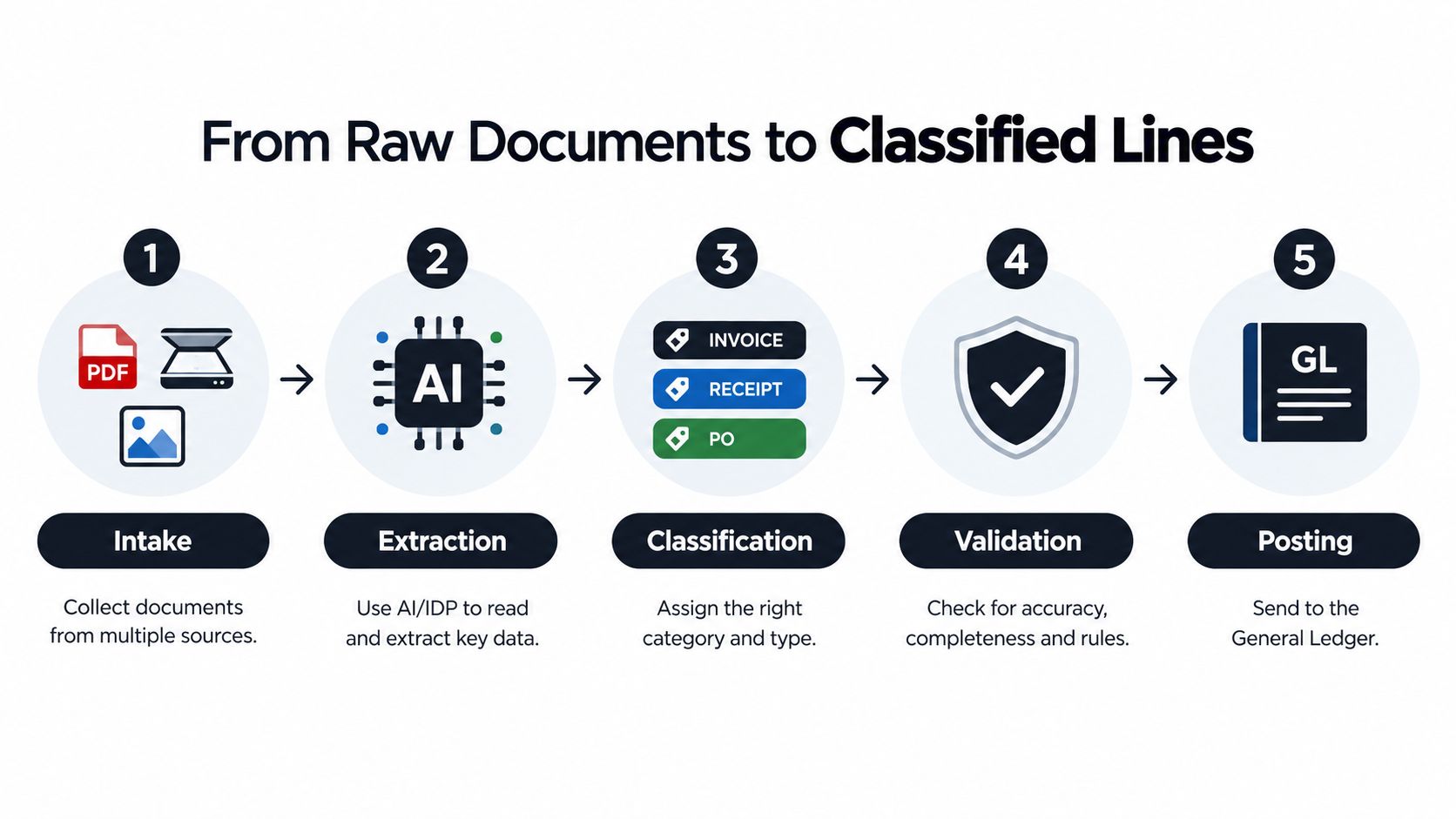
Five stages connect evidence to reporting
Intake brings documents into a controlled workflow. The system records the file, source, entity, period, and processing status.
OCR converts text from PDFs and images into machine-readable content. OCR documents processing is only the capture layer. It doesn't decide whether a payment is operational, investing, or financing.
Document classification identifies whether the file is an invoice, bank statement, payslip, lease agreement, delivery note, or another document type. This determines which extraction logic should run.
Field extraction and validation pull amounts, dates, counterparties, references, tax identifiers, account numbers, and line items. Validation can compare totals with purchase orders, ledger postings, fixed-asset records, loan schedules, or prior-period patterns.
Posting and cash-flow assignment maps the validated transaction to an account, journal, and cash-flow bucket. Exceptions go to a reviewer with the source document and reason for the flag.
Why upstream quality determines downstream accuracy
Suppose a bank statement contains a payment to a machinery supplier. Without the invoice or purchase order, the system may see only a counterparty and an amount. With the supporting files, it can identify an asset description, a fixed-asset project, a delivery confirmation, and the relevant ledger treatment.
The same principle applies to a lease settlement. The bank line shows cash leaving the account, but the lease schedule separates principal and interest. A cash flow process that extracts only the total payment cannot produce a dependable category split.
Teams evaluating invoice data capture should therefore look beyond character recognition. The useful output is structured, traceable data that can be reconciled and passed into the accounting workflow.
A good pipeline preserves the chain of evidence:
- Source file: The original PDF, scan, image, or statement remains accessible.
- Extracted fields: Amounts, dates, counterparties, and references retain their document location.
- Validation result: The system records what matched, what failed, and what required review.
- Classification decision: The bucket, rule, policy, and reviewer action remain visible.
Where AI and IDP Fit Into the Cash Flow Workflow
A finance team can build this pipeline with separate OCR, extraction, rules, and workflow tools. The difficulty comes from maintaining the connections between them. A document may be read correctly but classified incorrectly. A transaction may be assigned to the right account but lack the evidence needed for a cash-flow decision.
Intelligent Document Processing combines capture, interpretation, extraction, validation, and workflow routing. OCR handles the image or PDF. Layout-aware models recognize tables and line items. Classification models identify the document type and direct it to the appropriate extraction schema.
The controller remains part of the control loop
Suppose a recurring utility invoice arrives with a familiar supplier name. The system can identify the document, extract the billing period and amount, compare the total with expected ledger behavior, and suggest an operating classification. A vehicle invoice from the same supplier category may instead contain asset and delivery signals that require investing treatment.
The system shouldn't automatically force every result through. It should show confidence, supporting fields, validation failures, and the policy rule that produced the proposed classification. Human reviewers then focus on exceptions such as mixed invoices, unusual counterparties, missing references, and supplier-finance arrangements.
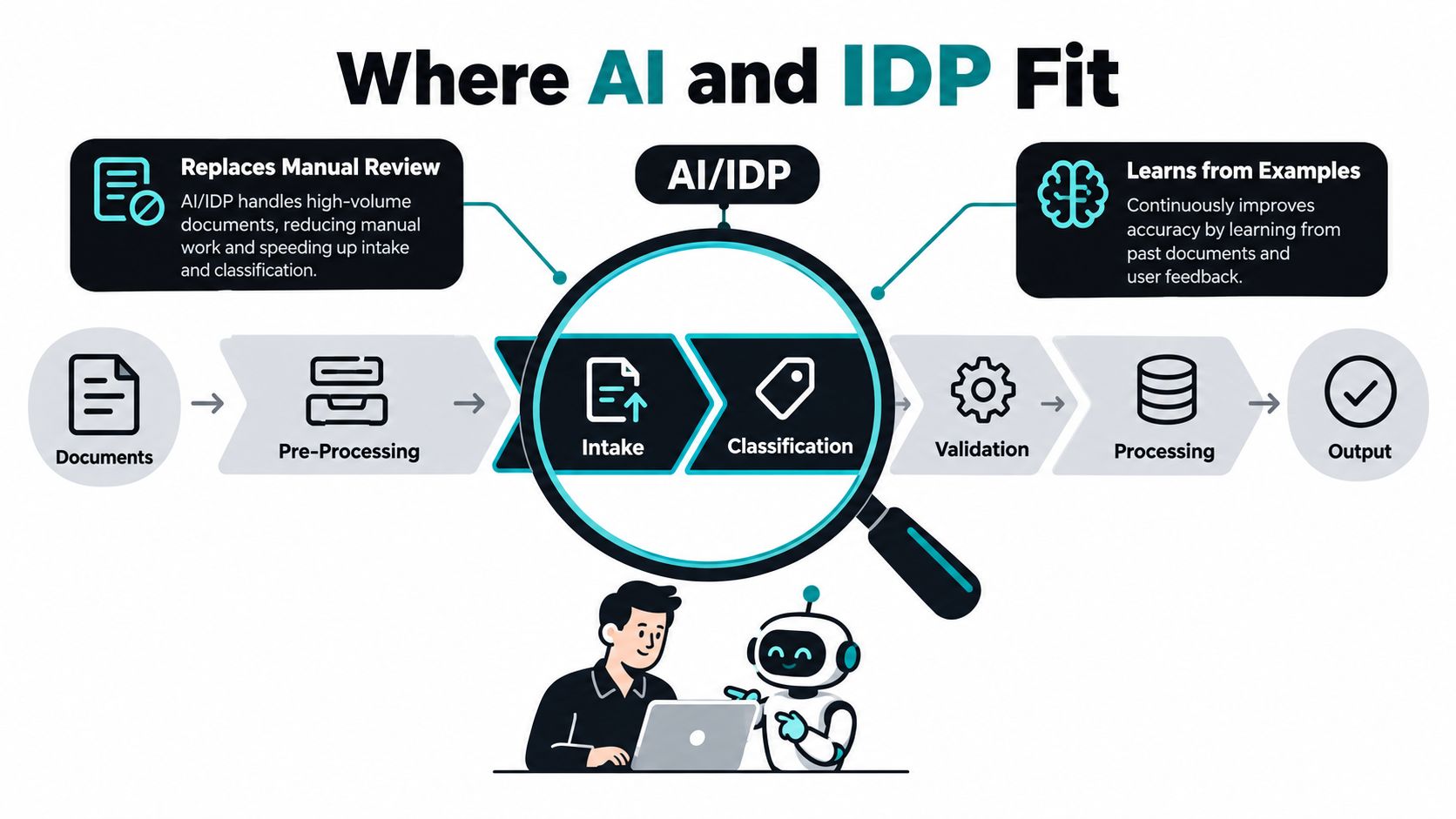
Tools such as Matil.ai combine OCR, classification, validation, and workflow orchestration through an API. Its capabilities include pre-trained document models, adaptable data structures, rapid customization, traceability, and a stated precision of above 99% in multiple use cases, as described in the publisher information. It also lists GDPR, ISO 27001, AICPA SOC, and zero data retention as enterprise security and compliance features. The practical relevance is not the OCR label alone. It's the ability to return enriched document data that downstream accounting systems can validate and use.
For teams assessing the broader model, what intelligent document processing means provides useful background. The central design question remains operational: can the pipeline explain how a raw document became a classified cash-flow line?
Real Document Types That Feed Each Cash Flow Bucket
The bank feed is the final visible event, not the full source of meaning. A controller needs the documents behind it to understand whether the cash movement relates to ordinary operations, a long-term asset, or financing.
Operating evidence
Operating activity often draws from supplier invoices for goods and services, sales invoices, payroll registers, utility bills, bank-fee notices, and tax payment records. Distinguishing signals include expense descriptions, employee identifiers, service periods, purchase-order references, and links to trade or expense accounts.
A recurring electricity invoice typically points toward operating cash flow. A payslip supports payroll classification. A tax voucher usually supports operating treatment unless the payment can be specifically connected to an investing or financing transaction.
Investing evidence
Investing activity requires documents that establish a long-term resource or investment. These can include asset purchase invoices, delivery notes for vehicles or equipment, investment account statements, loan agreements for advances to subsidiaries, and disposal documentation.
A fleet vehicle invoice may contain a vehicle identification number, asset description, capital project reference, and delivery confirmation. Those signals distinguish it from a routine vehicle repair invoice, even if the supplier and bank account are similar. Teams that need standardized examples for supplier documentation can also consult painting invoice templates, while remembering that a template's appearance doesn't determine its cash-flow category.
Financing evidence
Financing documents include loan drawdown notices, lender statements, amortization schedules, lease contracts, dividend declarations, and share issuance or buyback confirmations. The decisive signals are usually debt references, principal and interest splits, shareholder approvals, facility identifiers, or lease-liability schedules.
| Document Type | Typical Bucket | Key Signal |
|---|---|---|
| Supplier invoice for routine goods | Operating | Expense, inventory, or trade-payable reference |
| Payroll register | Operating | Employee payment and payroll period |
| Utility bill | Operating | Service period and operating consumption |
| Equipment purchase invoice | Investing | Asset description and fixed-asset reference |
| Capital delivery note | Investing | Delivery of a long-term resource |
| Investment account statement | Investing | Purchase or disposal of an investment |
| Loan drawdown notice | Financing | Borrowing facility and proceeds |
| Lease contract and schedule | Financing for principal | Lease liability and principal component |
| Dividend confirmation | Financing | Approved distribution to shareholders |
| Bank statement | Not sufficient alone | Cash movement without full economic context |
A fleet payment, a recurring supplier payment, and a lease settlement can appear as similar outflows in the bank file. The first may be investing, the second operating, and the principal element of the third financing. A bank-statement extraction workflow such as Matil's finance document extractor can make the bank data usable, but the final classification still depends on linked supporting evidence and policy.
What Clean Cash Flow Classification Actually Requires
A defensible statement of cash flows starts with disciplined documents, not accounting rules alone. A bank line may look like any other outflow, yet its classification depends on the invoice, delivery note, lease schedule, or policy behind it.
Source files must be structured and machine-readable. Image-only PDFs and incomplete scans obstruct extraction, matching, and validation.
Each bank movement should link to supporting evidence or a documented policy override before entering a bucket. Reviewers can then trace the reported amount to its origin without rebuilding the close from email threads.
Classification rules also need consistent, explainable treatment of borderline items, IAS 7, entity policy, and the indirect-method change for annual periods beginning on or after 1 January 2025, as documented by EY's IFRS update.
With these controls, AI-driven IDP can extract fields, classify documents, match relationships, flag exceptions, and retain an audit trail. Without linked evidence, a model may produce a balanced number that cannot support the CFO's sign-off.
Matil offers an API for extracting structured data from invoices, bank statements, leases, payroll documents, and other finance records, with OCR, classification, validation, and workflow orchestration. Explore Matil for traceable data ready for review and posting.


