Bills of Lading: Fields, Formats and Automated Extraction
Learn what bills of lading contain, which formats you will receive, and how to extract and validate their data accurately.

The carrier's PDF has arrived, the packing list is open, and finance needs the shipment cleared for payment. But the consignee differs between files, a container number is partly hidden by a stamp, and another version has just landed by email. Bills of lading need more than text recognition. They need separately validated fields and a clear record of which document governs the shipment.
Bill of Lading Fields You Need to Capture
A bill of lading is evidence of the contract of carriage, a receipt for goods received by the carrier, and, in negotiable form, a document controlling who can claim those goods. A wrong party name or cargo identifier can therefore affect both physical delivery and payment.
Before extracting fields, identify the document type:
- Straight bill: Names a specific consignee and isn't transferable by endorsement. Confirm the carrier's applicable presentation requirements.
- Order bill: Can be endorsed to another holder. Capture the original count and endorsement history alongside the commercial fields.
- Sea waybill: Names the consignee but is not transferable by endorsement and doesn't function as a document of title.
Core bill of lading fields and what they control
The examples below are illustrative field values, not prescribed formats.
| Field | What it holds | Example | Why it matters |
|---|---|---|---|
| Shipper | Party that hands over the cargo | ABC Textiles Ltd, Ningbo | Identifies who released the goods to the carrier |
| Consignee | Party entitled to receive the goods | Northwind Imports GmbH | Defines who can claim delivery, especially on straight bills |
| Notify party | Party told when cargo arrives | Rhine Logistics BV | Often where release and customs delays surface first |
| Bill number | Carrier or forwarder reference, also called B/L number | Carrier-issued reference | Primary matching key, used with issuer and shipment context |
| Bill type | Negotiability and original or copy status | Negotiable, three originals | Determines delivery-control checks |
| Container and seal numbers | Physical unit identifiers | Container identifier and seal reference | Matches cargo at the terminal and during inspection |
| Package count | Number of packages or units | Carton count | Compared with the packing list and receipt |
| Cargo description | Goods as declared | Woven cotton shirts in cartons | Supports tariff classification and customs screening |
| Gross weight | Total weight or stated measurement | Declared gross mass in kilograms | Incorrect weight can create customs exceptions |
| Port of loading | Port where cargo is loaded | Ningbo, CN | Establishes the loading location and routing |
| Port of discharge | Port where cargo is unloaded | Hamburg, DE | Establishes the discharge and release location |
| Vessel and voyage | Ship name and voyage reference | Named vessel and carrier voyage reference | Links the bill to the sailing schedule |
| Freight terms | Whether freight is prepaid or collect | Prepaid | Supports freight invoicing and payer checks |
| Incoterms | Trade term governing cost and risk allocation | FOB Ningbo | Often absent from the bill; confirm against the sales contract |
Customs, banks, and forwarders need these as separate values, not an undifferentiated text block. The U.S. inward-manifest rules and maritime data specification identify cargo descriptions, weight, parties, routing, container identifiers, and hazardous-material information, including a six-digit tariff classification when supplied.
Don't confuse freight prepaid with the buyer and seller's allocation of risk. Freight terms and Incoterms answer different questions.
For a vehicle shipment, keep transport arrangements separate from document checks. If you plan to ship your vehicle with National Car Transport, use its route information to prepare questions about the carrier's required shipment and release documents.
Before trusting an extracted record:
- Find the bill number and identify its issuer.
- Confirm the consignee, rather than substituting the notify party.
- Compare container and seal numbers with the packing list or associated stuffing record.
Formats You Will Receive and Their Extraction Risks
One shipment can reach your team through several formats. A readable PDF, a stamped original, and an electronic platform record need different handling, even when they describe the same cargo.
The format determines how you read the document. Its version and authority determine whether you should use it.
Bill of lading formats, extraction risks and checks
| Format | Typical layout | Main extraction risk | Check before use |
|---|---|---|---|
| Original paper bill | Printed form with stamps and signatures | Stamps over numbers, handwriting and skew | Confirm the original count and signatures |
| Scanned copy | Image file, often multi-page | Low resolution, cut-off text and split tables | Page count matches the original |
| Text-based PDF from email | Digital file with a text layer | Multi-page cargo tables and merged cells | Line totals match the bill total on page one |
| Electronic bill of lading | Structured record on a platform | Platform-specific fields; a visual layout may not exist | Control status and endorsement history are recorded |
| Mixed set for one shipment | Paper, scan and electronic versions together | Duplicates and superseded versions | One authoritative version is identified and tagged |
Paper originals need a physical-document procedure. A reviewer should inspect signatures, stamps, and the stated original count; OCR shouldn't be treated as signature authentication.
A text-based PDF can often be read without OCR. However, its text layer may place a weight beside the wrong cargo line when a table continues across pages. Preserve headers, row associations, and continuation markers rather than joining page text.
Mixed formats need version governance
The FIT Alliance reported that companies using both paper and electronic bills of lading rose from 28.0% in 2022 to 41.7% in 2024, according to FIATA's summary of the survey. Parallel processing makes duplicate detection a normal operating requirement, not an edge case.
Say an amended consignee appears in a platform record while an earlier PDF remains in the accounts-payable inbox. Both files may be legible, and both may extract cleanly. The team still needs evidence that the amendment was authorized and that the earlier version has been superseded.
Practical rule: Tag every incoming file with its format, source, document status, and version before extraction.
Keep arrival time separate from issue time. The last file received isn't necessarily the latest authorized document, and identical cargo details don't prove that two records carry the same delivery rights.
Why Manual Entry and Basic OCR Fail on Bills
Manual entry and basic OCR fail for different reasons. A clerk understands that a number belongs to a container, but can mistype it. Basic OCR may read the characters correctly without knowing whether they represent a container, a seal, a package count, or a weight.
Both approaches can rely on the same mistaken assumption: reading text is the hard part. The harder task is identifying what each value means and deciding whether it agrees with the shipment.
Readable text isn't a usable record
A plain OCR output might preserve every word while losing the relationships between them. If a cargo table spans pages, the extracted weight may attach to the next row. If a stamp overlaps a party address, the engine may combine unrelated text into one field.
An OCR accuracy comparison is useful when assessing recognition quality, but your acceptance test should go further. Measure whether the right value reaches the right field and whether the workflow catches an incorrect result.
Consider a hypothetical forwarder receiving 300 bills a week. A clerk mistypes a container reference, and the shipment record no longer matches the terminal's record. If the discrepancy isn't caught before release processing, the team could spend days locating the source, confirming the correction, and updating connected systems.
Count the work after extraction
The hidden workload includes more than initial typing:
- Reconciliation: Staff compare the bill with invoices, packing lists, and booking records.
- Correction: Operations must determine whether the source document or the extracted value is wrong.
- Coordination: Finance, customs brokers, and carrier representatives may all need the corrected record.
- Volume handling: More documents create more review work unless the process distinguishes clean records from exceptions.
A fast text reader can still produce a slow document workflow.
The format risks also affect staffing. A clerk can't resolve an unclear scan by typing faster, and an OCR engine can't decide which amendment is authoritative from character recognition alone.
This is a structural problem, not a typing-speed problem. Better processing needs document context, field relationships, and explicit approval rules.
How AI Extraction Turns a Bill into Validated Data
Data extraction from documents is the chain of reading, classifying, extracting, and checking document content so each value lands in a named field. For bills of lading, a useful output preserves cargo relationships, document identity, and review evidence, not just the visible text.
The basic processing stages are shown below.
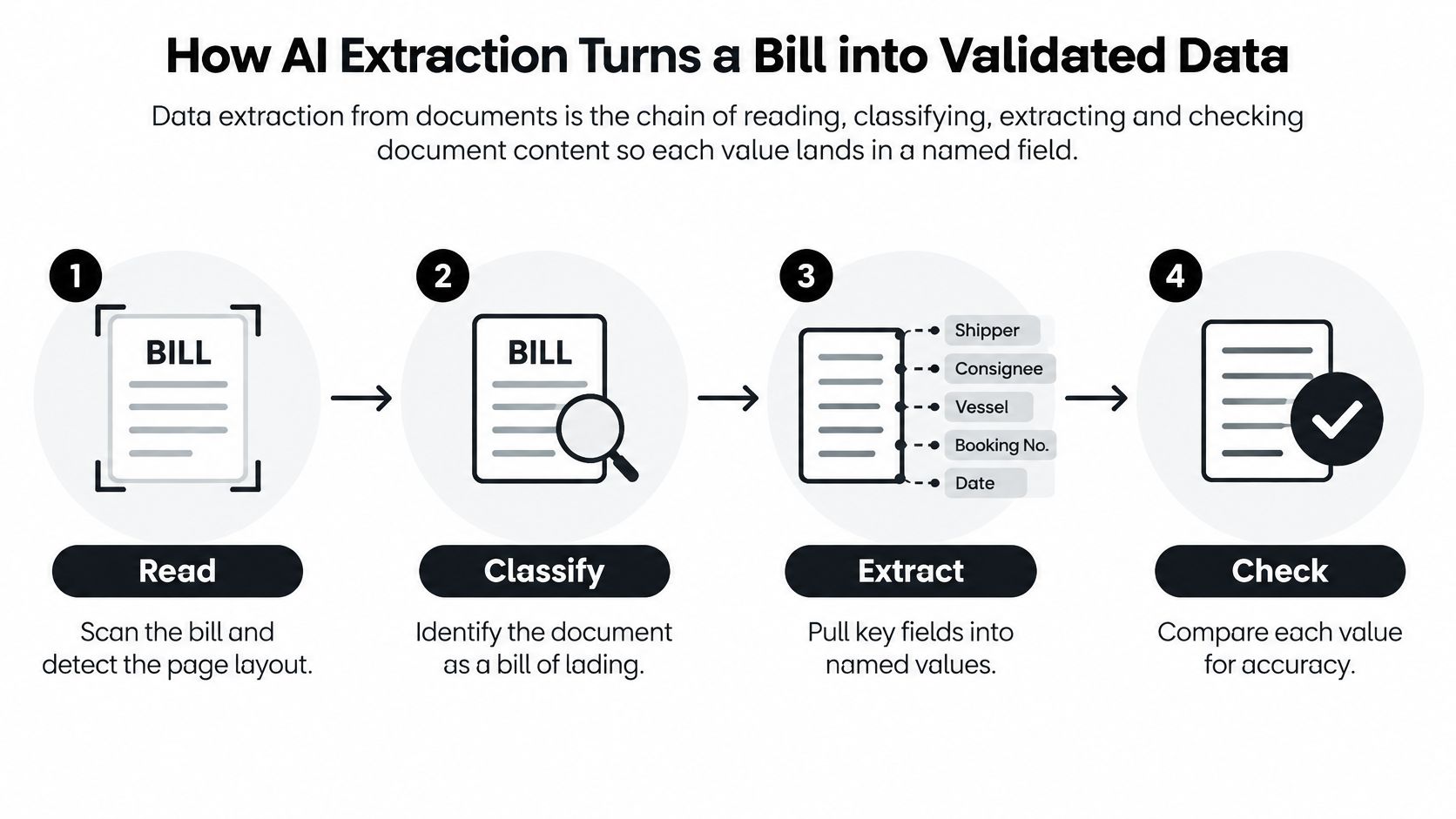
Build a field-aware extraction pipeline
Split and ingest. Separate a combined file into individual bills and related documents, then attach a document ID. Keep continuation pages together so cargo lines aren't separated from their bill.
Read with OCR where needed. Convert images into text while retaining coordinates and table structure. Use the existing text layer for suitable digital PDFs, and preserve the association between headers and cargo rows.
Classify the document. Distinguish a bill of lading from an invoice or packing list, then identify its type and copy status. This prevents invoice payment terms from being mistaken for freight terms.
Extract named fields. Map values into structured JSON, including bill number, carrier, shipper, consignee, containers, packages, weight, and ports. Keep repeated container and cargo entries as arrays rather than flattening them into a paragraph.
Validate relationships. Compare package totals, weights, identifiers, and reference documents. Don't equate container counts with package counts: a container can hold many packages, so those fields need different checks.
Route the result. Send accepted records to the system of record and exceptions to a reviewer. Highlight the disputed field, its source location, and the failed rule so the reviewer doesn't have to search the entire document.
Matil.ai combines OCR, classification, validation, and workflow automation through a simple API, with a pre-trained bill of lading model and flexible structures for rapid customization. Its reported accuracy is above 99% in multiple use cases, but that isn't a guarantee for every carrier layout or damaged scan. Test field accuracy on your own documents, especially delivery-critical identifiers.
Keep extraction separate from legal control
A structured record isn't automatically a transferable electronic bill. UNCITRAL's Model Law on Electronic Transferable Records calls for reliable identification of the electronic record, protection of its integrity, and exclusive control by the entitled person.
That distinction changes the implementation. Preserve the full record and audit history, bind amendments and endorsements to the original identity, and retain platform control metadata.
Control boundary: Access to a PDF doesn't establish exclusive control of an electronic bill of lading.
Extraction should help operations consume verified information without claiming to replace the carrier or platform system that manages document rights.
Validation Rules That Catch Costly Bill Errors
Validation turns extraction into control: each rule compares a field with another field or with a reference record, such as the packing list. A confidence score answers how certain the model is; a validation rule asks whether the result is acceptable for the intended action.
Use explicit checks before approving a shipment record.
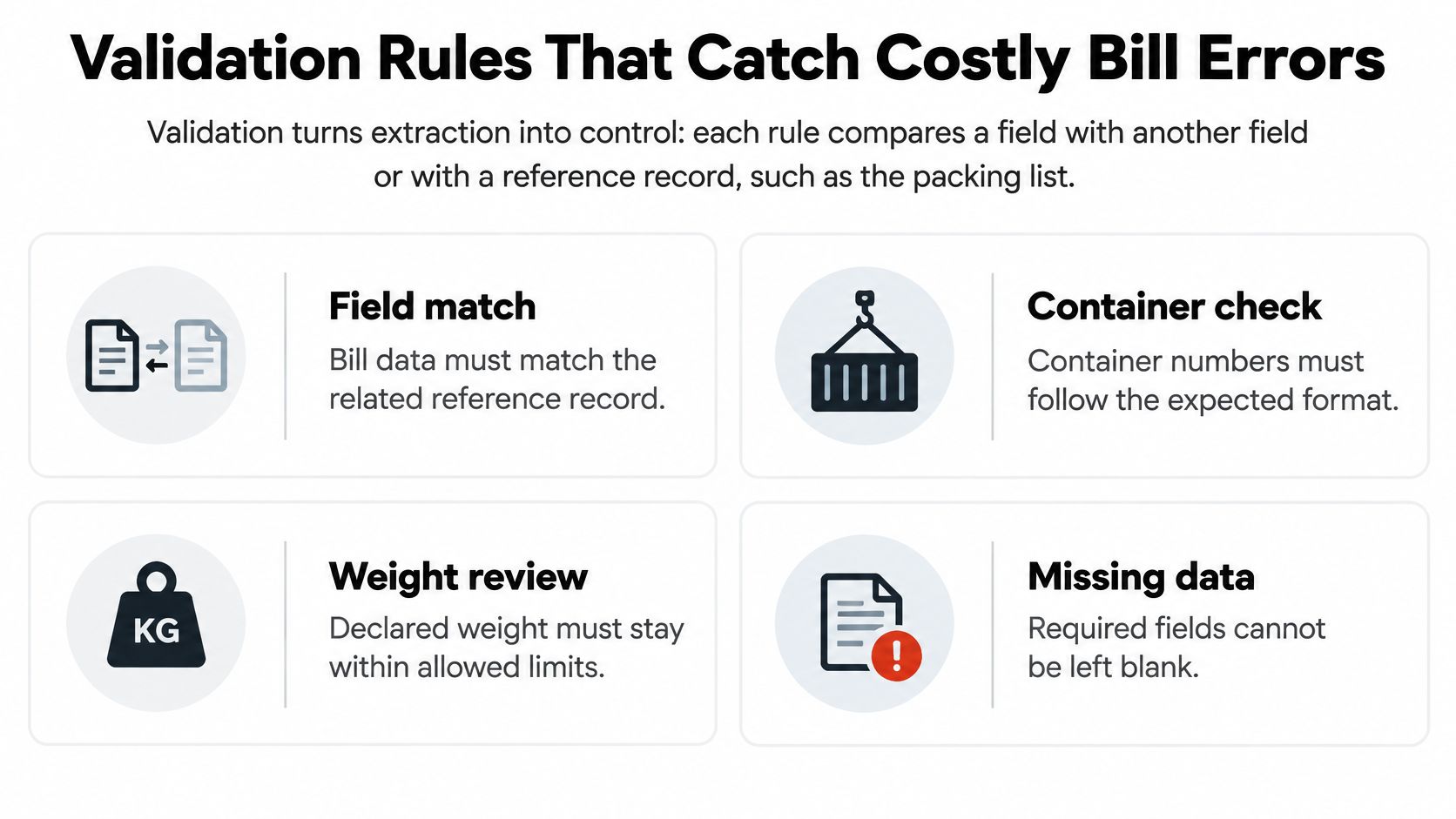
Validation rules for bill of lading data
| Check | Rule | Example failure | Action |
|---|---|---|---|
| Hazardous flag | UN number required when the hazardous flag is positive | Flag set, UN field empty | Route to review |
| Container count | Container numbers match the packing list | Packing list shows a container the bill omits | Hold release |
| Package total | Line package counts sum to the bill total | Line sum excludes a continued cargo row | Flag mismatch |
| Weight total | Line gross weights sum to the bill total within tolerance | Line weights differ from total beyond tolerance | Review before customs filing |
| Tariff code | Six-digit classification when supplied | Five-digit code extracted | Request correction |
| Date order | For a shipped-on-board workflow, issue date isn't earlier than the loading date | Issue date before loading date | Flag for review |
| Party fields | Consignee and notify party are complete and not swapped | Consignee field blank | Block automatic approval |
| Duplicate check | Same bill number from the same shipper seen before | Second bill with same number and shipper | Keep the authoritative version |
| Negotiability | Original count and endorsement recorded for negotiable bills | Negotiable bill, zero originals recorded | Hold for compliance |
Treat the table as an operating specification, not a universal legal rulebook. Date checks must distinguish received-for-shipment bills from shipped-on-board bills. Electronic negotiable records need control and endorsement evidence rather than a paper-original count.
Set actions, tolerances, and owners
Prioritize by consequence. An unresolved container mismatch should stop automatic release approval; a delivery-rights gap belongs with compliance. A malformed tariff field or unusual date sequence generally needs correction or document-specific review.
Normalize the outcomes into hold release, request correction, and send to compliance. Attach each failed rule to an owner, evidence, and a resolution status.
For weights, operations may permit a documented rounding tolerance after normalizing units. Don't apply that tolerance to container or seal identifiers. A near match isn't a match.
Operations and compliance should define these policies together. Technical teams can implement field-level validation, but shouldn't independently decide which discrepancies are safe to accept.
Use a strict-first pilot:
- Block every exception from automatic approval, without automatically stopping unrelated physical operations.
- Log exceptions during a two-week trial, tagging extraction errors, source errors, and policy false positives.
- Relax only demonstrated false-positive tolerances, after the accountable owner confirms they don't conceal real defects.
Logistics and Finance Cases Where Extraction Pays Off
The following cases are illustrative workflows, not customer results. Measure each against your own baseline instead of applying an invented savings percentage.
The workflow below shows how document intake can connect to downstream processing.
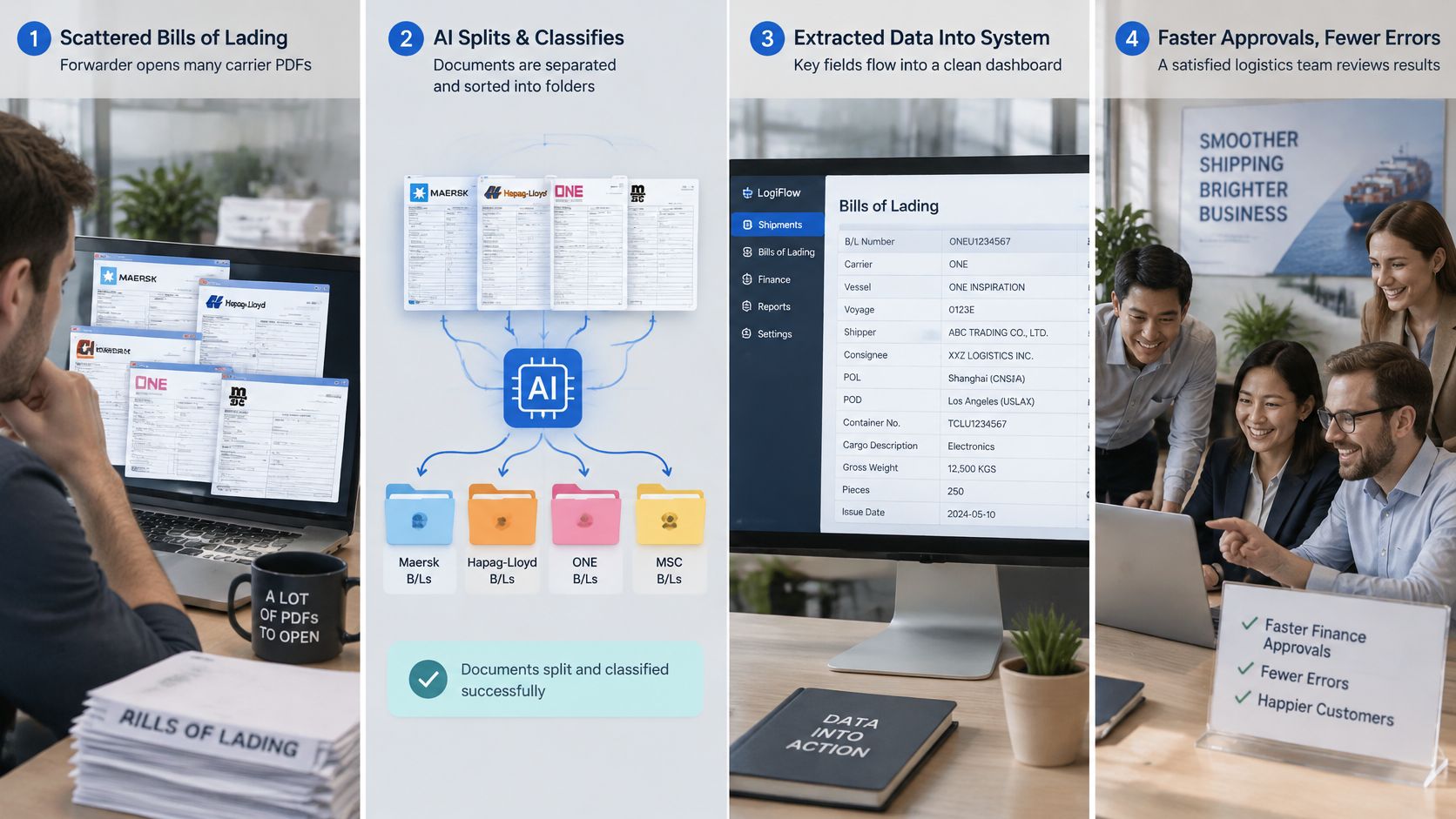
Illustrative team workflows
Freight forwarder. Operations receives multi-page PDFs from different carriers and rekeys each bill into the transport management system. A document pipeline separates files, identifies bill types, and passes accepted fields into the shipment record. Track the result through weekly rekeying time, manual touches, and records requiring correction, including time spent resolving exceptions.
Bank trade finance team. Staff inspect presentations for discrepancies between bills and invoices. Automated comparisons flag differences in shipper, consignee, cargo description, and quantities while leaving documentary interpretation with trained reviewers. Track review turnaround and returned presentations, distinguishing extraction mistakes from genuine documentary discrepancies. Similar wording doesn't always mean equivalent goods descriptions.
Customs broker. Shipment information arrives incomplete, and staff chase weights or classification details near the filing deadline. Pre-filing validation identifies missing values and routes them to the responsible party before submission. Measure first-pass completeness and correction requests. Extraction can verify that a supplied tariff field is well formed, but it doesn't independently establish that the goods have been classified correctly.
Compliance and KYC team. Party names arrive with inconsistent spacing, abbreviations, and address layouts. Extraction preserves the original name while creating a standardized version for screening input, with consignee and notify party kept separate. Track preventable rescreening and manual identity clarification. Don't erase meaningful name differences or treat a normalized name as proof of identity.
For a broader view of connecting document intake to operational tasks, AY Automate's logistics automation resource provides relevant workflow context.
This video offers another way to review the document-processing approach.
Measure the whole handoff
Use a shared measurement set across teams:
- Time: Count intake, review, correction, and downstream reconciliation.
- Quality: Record wrong fields separately from missing source information.
- Automation: Track accepted records that reach the destination without manual repair.
- Capacity: Assess whether reviewers can handle changing volumes without growing the backlog.
Connect the bill to the rest of your supply chain documentation. Faster extraction only creates operational value when the receiving system can use the record without another round of copying.
Set Up Bill of Lading Extraction on a Test Batch
Test the complete workflow before rollout. A clean demonstration PDF won't reveal how your process handles faint scans, continuation pages, amendments, or duplicate submissions.
Define the pilot
Collect representative bills. As a practical pilot design, aim for about a hundred documents covering your carrier layouts and every incoming format, including mixed paper and electronic sets.
Write the acceptance specification. Define required fields, validation rules, document authority checks, and exception owners. Label an expected result for each test document.
Compare every extracted field with a manual check. Record where errors cluster, such as weights, container references, or party boundaries. Assess false approvals separately from correctly flagged exceptions.
Choose the production processing mode. Use the table below to match response timing to the receiving system. Test retries, duplicate submissions, and failed deliveries through the same API or no-code output path you'll use in production.
Verify security and operating requirements. Our enterprise security provisions include GDPR, ISO 27001, AICPA SOC, and zero data retention. Include these requirements and the availability SLA in your procurement review, and document what your own integration retains in logs.
Processing modes for bill of lading extraction
Our API provides these processing modes:
| Mode | How results return | Best for |
|---|---|---|
| Normal | Immediately in the response | Real-time integrations that need structured data at once |
| Async | Returned by webhook when ready | Files submitted now and processed later |
| Batch | One request covering hundreds of documents | Nightly imports and migrations |
Batch submission groups transport, not billing units: each distinct document unit generates an independent request. Include document splitting in the pilot so your volume estimate reflects actual document units rather than uploaded files.
Approve rollout only when your team can explain which records pass automatically, which need review, and who resolves each exception. Start with your own sample before committing to production.
Matil offers bill of lading extraction that combines OCR, classification, field validation, and workflow automation through an API. Visit Matil to evaluate a representative batch of your bills, compare the output with your approved records, and test how exceptions reach the right reviewer.


