Supply Chain Documentation Explained for 2026
Supply chain documentation includes invoices, bills of lading and customs files. Learn the fields, the failure points and how to automate extraction.

216 hours of documentary compliance for imports and exports on average appears in the historical Doing Business data discussed by the World Bank. Supply chain documentation isn't just filing. It determines whether a broker can submit an entry, a bank can assess a payment, and a consignee can obtain cargo. Yet a perfectly transcribed file can still contain a false origin claim or contradictory quantities.
Supply Chain Documentation Types and Proofs
Supply chain documentation is the commercial, transport and government paperwork that records what moved, who sold and carried it, what it's worth, and whether it may enter a market. Each document supplies a different kind of evidence. No single file proves the entire transaction.
Core supply chain documents and what each proves
| Document | What it proves | Primary user |
|---|---|---|
| Commercial invoice | Sale, value and tax base | Finance and customs |
| Packing list | How goods are packed | Warehouse and carrier |
| Bill of lading | Receipt, carriage contract and sometimes title | Carrier, bank and consignee |
| Customs declaration or DUA | Legal import, export or transit | Broker and customs |
| Certificate of origin | Claimed country of origin | Customs and compliance |
| Delivery note | Goods handed over | Operations and accounts payable |
| Insurance certificate | Cargo cover in force | Finance and claims |
An ocean shipment may need an invoice, packing list, bill of lading, customs declaration and certificate of origin. Those files rarely share a layout. They may also describe the same goods differently, using a purchase description, warehouse SKU or tariff description.
Start with the proof required, not the filename. An attachment called “shipping documents” might contain only an invoice. A signed delivery note doesn't replace evidence of cargo insurance, and a packing list doesn't establish the sale price.
What a transport document actually controls
A negotiable bill of lading serves as a cargo receipt, evidence of the carriage contract and a document of title. Its consignee field and endorsement history therefore aren't ordinary text. Changing them can affect who is entitled to demand delivery.
A sea waybill is not transferable. It identifies the recipient without providing the same mechanism for transferring title. Don't route both documents through an identical cargo-release approval just because their layouts look similar.
Operational requirements also sit alongside international trade paperwork. For a trucking-specific example, Peak Transport's guide to Amazon Relay documentation requirements is useful when mapping the records a transport operation needs to maintain. Keep those requirements distinct from the commercial and customs evidence for the goods.
Build a pre-departure completeness check
Assign each required proof an owner and a readiness condition:
- Seller or exporter: Supplies the commercial description, price and supporting origin information.
- Warehouse: Confirms package identifiers, contents and weights.
- Carrier or forwarder: Confirms transport references and the correct transport document.
- Broker: Checks that the commercial set supports the intended declaration.
- Finance: Confirms payment evidence and any bank-document requirements.
Use the table as a departure gate. A blank required proof means the packet isn't ready for the carrier, broker or bank. A populated row means the evidence is present, not that every statement in it has been independently verified.
What Manual Supply Chain Documentation Still Costs
Approximately five billion trade documents are exchanged worldwide each year, according to UNCTAD's electronic trade-document submission, which also cites IATA's estimate of US$1.5 billion annually for handling paper trade documents. The same submission describes traditional paper-based procedures as representing 5% to 10% of world trade value, and reports historical electronic-document implementations that reduced processing costs by up to 20% and traders' document-handling costs by up to 35%.
These are historical estimates, not a forecast for an individual business. Their operational lesson is concrete: preparing, exchanging and correcting paperwork creates costs beyond the person typing it.
The handoffs are easiest to see as a shared workflow.
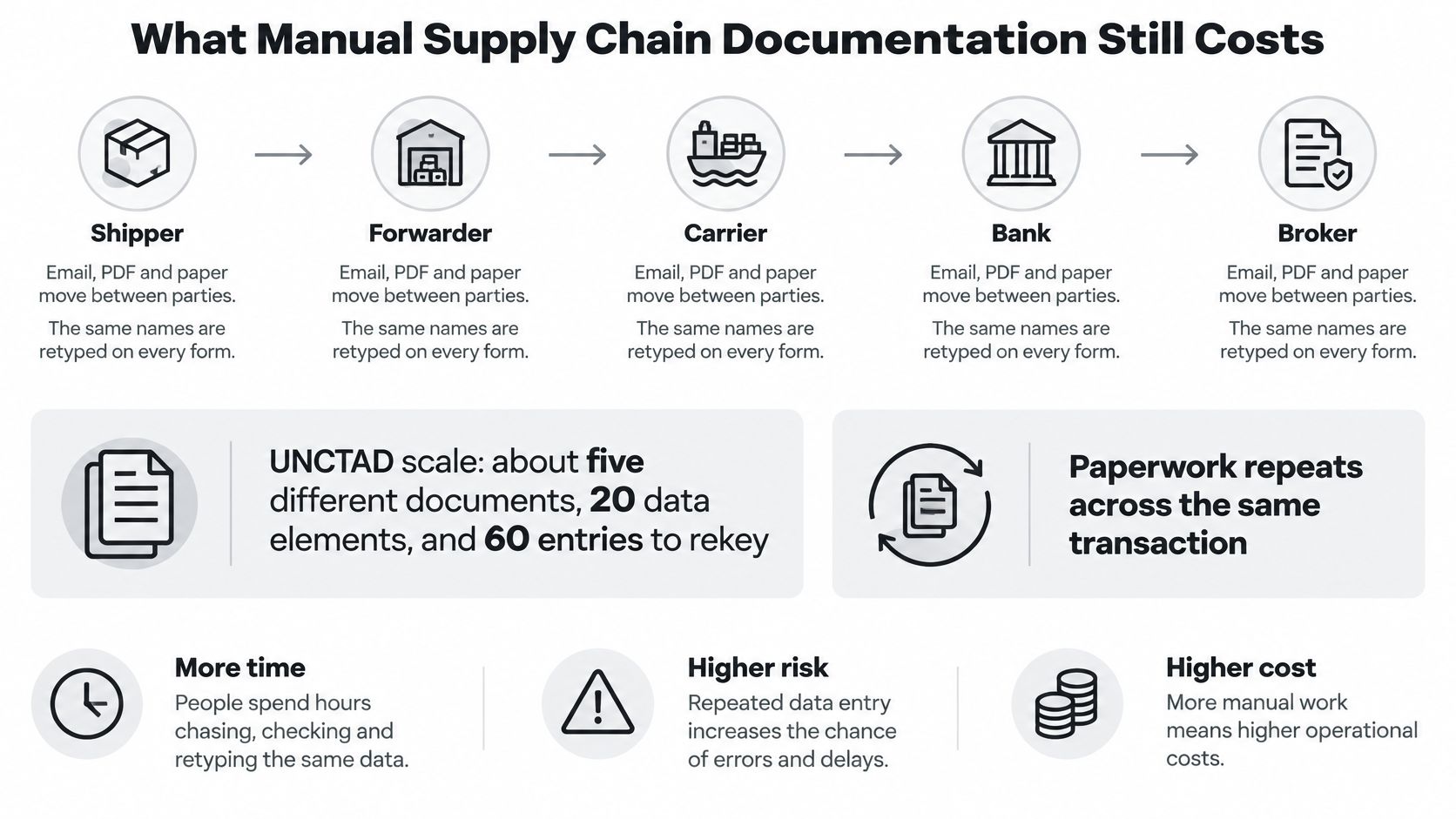
Where the labor goes
A shipper emails a PDF to a forwarder. The forwarder copies party details into booking instructions. A broker requests a missing address, while finance enters the invoice into accounts payable.
Nobody owns the whole packet. Each team fixes the version in front of it, so a corrected consignee name may reach the broker without reaching the carrier.
The hidden costs have recognizable owners:
- Re-keying: Operations staff enter information that another party has already typed.
- Broker queries: Someone must find the missing field, contact its owner and resubmit the correction.
- Release delays: Cargo waits while the responsible parties resolve an inconsistency.
- Payment corrections: Finance investigates duplicate invoices, incorrect coding or unsupported receipts.
- Volume pressure: Managers add clerical capacity because every additional packet requires similar handling.
Parallel paper and electronic processes can preserve this work instead of removing it. A supplier may send a scan even when the buyer has a digital portal, leaving staff to bridge the formats.
Why text-only OCR disappoints
Optical character recognition, or OCR, reads characters from an image. It doesn't understand the business relationship between those characters.
An OCR result might correctly read a consignee on an invoice and a different consignee on a bill of lading. Both transcriptions can be accurate while the shipment file remains unusable.
Practical rule: A searchable PDF is easier to find. Structured, reusable data is what lets another system check and act on its contents.
The useful improvement isn't a clearer scan. It's removing repeated interpretation and typing while making unresolved differences visible to the person who can fix them.
Fields Customs and Tax Rules Require
Mandatory data by document or regime
| Record | Required elements | Fails when |
|---|---|---|
| EU VAT invoice | Date, sequential number, parties, applicable VAT IDs, description, quantity, unit price excluding tax, VAT rate and amount, rate breakdown | An applicable VAT ID, required rate or unique number is missing |
| US commercial invoice for entry | Description, quantity, value, eight-digit HTS subheading, foreign seller or manufacturer name and address | Goods cannot be classified or the invoicing party is unclear |
| Packing list | Packages, marks, net and gross weight, contents | Weights or counts disagree with the transport record |
| Bill of lading | Shipper, consignee, notify party, vessel or voyage, ports, containers, goods | Parties or ports disagree with the applicable invoice or booking |
| Certificate of origin | Exporter, consignee, applicable origin criterion, HS classification, required authorization | Origin wording conflicts with the invoice or supplier file |
| Customs declaration or DUA | Procedure, commodity, customs value, origin, transport mode | Declared value or quantity lacks support in the commercial set |
The table is a validation checklist, not a universal legal template. Certificate requirements depend on the applicable origin arrangement, and transport fields depend on the movement. Encode the rule for the actual lane and document.
For a full VAT invoice, the European Commission's invoicing guidance lists issue date, unique sequential number, supplier and customer details, applicable VAT identifiers, description, quantity, prices excluding tax, VAT rate and amount, and a breakdown by rate or exemption. Capture the transaction or payment date too when it differs from the issue date.
For US entry, CBP's commercial-invoice guidance describes the invoice or acceptable substitute needed before release, including merchandise description, quantities, values, the eight-digit HTS subheading, and the foreign invoicing party's complete name and address. A readable PDF doesn't establish that those fields are complete or correct.
Normalize the meaning, not just the label
The WCO Data Model provides harmonized definitions and messages for cross-border information. Apply that principle by storing a party, location, goods item or transport reference consistently, rather than creating unrelated fields for every supplier's label.
Keep an audit-ready field record containing:
- Original value: Exactly what appeared on the page.
- Normalized value: The standardized name, date, quantity or identifier.
- Applicable code: The relevant classification or location code.
- Source location: Document identifier, page and field coordinates.
- Validation status: Pass, fail or review, with a reason.
Normalization mustn't erase meaningful differences. A seller and shipper can legitimately differ; net and gross weights should not be forced to match. Compare equivalent roles and measures.
Apply the right filing context
A customs declaration expresses a legal procedure, not merely a summary of the invoice. The broker must reconcile the declared values and quantities with their supporting records and explain legitimate adjustments.
Urgency doesn't remove that obligation. Approved Jets' guide to shipping critical parts by air provides useful transport context when an operations team is planning an urgent movement.
A missing required VAT ID, tariff code or party address is an exception to resolve, not an empty cell to overlook.
How to Extract and Validate a Shipment File
Document data extraction is the conversion of a PDF or image into checked, structured fields that another system can use. Yes, invoice extraction can be automated. Safe posting also requires rules that distinguish readable content from acceptable transaction data.
The workflow has separate reading, interpretation and approval stages.
- Ingest the packet. Accept scans, photographs and multipage PDFs. Preserve the received file and assign a shipment reference before processing.
- Classify each page. Identify invoices, packing lists, transport documents and supporting certificates. Don't apply invoice rules to a page of package weights.
- Split mixed packets. Group pages into individual documents. Keep continuation pages attached to their parent record.
- Read with OCR. Extract characters and their page positions. Flag unreadable regions rather than guessing through them.
- Map to a schema. Convert labels into named fields such as
invoice_number,consignee_name,container_referenceandquantity. - Validate the record. Check data types, mandatory fields, arithmetic and equivalent values across documents. Separate a legitimate difference from an unexplained contradiction.
- Return structured results. Deliver JSON with a pass, fail or review status, retaining a source reference for every extracted field.
The operational stages can be summarized visually.
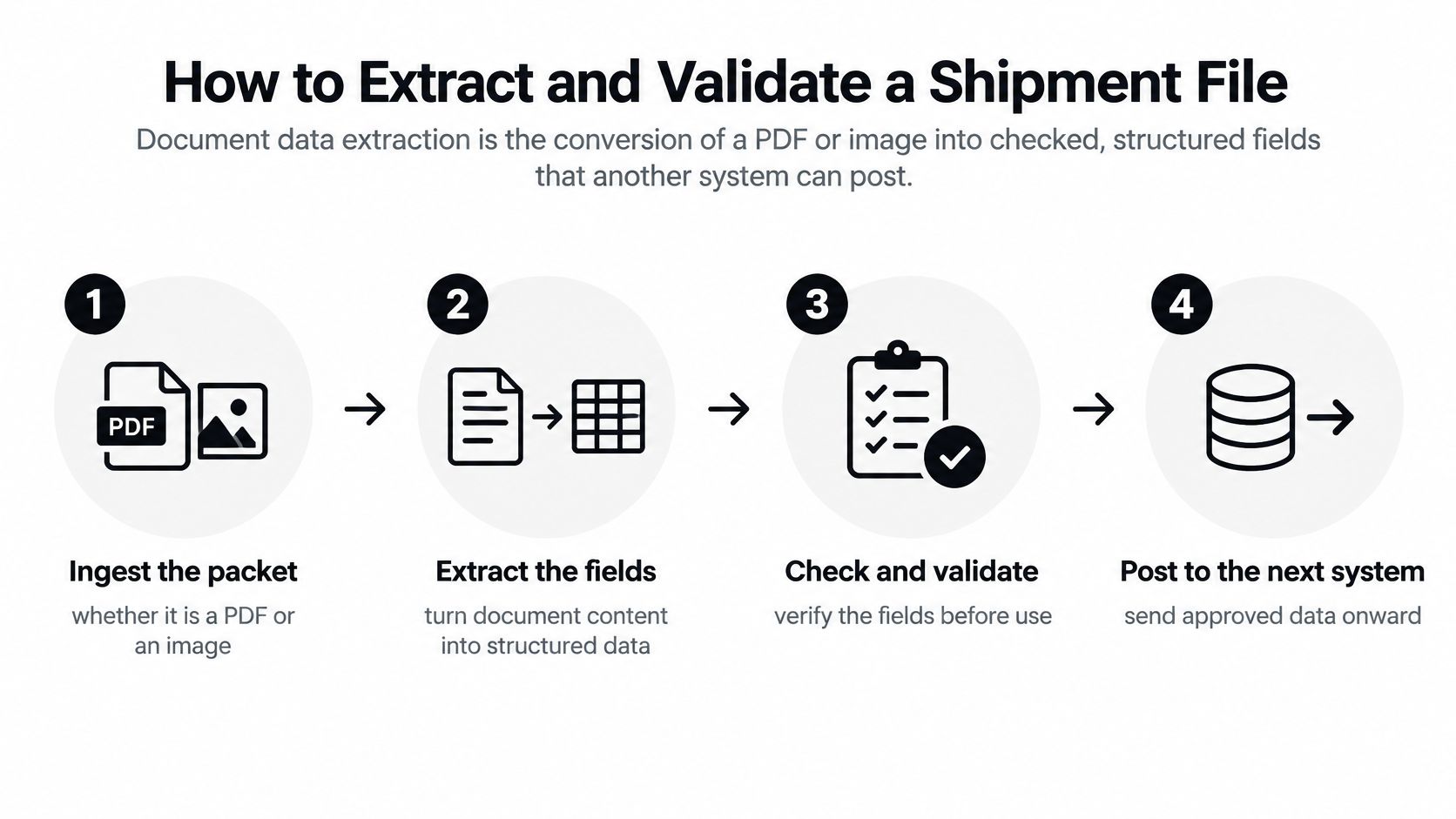
Define what a failed check does
A validation rule needs an action. If the invoice currency is absent, hold the financial posting. If a container reference is unreadable, request a clearer carrier record. If the consignee differs, send both source excerpts to the reviewer.
Create an exception queue with a named owner, reason code and resolution history. Otherwise, automation moves unanswered questions from an inbox into a dashboard.
For implementation detail, the guide to extracting data from PDFs explains the conversion from document content into structured output. The key design choice is the schema: downstream software needs stable fields, not a paragraph of recognized text.
Keep supporting records connected
Not every logistics record belongs in a customs schema. Driver and transport compliance records may require their own matching and retrieval rules.
My Safety Manager's guide to understanding HOS supporting documents is useful when defining that separate supporting-record workflow. Link relevant records to the movement without treating them as substitutes for commercial evidence.
OCR is the reading step. Approval is a business decision enforced by validation rules and accountable reviewers.
Only approved, validated JSON should reach the ERP, customs application or accounts-payable posting function. Review and failed results should remain available for investigation without triggering the transaction they couldn't support.
Controls When the Paperwork Cannot Be Trusted
A 2025 garment-testing program covering approximately 1,000 garments annually across 40 brands found cotton linked to restricted or prohibited regions in 13% of tested items, up from 6% the previous year; 90% of brands had exposure in at least one tested item, according to Retail Gazette's account. Those findings concern the tested program, not all garments or brands. They illustrate the gap between supplier documentation and independent verification.
Documentation can accurately record a supplier's claim without proving the material's actual origin. Extraction accuracy and provenance confidence are different measures.
The controls need to address both.
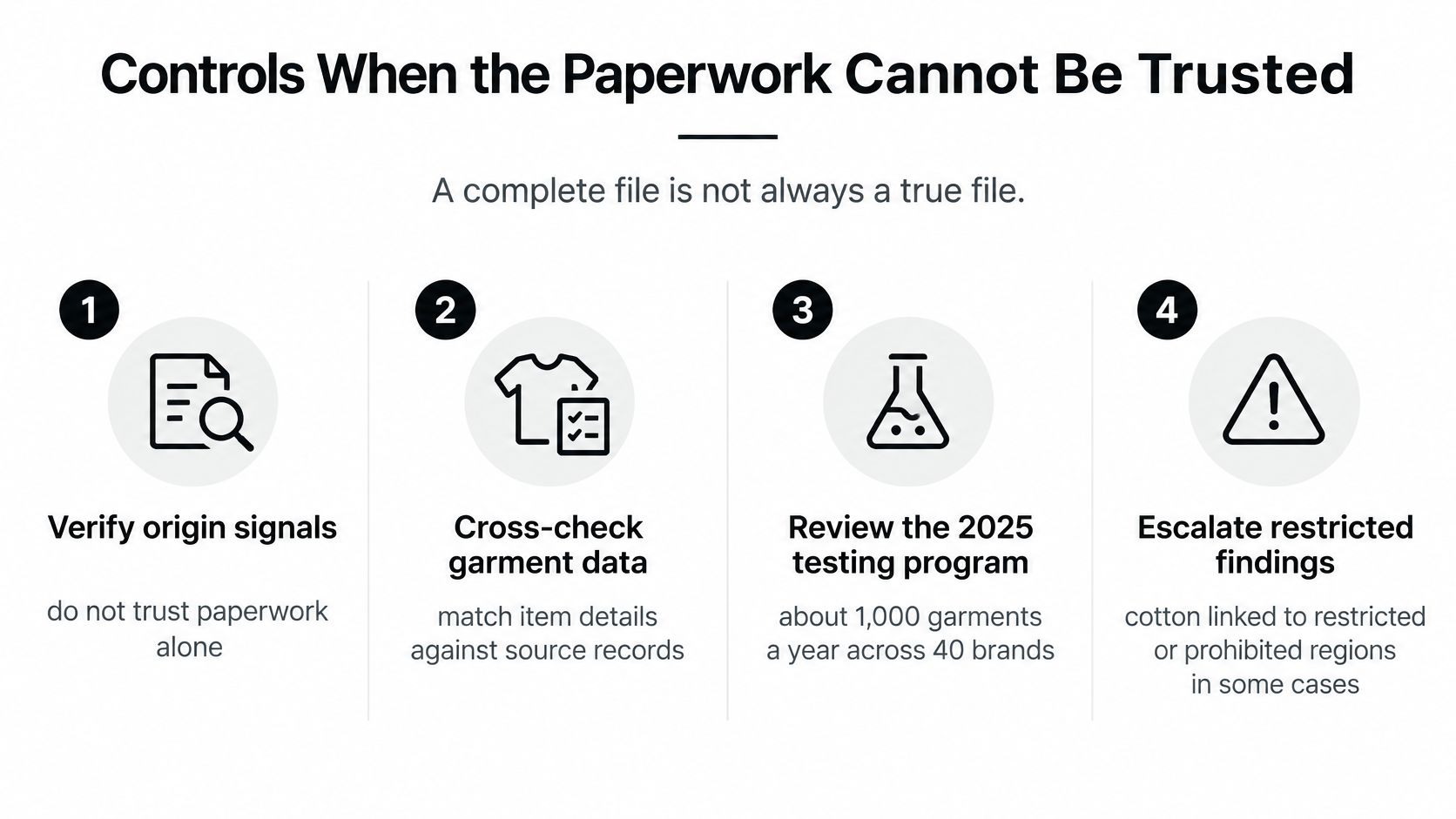
Preserve evidence before interpreting it
Keep the original file immutable. Store a version identifier, receipt timestamp and cryptographic hash, which acts as a fingerprint for detecting later changes.
Separate editable booking instructions from signed commercial records. A correction to an operational field shouldn't overwrite the record that supported a bank decision or cargo release.
The DCSA standards release describes Bill of Lading 3.0 digital signatures for integrity, authenticity and non-repudiation, alongside more than 190 shipping-instruction attributes added in Booking 2.0 to support ICS2 requirements. Validate the attributes applicable to the filing rather than assuming every attribute is mandatory for every shipment.
Score risk separately from reading confidence
A high OCR confidence score means the system is confident about what it read. It doesn't mean the seller is trustworthy or the origin claim is substantiated.
Use distinct controls:
- Document consistency: Compare origin, quantities, party roles and commercial values across equivalent records.
- Supplier identity: Investigate unexplained changes in names, addresses or invoicing entities.
- Provenance risk: Route restricted-origin signals and unsupported material claims for independent review or testing.
- Signature integrity: Stop processing when a required signature cannot be verified.
- Decision confidence: Auto-accept only records that satisfy the relevant evidence and risk rules.
Suppose an invoice and origin certificate agree, but a supplier's material record identifies a different source. Agreement between the first documents doesn't cancel the conflict. The reviewer needs evidence explaining the material path.
Release gate: A clean transcription must never override a failed authenticity check or an unresolved origin conflict.
Reject downstream posting when a mandatory attribute, required signature or material cross-document check fails. Preserve the rejection reason and the evidence used to resolve it.
Set retention periods according to the regime and record purpose. Link each version, review and approved posting to the shipment record so an auditor can reconstruct both the original claim and the decision made from it.
Invoices Bills of Lading and Delivery Notes
A shipment file can be readable and still be wrong. An invoice, bill of lading and delivery note each record a different part of the transaction, so the key fields must agree before the file moves forward.
Electronic formats do not prevent mismatched versions or missing details. Freight paperwork can arrive in different formats, with incomplete fields or conflicting information. The challenge is matching each record to the same shipment and checking what it proves.
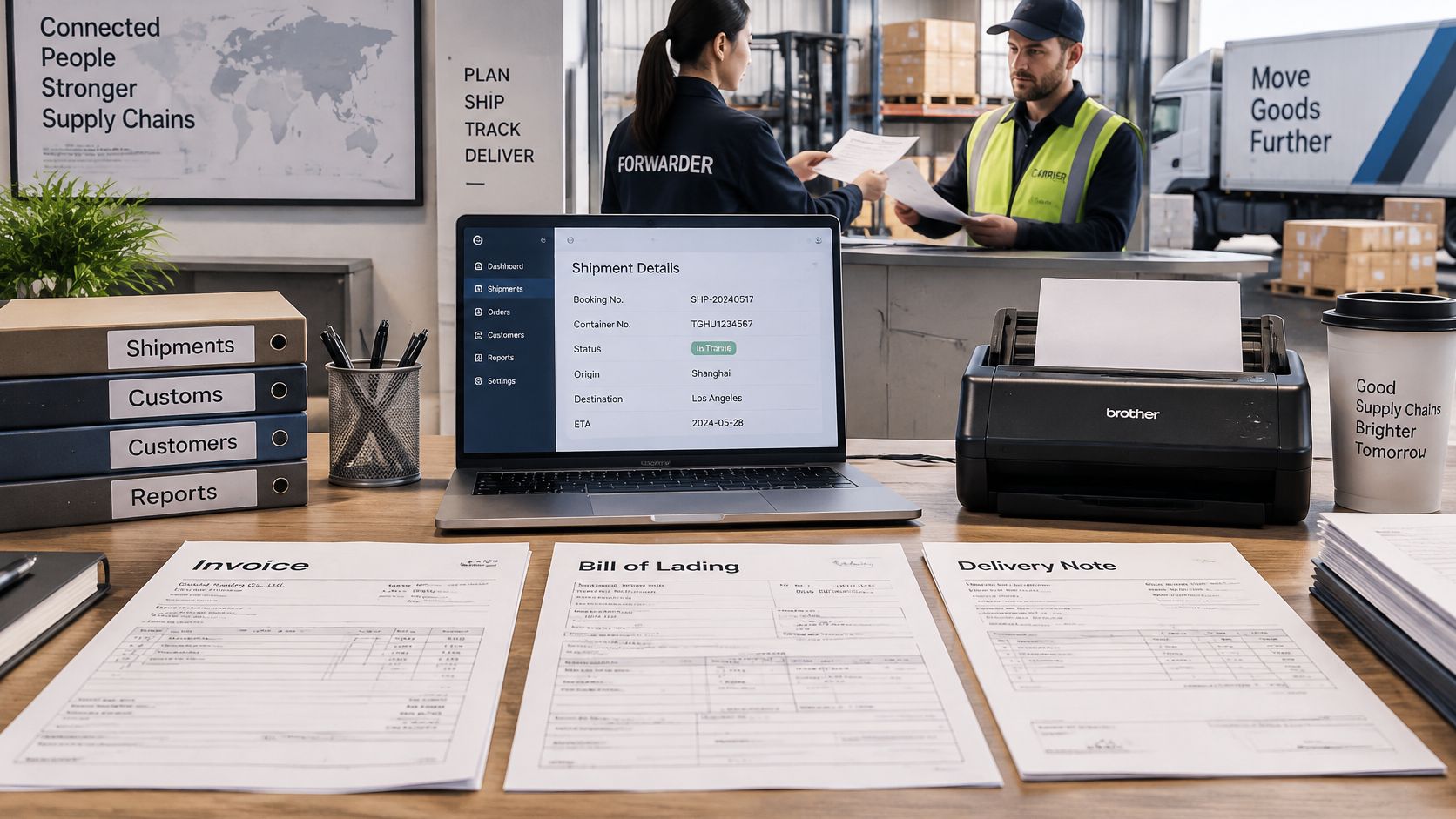
Invoices
Problem: Manual invoice entry takes time before finance can investigate exceptions. AccountingWEB's invoice-cost analysis describes five to fifteen minutes per invoice and cites manual error rates of approximately 1% to 4%. Its example of 500 invoices a month at ten minutes each amounts to about 83 labor hours, or roughly £1,800 at £22 per hour, before rework.
Fix: Extract the invoice header and line items. Check the applicable VAT fields, reconcile the totals, and compare the supplier identifier and invoice number with existing records.
Result: Finance can route suspected duplicates and unsupported tax treatments for review before payment. Extraction does not determine the accounting code; posting still needs purchase-order and ledger context.
Bills of lading and customs files
Problem: A scan contains inconsistent consignee details or incomplete advance-shipping information. The broker cannot tell which version the carrier accepted.
Fix: Identify the authoritative transport record, separate its pages, and reconcile relevant quantities, ports and party roles. Knowing what a bill of lading does in shipping helps distinguish a routine data correction from a change that affects title.
Result: The broker receives a packet with the conflicts identified. Questions that remain unresolved go to the person authorized to address them.
This video offers additional context for the document workflow.
Delivery notes
Problem: A receiving clerk retypes SKU and quantity lines against a purchase order, including partial deliveries.
Fix: Extract the lines, then compare received quantities with open order balances. Route unknown SKUs, excess quantities and damaged-goods annotations for review. Matil's pretrained delivery-note model extracts SKUs and quantities and validates order lines.
Result: Approved receipts can post automatically while exceptions remain visible. Across all three document types, cross-checking fields helps catch contradictions that clean-looking extraction alone cannot resolve. Keep a source for each posted field so reviewers can trace it back to the document.
Pilot One Lane Before You Scale
Choose a repetitive commercial-invoice lane for the first pilot. Its fields and approval boundaries are usually easier to define than the release and title questions attached to negotiable transport documents.
Keep the decision simple:
- Name the documents. Identify the expected packet and its owners.
- Capture the legal fields. Define required values for the actual transaction.
- Refuse contradictions. Give unresolved conflicts an explicit stop condition.
- Post approved data. Make the receiving system respect the validation status.
Establish the acceptance measures
Measure minutes of re-keying per document, exceptions per hundred files, and the share of posted fields with a traceable source before go-live. Test representative poor scans, revised invoices and mixed packets, not just clean samples.
Matil is a practical API-based way to run that pilot. It isn't just OCR: its pipeline combines classification, extraction, validation and automation, with pre-trained models and custom schemas defined by field name, type and description. Its reported accuracy exceeds 99% in multiple use cases, but your acceptance test should measure the fields and documents your own process uses.
Our compositor classifies documents and routes each category to its extraction schema in a single API call. Normal processing returns structured data synchronously for live integrations; Async delivers results through a webhook; Batch accepts hundreds of documents for nightly imports or migrations. For custom documents, our team analyzes examples and prepares an optimized model in less than a week.
Resolve security and retention before uploading
Include GDPR, ISO 27001 and AICPA SOC requirements in the security assessment, and confirm the applicable scope and contractual evidence. Don't interpret a general zero data retention claim as the default operating policy.
By default, we retain processed documents and results for 12 months for audit, traceability and technical support, then delete them automatically. If zero data retention is required, confirm the agreed configuration and deletion terms in writing before sending live files.
Our official API documentation is available through the technical documentation portal. Test a real packet against one document structure, reconcile the output with the source, and expand only when the receiving team accepts both the results and the exception handling.
Matil combines document extraction, classification, validation and workflow orchestration to turn shipment paperwork into structured data for downstream systems. Visit Matil to evaluate a commercial-invoice pilot using a representative packet, defined acceptance checks and agreed retention terms.


