How to Ensure Data Security: A 2026 Compliance Guide
Learn how to ensure data security in 2026 with practical controls, compliant pipelines, and strategies that protect sensitive information.

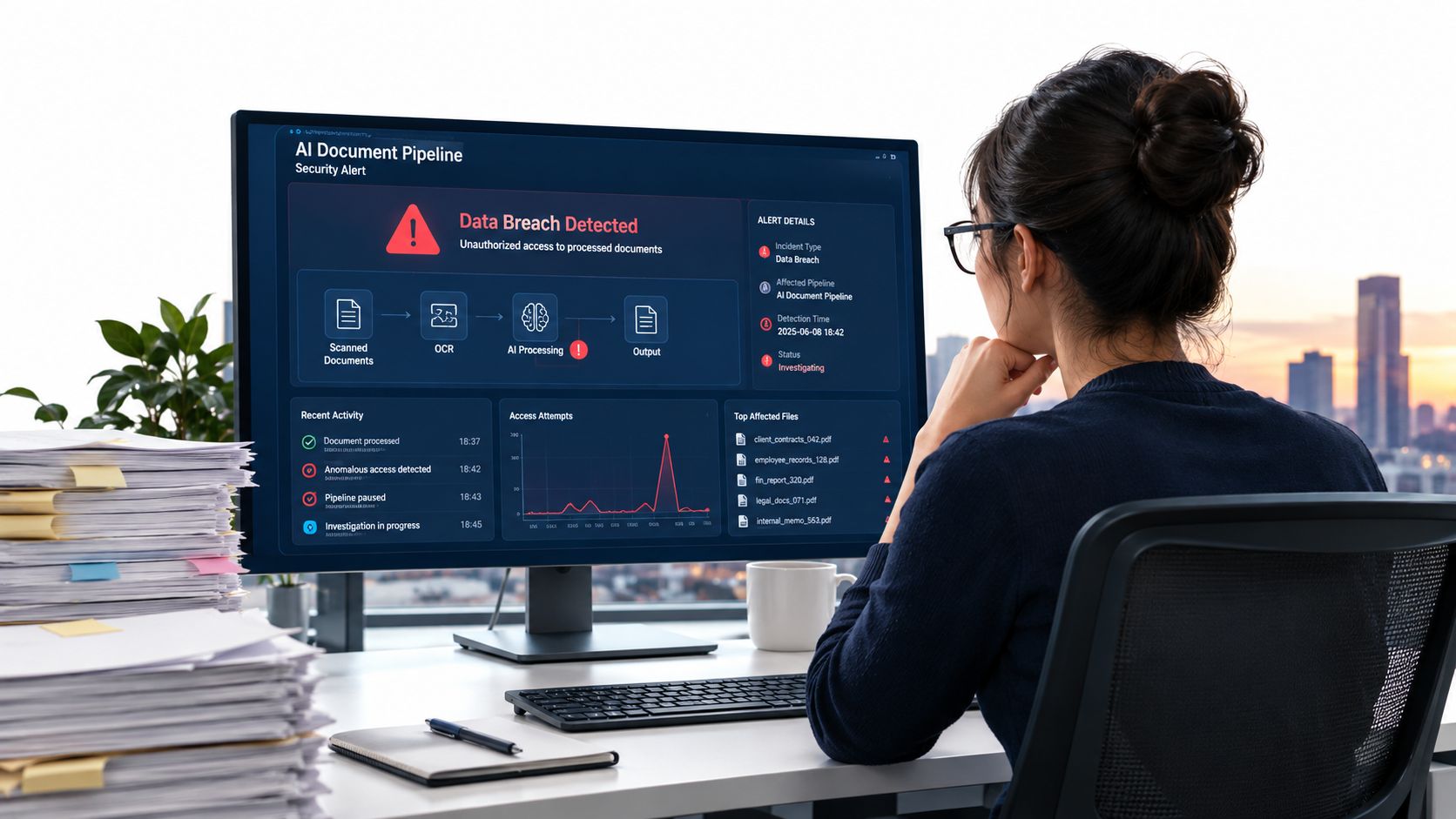
A finance team uploads invoices, payslips, and identity documents to an AI extraction workflow. The files are encrypted and users authenticate with MFA, yet extracted fields appear in application logs, a vendor retains raw images longer than expected, and an API token still has broad access. How to ensure data security in this environment requires more than perimeter controls. It requires governance across every stage of the data lifecycle.
Why Data Security Failures Still Happen
A document pipeline can fail without a dramatic firewall breach. An employee might paste OCR text into an unapproved AI service to resolve a parsing error. A developer might log the full JSON response while debugging. A supplier might retain uploaded documents for support purposes. Each action creates a separate route from a protected upload to an exposed invoice number, bank account, or identity attribute.
Encryption and MFA remain necessary, but neither control answers every operational question. Encryption protects data while it moves or rests, not necessarily when an authorized application writes sensitive content to a verbose log. MFA reduces account takeover risk, but it doesn't prevent an authenticated user or compromised service account from exporting documents beyond its intended purpose.
The 2025 Verizon Data Breach Investigations Report analyzed more than 22,000 security incidents worldwide, including 12,195 confirmed data breaches. Human involvement remained present in approximately 60% of breaches, while third-party involvement doubled to 30%. Those findings point to a structural problem: security depends on people, suppliers, cloud providers, software vendors, and the controls connecting them.
Data security covers the full lifecycle
For document-heavy operations, data security covers:
- Collection: Accept only the documents and fields required for the business process.
- Processing: Restrict model context, isolate tenants, and control service-to-service access.
- Storage: Encrypt raw files, OCR text, structured output, backups, and temporary artifacts.
- Use: Validate who can view, edit, export, or send data to downstream systems.
- Deletion: Apply documented retention rules and verify that deletion reaches replicas and derived data.
- Response: Preserve evidence so teams can investigate access, assess impact, and meet notification duties.
The report also recorded a 37% increase in ransomware activity, with ransomware appearing in 44% of breaches. These figures reinforce a practical principle: defense in depth beats reliance on a single safeguard. A secure pipeline combines identity controls, encryption, patching, segmentation, backups, employee awareness, supplier review, and continuous monitoring.
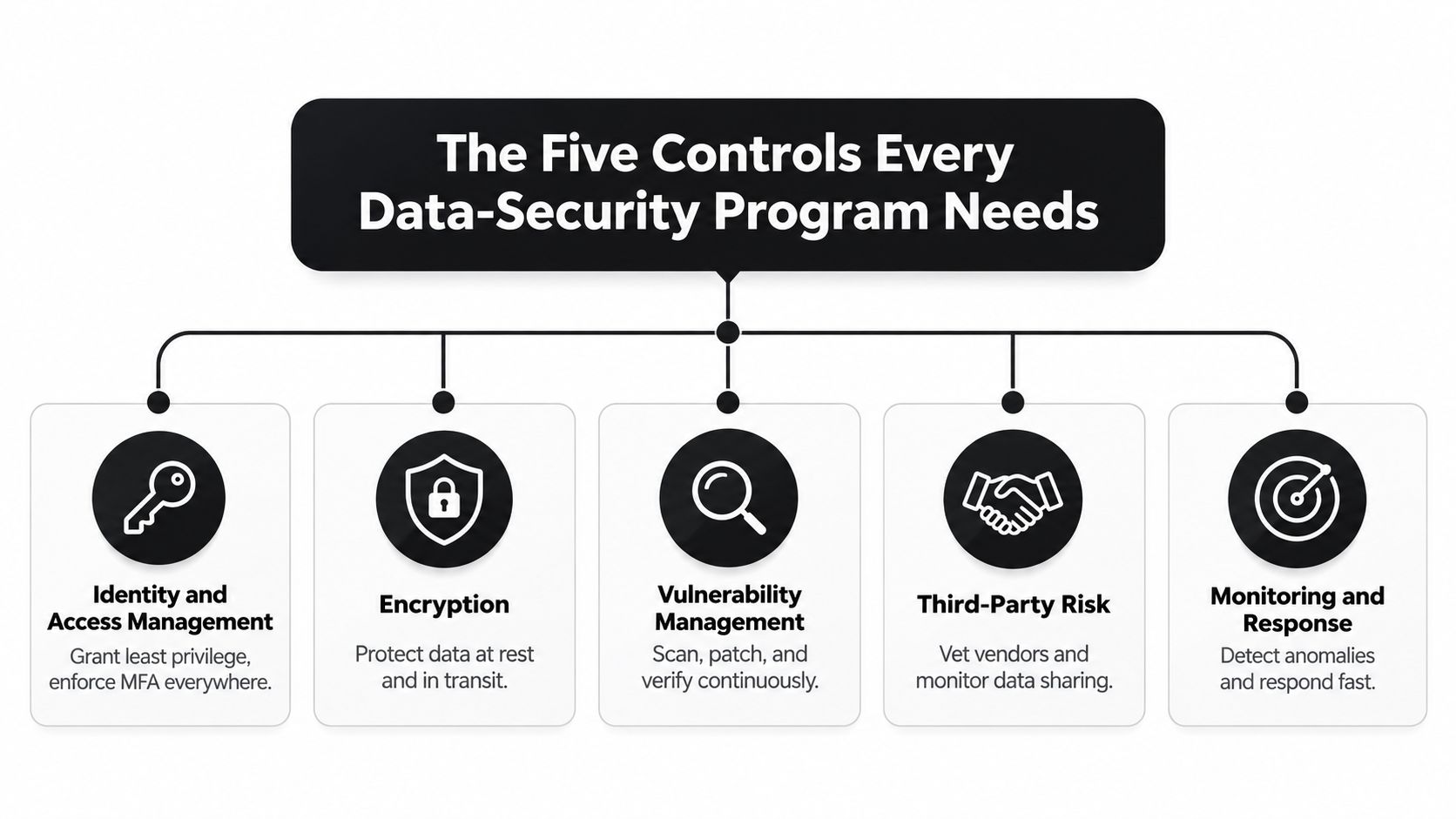
The Five Controls Every Data-Security Program Needs
A workable data-security program turns broad principles into controls that engineers and operations teams can verify. The following five areas cover the points where document workflows most often lose control.
1. Identity and access management
Start with an inventory of human and machine identities. Require phishing-resistant MFA for privileged users, apply least privilege to service accounts, and issue short-lived, narrowly scoped tokens for document APIs. Separate production, staging, internal testing, and customer tenants so a debugging account can't reach unrelated data.
Review privileged access monthly. Measure how quickly the team can revoke a user, token, or supplier credential. Access should be granted for a defined purpose, recorded, and removed when that purpose ends.
2. Encryption and key control
Protect documents and derived JSON in transit and at rest. For sensitive workflows, decide who controls encryption keys, how keys are rotated, and which administrators can access them. Encryption isn't a substitute for authorization, but it limits the value of copied storage and intercepted traffic.
Retention deletion must cover raw images, OCR text, model inputs, structured outputs, queues, caches, and backups. A deletion request that removes only the visible file doesn't meet the operational need.
3. Vulnerability management
Scan internet-facing services, libraries, container images, and document-processing dependencies continuously. Define a remediation SLA for critical vulnerabilities, then verify that the patch reached production rather than merely closing a ticket.
Test the result. A secure configuration should survive dependency changes, new integrations, and deployment automation. Vulnerability management fails when teams treat scanning as evidence of safety instead of using it to drive remediation and verification.
4. Third-party governance
A supplier that receives invoices or KYC documents becomes part of the security boundary. Assess independent audit evidence, subprocessors, breach-notification commitments, regional processing, access controls, retention periods, and deletion guarantees. Review whether the vendor uses customer data for training or other secondary purposes.
For a broader operating perspective, enterprise data security strategies for 2026 can help teams compare governance, access, monitoring, and response priorities without reducing the program to a certification exercise.
5. Monitoring and incident response
Log authentication, API reads, writes, exports, model decisions, validation failures, retention actions, and administrative changes. Keep sensitive payloads out of logs. A timestamp and document identifier can support investigation without copying the entire payslip or identity document into an observability platform.
Write containment playbooks for compromised API keys, malicious insiders, prompt injection, vendor exposure, and document exfiltration. Test restoration from backups and confirm that the team knows who makes the notification decision.
Practical rule: If a control can't produce an owner, an audit record, and a test result, it isn't operational yet.
Mapping Data-Security Controls to Compliance Requirements
Auditors rarely accept a policy by itself. They look for evidence that the policy governs real systems, users, suppliers, and incidents. NIST Cybersecurity Framework 2.0 provides a useful structure because it connects governance with technical protection and recovery.
Use NIST as an operating model
The framework now organizes work around six functions:
| Function | Evidence in a document-processing environment |
|---|---|
| Govern | Data owners, risk tolerances, retention rules, supplier responsibilities |
| Identify | Inventories of data stores, document classes, processing purposes, and trust boundaries |
| Protect | MFA, least privilege, encryption, secure development, training, and segmentation |
| Detect | Access telemetry, integrity alerts, anomaly detection, and monitoring coverage |
| Respond | Containment, communication, investigation, and notification playbooks |
| Recover | Tested restoration, recovery objectives, lessons learned, and control improvements |
NIST's history matters because the framework shifted cybersecurity toward continuous, risk-based management. The first version was published on February 12, 2014, after a process initiated by Executive Order 13636 on February 12, 2013. The framework remains voluntary guidance built from existing standards and practices, which makes it adaptable across sectors.
Measure coverage rather than collecting certificates. A practical target is 100% of production data stores mapped to an owner and classification, 100% of privileged access protected by phishing-resistant MFA, and quarterly restoration tests that achieve a documented recovery-time objective, as described in the NIST Cybersecurity Framework 2.0 publication.
GDPR turns traceability into an operating requirement
Under Article 33 of the GDPR, an organisation must notify the relevant supervisory authority without undue delay and, where feasible, no later than 72 hours after becoming aware of a personal-data breach, unless the breach is unlikely to create a risk to individuals' rights and freedoms. The notification should describe the breach, affected categories and approximate numbers where possible, likely consequences, and corrective measures.
The European Data Protection Board's breach guidance also emphasizes recording when the organisation became aware, how it assessed risk, the effects, and remedial steps. For automated document processing, timestamps, access history, validation outcomes, retention actions, and incident decisions become audit evidence.
FATF requires more than OCR output
FATF Recommendation 10 and its digital-identity guidance require regulated entities to identify customers and verify identities using reliable, independent evidence. OCR can read a name or identification number, but it doesn't prove that the evidence is authentic or that the attributes resolve to one unique person.
A KYC workflow therefore needs document classification, field-level validation, consistency checks, identity matching, exception handling, and an auditable record of the evidence used. FATF's broader digital identity guidance also connects onboarding to ongoing due diligence and transaction scrutiny. Teams assessing AI controls can supplement this framework with Agentable audit guidance, then document how each control operates in production. For background on assurance terminology, see SOC 2 compliance, while remembering that certification doesn't replace continuous testing.
Securing AI Document-Extraction Pipelines End to End
AI adds security decisions that traditional OCR workflows often hide. A document can leak through a prompt, model context, debug trace, retained upload, agent action, or downstream ERP integration even when the original storage bucket is well protected.
Recent evidence in the World Economic Forum's Global Cybersecurity Outlook 2026 found that 87% of surveyed organizations identified AI-related vulnerabilities as the fastest-growing cyber risk during 2025, while generative-AI data leaks were among the leading concerns for 34% of respondents looking toward 2026. The numbers describe the pressure, but the implementation response is concrete.
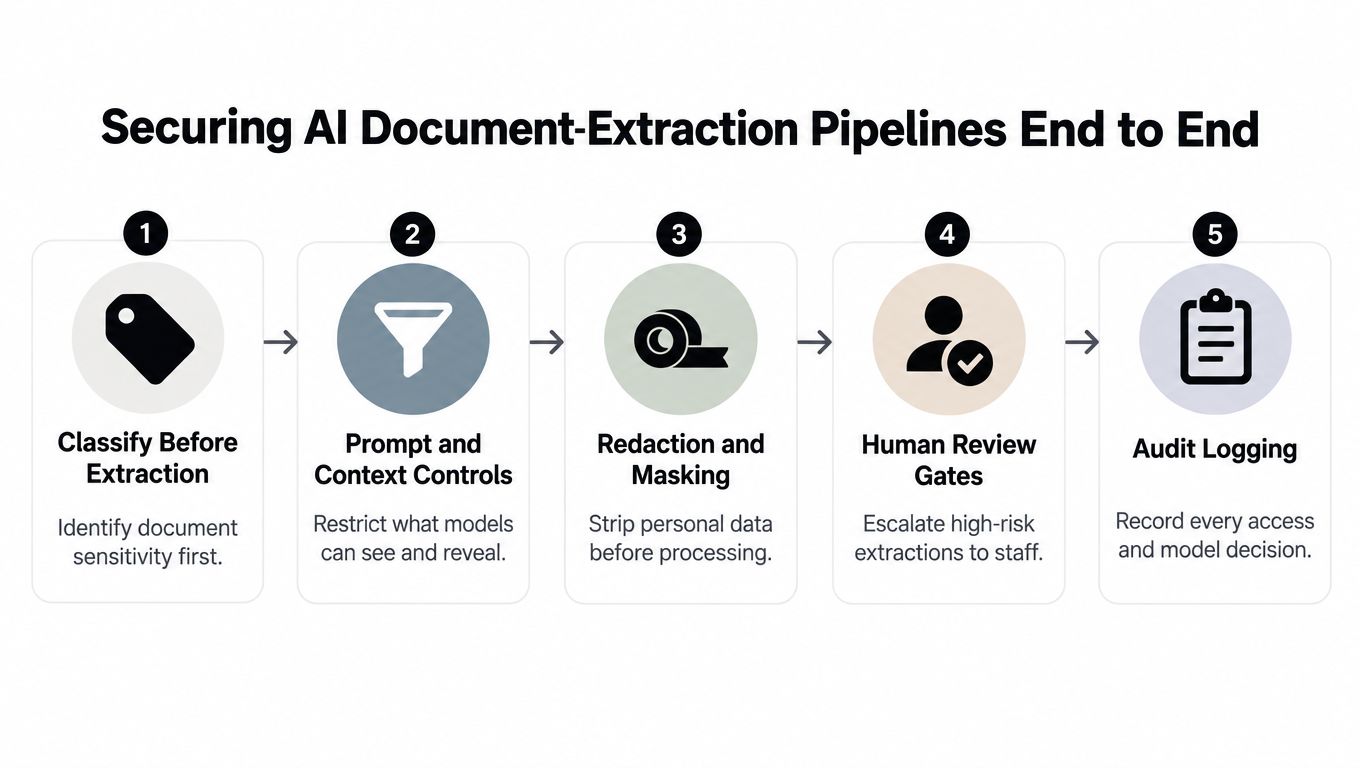
Apply controls at each stage
Classify before extraction. Identify whether the upload is an invoice, payslip, passport, bank statement, contract, Bill of Lading, or customs declaration. Assign sensitivity and processing rules before sending content to a model.
Minimize model context. Send only the pages and fields required for the task. Restrict prompts and retrieved context so an extraction model can't reveal unrelated customer records or hidden instructions embedded in a document.
Redact and mask sensitive fields. Where the workflow permits, mask unnecessary account numbers, addresses, or identification attributes before processing. Keep the mapping protected and separate from routine application logs.
Isolate tenants and roles. Use separate customer namespaces, role-based permissions, and scoped service accounts. A model-processing worker should access the current job, not every document in the platform.
Validate before downstream writes. Check field types, totals, dates, identity consistency, duplicate records, and confidence thresholds before writing extracted data into an ERP, CRM, payment system, or KYC case file. Route high-risk exceptions to a trained reviewer.
Record decisions without copying secrets. Log who accessed the file, which model or rule ran, what validation failed, and what action followed. Avoid storing raw images, full OCR text, passwords, or sensitive prompt context in logs.
Test misuse continuously. Send controlled prompt-injection documents, malformed PDFs, duplicate identities, and exfiltration attempts through the pipeline. Confirm that the system blocks, quarantines, or escalates them.
A zero-retention statement isn't enough. Buyers need evidence about subprocessors, regional processing, encryption-key ownership, access telemetry, incident response, and training use.
For teams evaluating retention claims, zero data retention for AI provides useful terminology for the questions procurement and engineering should ask. Matil.ai can be evaluated as one document-extraction option because its API combines OCR, classification, validation, and workflow orchestration, with pre-trained and customizable models, structured JSON output, traceability, GDPR, ISO 27001, and AICPA SOC positioning, plus a zero data retention policy.
The pipeline should also preserve deletion evidence. When an invoice or identity document reaches its retention limit, remove the original, derived OCR, structured output, temporary files, caches, and applicable backups, then record the action and its result.
Why Automation Without Governance Increases Breach Risk
Automation can reduce repetitive access and standardize controls, but it can also increase the speed and reach of a mistake. A finance employee who uploads a payslip to an unapproved assistant may bypass retention, regional-processing, and audit requirements in one action. A developer who enables verbose logging may replicate sensitive documents across monitoring systems before anyone notices.
The 2025 Verizon executive summary identifies human involvement, supplier exposure, and vulnerability exploitation as recurring access problems. The operating response isn't to remove people from every workflow. It is to define approved data paths, restrict permissions, log meaningful events, and give staff a clear escalation route.
IBM's 2025 findings add a useful trade-off. Organisations using AI and automation extensively had an average breach cost of USD 3.62 million, compared with USD 5.52 million for organisations that did not, a difference of USD 1.9 million, according to the source described in the Verizon executive summary. Automation can therefore support resilience, but only when teams govern where it runs and what it can access.
Governance must constrain speed
Shadow-AI incidents were associated with higher breach costs in the same evidence. Approved integrations, prohibited destinations, human escalation, and payload inspection matter more than just adding another model to the workflow.
- Approved paths: Route confidential documents through sanctioned applications and vendors.
- Explicit prohibitions: Ban uploads to unapproved services, personal accounts, and unreviewed plugins.
- Human escalation: Require review for uncertain identity matches, unusual exports, and high-risk document classes.
- Evidence: Preserve access, deletion, validation, and incident records without placing raw content in logs.
Technical teams can use governance of information security as a reference point when defining ownership and decision rights. Smaller organisations may also need external operational support, such as F1Group Lincoln IT support, for monitoring, response preparation, or control maintenance. The provider matters less than the discipline: every external helper must have scoped access, documented responsibilities, and a clear offboarding process.
Prioritized Actions for Finance, Operations, and CTO Teams
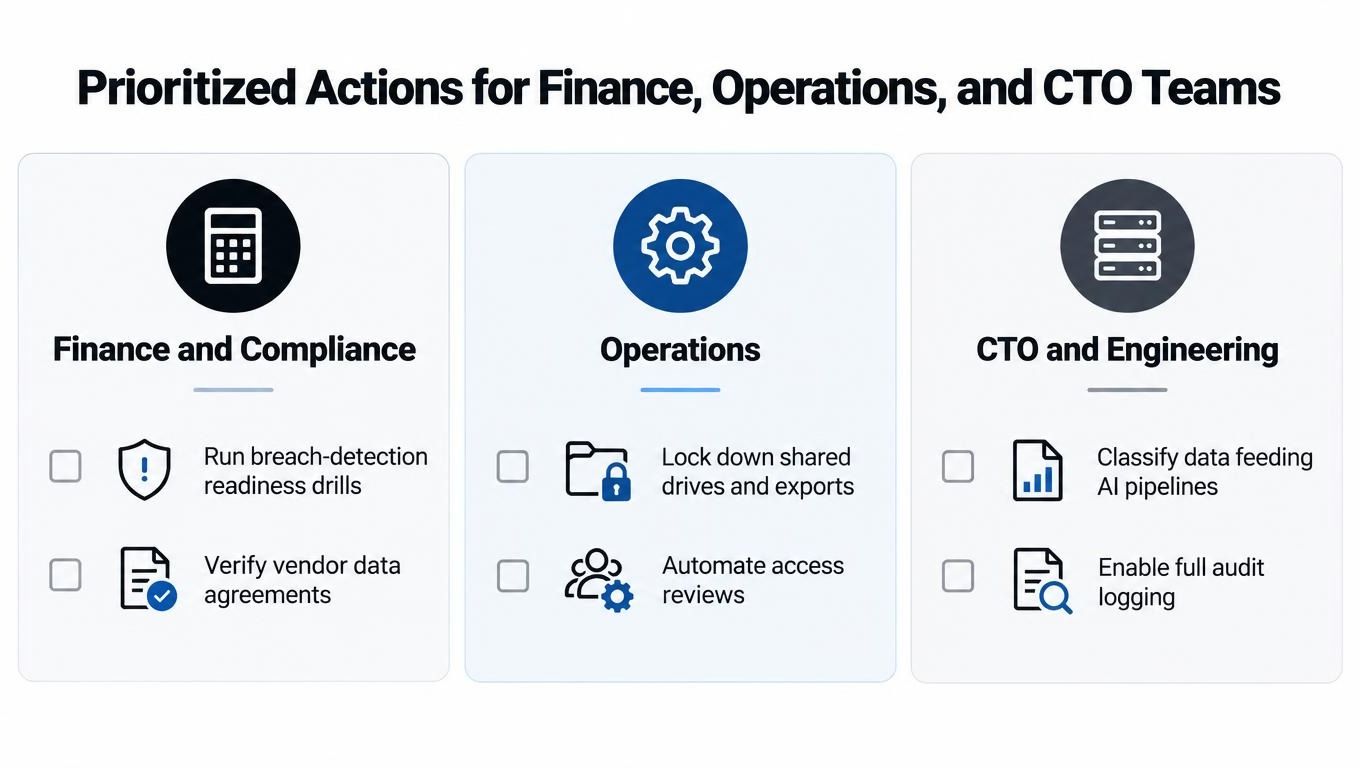
Security programs stall when every team receives the same checklist. Finance needs evidence and notification readiness. Operations needs repeatable workflows that prevent uncontrolled exports. CTOs and engineers need enforceable technical boundaries with measurable coverage.
Finance and compliance
Start with the records needed to explain a breach. Confirm that the team can identify when an incident occurred, when it was discovered, which documents were affected, who accessed them, and what containment followed. Test the notification decision process against the GDPR requirements rather than waiting for a real event.
Then review retention and supplier evidence:
- Retention rules: Map legal and operational retention periods to invoices, payslips, KYC files, contracts, and logistics documents.
- Vendor agreements: Verify subprocessors, processing regions, deletion guarantees, breach commitments, and permitted data use.
- Evidence packets: Keep current access reviews, risk assessments, restoration results, incident records, and control-owner attestations.
- KYC quality: Require evidence validation and identity matching, not just extracted names and numbers.
Operations and back-office teams
Operations teams control how documents enter the business. Classify documents at intake, separate high-risk categories, and define what happens when extraction confidence or validation results fall outside an approved rule.
Standardize exception handling for invoices with mismatched totals, payslips with inconsistent employer data, identity documents with duplicate identifiers, and logistics forms with missing shipment references. A human review gate should have a named owner, a decision reason, and a route back into the controlled workflow.
Lock down shared drives and exports. Many incidents happen after the extraction step, when a user downloads a spreadsheet, forwards a PDF, or copies structured data into a personal workspace. Use role-based folders, managed transfer mechanisms, and access reviews that remove stale permissions.
CTOs and engineering teams
Build a system inventory that includes raw uploads, OCR artifacts, prompts, model context, structured JSON, queues, caches, backups, and downstream integrations. Assign every store an owner and classification. Without that map, retention deletion and incident scoping remain assumptions.
Prioritize the controls that limit blast radius:
- Authenticate APIs strongly. Use short-lived, scoped credentials and rotate compromised keys quickly.
- Isolate tenants. Enforce tenant identifiers at every storage, processing, and export boundary.
- Protect privileged access. Require phishing-resistant MFA and review administrative permissions.
- Sanitize telemetry. Log event metadata and decisions, not full document payloads.
- Test realistic misuse. Exercise compromised keys, malicious insiders, prompt injection, document exfiltration, and supplier access.
- Measure coverage. Track mapped data stores, privileged MFA coverage, vulnerability remediation within SLA, access-revocation time, detection time, and vendor-control coverage.
Security improves when teams can prove what the system does, not when they can only describe what it should do.
NIST CSF 2.0 treats security as a cycle of governance, identification, protection, detection, response, and recovery. Apply that cycle to every document type and every supplier. The strongest automation program isn't the one with the fewest human decisions. It's the one that reserves human attention for high-risk exceptions while enforcing safe defaults everywhere else.
If you're evaluating document automation, Matil combines OCR, document classification, field validation, structured extraction, and workflow orchestration through an API, with controls designed for sensitive business documents. Visit Matil to assess whether its extraction workflows fit your security, compliance, and operational requirements.


