JSON Schema Validation Java: A Practical Guide
JSON schema validation Java teams can ship: pick a 2020-12 library, cache the schema, and return path-level API errors.

The most popular advice on JSON Schema validation in Java is to pick the fastest library and move on. That's backwards. I would pin the draft first, decide whether format should reject anything, cache one compiled schema, and only then worry about throughput on your own payloads.
Swapping validators won't fix a schema written for the wrong dialect. It also won't fix a pipeline that reparses the same file on every request, or an invoice check that treats a structural pass as business approval.
Java Libraries for Draft 2020-12 Validation
For a new Java service, declare https://json-schema.org/draft/2020-12/schema in $schema and pick a library that implements that dialect. You're usually adding this check to Spring or Quarkus, a Kafka consumer, or an ETL job that already parses JSON with Jackson. The library choice matters, but mostly as a filter for draft support, not as a performance trophy.
Start with networknt json-schema-validator unless you have a reason not to. It covers the older drafts teams still inherit and the modern ones you should target, loads schemas from the classpath or a URI, and lets you hold a compiled JsonSchema for reuse across requests. That reuse is the feature you'll feel in production.
How the Options Differ in Practice
json-sKema is the spec-oriented pick when strict 2020-12 behavior matters, including dynamic references, and you don't need older keyword sets dragging along. Harrel json-schema is the compliance-minded alternative across the same modern ground, worth shortlisting when dialect correctness matters more than picking the name everyone recognizes.
By contrast, everit still shows up in legacy builds, but it stops at Draft 7. Point a 2020-12 schema at it and you've created a silent contract bug, because keywords you think are enforced may not mean what you wrote. victools jsonschema-generator solves a different problem entirely, since it writes a schema from records or POJOs and doesn't validate instances, so pair it with one of the actual validators above.
| Library | Maven artifact | Drafts | Validates instances | Choose when |
|---|---|---|---|---|
| networknt json-schema-validator | com.networknt:json-schema-validator | Draft 4, 6, 7, 2019-09, and 2020-12 | Yes | Default for Spring, Quarkus, and long-lived API workers |
| json-sKema | com.github.erosb:json-sKema | Through 2020-12 | Yes | You want stricter 2020-12 behavior and dynamic refs |
| everit | org.everit.json.schema:org.everit.json.schema | Up to Draft 7 | Yes | Legacy code already pinned to Draft 7 or earlier |
| Harrel json-schema | dev.harrel:json-schema | Draft 4, 6, 7, 2019-09, and 2020-12 | Yes | Dialect compliance matters more than ecosystem familiarity |
| victools jsonschema-generator | com.github.victools:jsonschema-generator | Emits 7, 2019-09, or 2020-12 | No | You generate a schema from Java types, then validate elsewhere |
One decision travels with whichever row you pick: format is annotation-only by default in 2020-12, so a "format": "email" keyword documents intent but rejects nothing unless you enable format assertions. If your contract depends on it, turn assertion on explicitly and test that it fires.
Lock one row and one $schema URI, then write compatibility tests against that pair. Don't let throughput numbers from someone else's benchmark talk you into switching libraries before you've measured allocation on your own invoices, receipts, or event payloads.
JSON Schema validation checks that a JSON document matches a schema's structure and rules, and returns the list of failures.
That list of failures is the useful output. A bare pass or fail tells the caller almost nothing about what to fix next.
How to Validate a Payload and Cache the Schema
Build the pipeline in a fixed order and keep it boring. The sequence below uses networknt names, and the same order applies if you choose json-sKema instead.
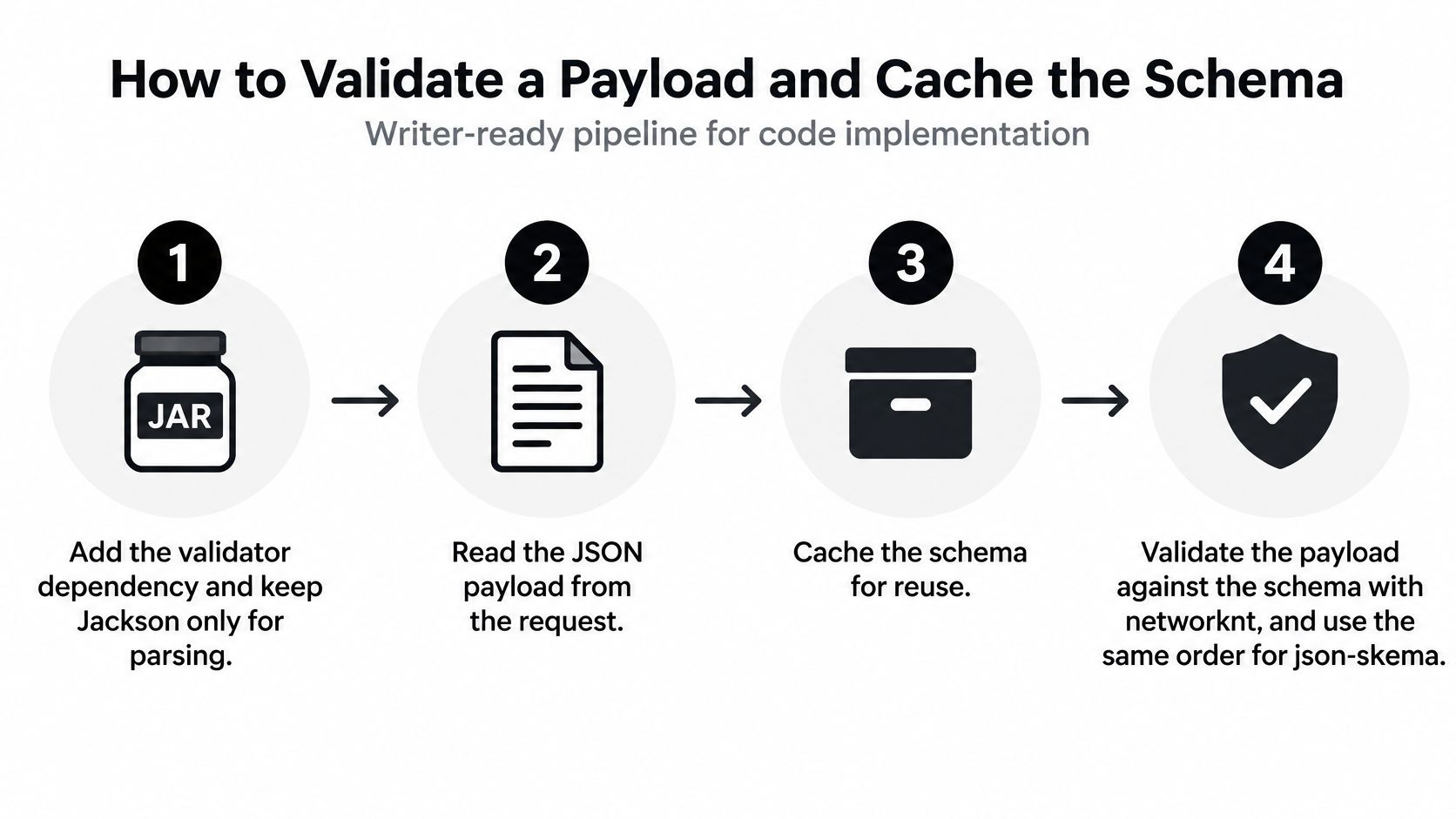
- Add the dependency first. Add the validator and keep Jackson only for parsing, so parsing and validation stay separate jobs.
- Pin the dialect in the file. Store the schema on the classpath and set $schema to
https://json-schema.org/draft/2020-12/schemaso the factory can't guess. A schema that omits this line gets resolved against whatever default the library ships, and that default is not always the draft you tested against. - Compile once at startup. Build one JsonSchemaFactory with SpecVersion.VersionFlag.V202012, call getSchema on the stream, and hold that JsonSchema for the process lifetime.
- Parse each payload once. Turn the request body or record into a single JsonNode and don't parse it again inside the validator.
- Validate the node. Call schema.validate(node), where an empty set means structural success and any ValidationMessage means failure.
- Return structured failures. Map each message to HTTP 400 or a dead-letter record using the instance location, keyword, and schema location, never only a boolean.
- Don't rebuild per call. Recreating the factory or schema reparses the file and resolves $ref again for no benefit.
That order is deliberate, and it's the sequence I'd hand to any team wiring this up: pin the dialect, compile and cache once, parse each payload a single time, then hand back structured error paths. Mixing keywords from different drafts is an easy mistake when schemas get copied between services, so I check the JSON Schema documentation hub whenever I'm unsure which vocabulary a keyword belongs to. A broken reference should surface as a startup failure, not as a per-request surprise.
Step 7 deserves one more sentence, because it's where the actual cost hides. Caching the compiled schema only pays off if the per-request path stays cheap, so measure allocation on your own payloads before and after you wire this in. An invoice with forty line items allocates very differently than a bare event envelope, and library benchmarks rarely look like either.
One Small Invoice Example
Say your object has invoiceId as a string, issueDate as a string, totalAmount as a number, and lines as an array of objects with sku and quantity. A valid body supplies all four fields with those types. The same body missing totalAmount should fail on required at the root, and your response should name that path so the producer can fix it without guessing.
A format keyword on issueDate may not reject a bad date until assertion mode is on. Don't learn that from a production incident. Test the exact configuration you ship and add an application-level date check where the business cares.
The short walkthrough below shows the same validate and return errors flow in code form.
Minimum Fixtures Before You Ship
- Valid fixture: A complete invoice that should pass without warnings.
- Missing and mistyped fields: One case with a required field absent and one with a string where a number belongs.
- Closed shape cases: An unknown property, a boundary number, and a bad pattern.
- Nested and reference cases: An error inside lines, plus a broken $ref that should fail loudly.
Your caller contract is a list of paths the client or ETL operator can fix. If the error output doesn't support that, the validator is only half wired in.
Why Valid Schemas Still Pass Bad Invoices
A green result creates a false sense of safety. The schema can be valid, the instance can pass, and the invoice can still carry a nonsense date, an unknown currency, or a tax identifier your ledger will reject later.
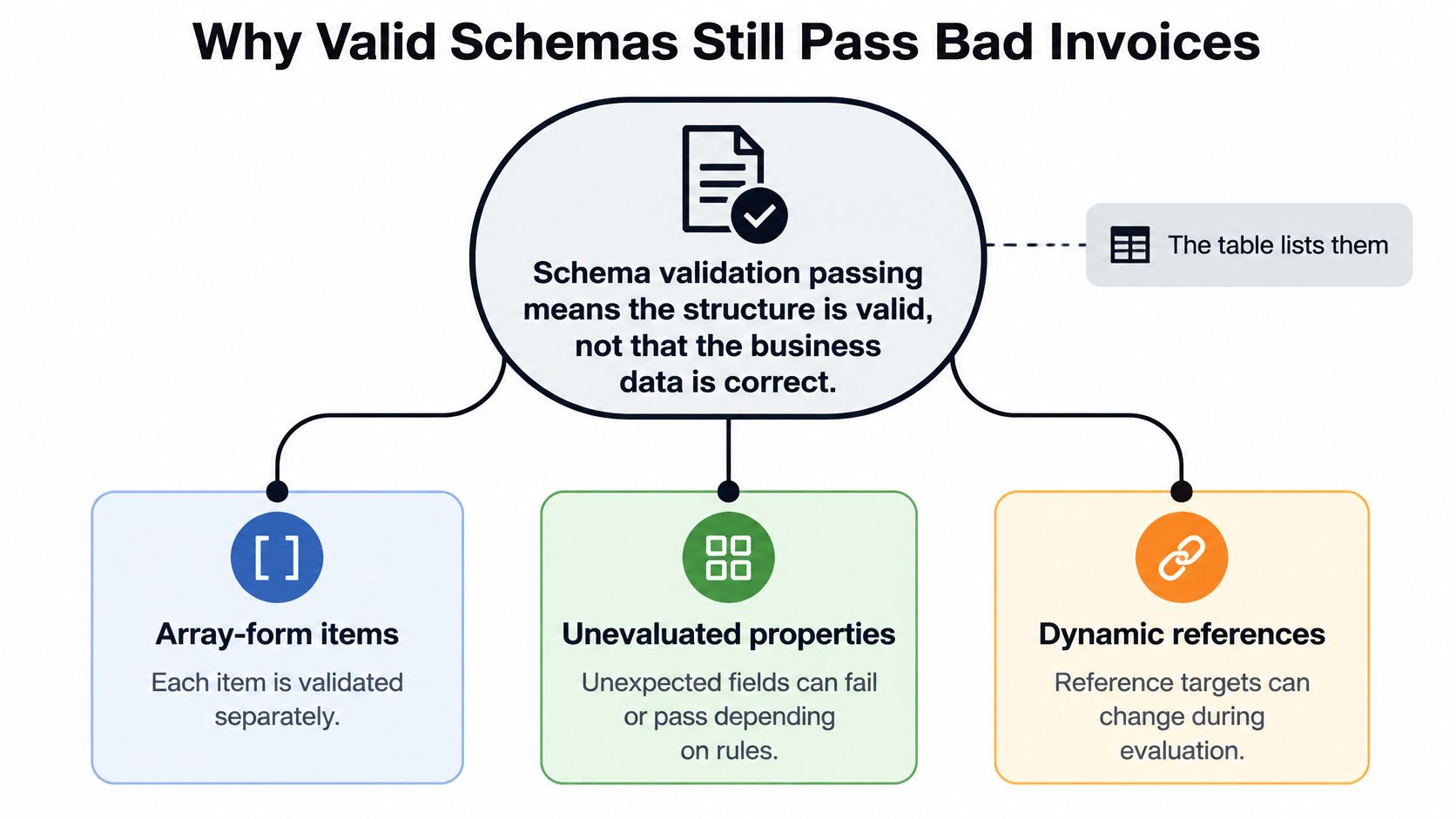
The Draft 2020-12 release notes state that Draft 2020-12 was published on 16 June 2022, and they record the format vocabulary being separated into annotation and assertion concepts. The same release replaced array-form items and additionalItems with prefixItems and schema-form items, and replaced $recursiveRef and $recursiveAnchor with $dynamicRef and $dynamicAnchor.
| Change | What it does now | What breaks if you ignore it |
|---|---|---|
| items and additionalItems | Replaced by prefixItems and schema-form items | Tuple rules from Draft 7 validate different positions |
| $recursiveRef and $recursiveAnchor | Replaced by $dynamicRef and $dynamicAnchor | Recursive refs written for the old keywords stop matching |
| format | Annotation-only by default since Draft 2019-09 | Bad dates, emails, and uris pass unless assertion is enabled |
What This Means for Invoices
Pin the 2020-12 dialect URI on every schema and don't mix Draft 7 keywords into 2020-12 documents. Then check bad invoice dates, tax ids, currencies, and country codes in application code with real calendars and allow-lists, because that's where accounts payable invoice processing either stays clean or turns into manual reconciliation.
Compatibility tests should cover $ref, arrays, formats, and unevaluatedProperties, not only basic type checks. A test suite that only proves strings are strings will miss every change in the table.
A passing schema check is structural validation, not business approval.
Keep those two gates separate in code and in logging. When a finance user asks why a bad invoice got through, you want to answer which gate passed it and why.
Schema Design Tips for Closed API Contracts
Treat the schema as the contract, not as a mirror of every Java field. A DTO can carry convenience fields for internal use. The schema should only promise what producers must send and what consumers can rely on.
Require the fields a downstream ledger or API can't invent, such as invoiceId, currency, totalAmount, and at least one line. Type every property, even when the type feels obvious, because untyped properties accept almost anything and widen your contract.
Add Constraints Only Where a Rule Exists
Use minimum, maximum, minLength, maxLength, pattern, minItems, or maxItems only where a business rule backs the bound. A three character limit on currency has a reason. A regex on a free-text description usually doesn't, and it's how you buy catastrophic backtracking on hostile or malformed input.
Set additionalProperties to false when clients must not smuggle unknown fields into your system. Leave the object open only for forward-compatible webhooks where new fields are expected, and say so in the description so a future reader doesn't close it by reflex. That decision belongs in your published schema definition, not in tribal knowledge.
Use prefixItems only when the first array positions mean something different from the rest. For ordinary line items, items with one schema for every line is clearer and cheaper to reason about. Tuple validation on a normal invoice array is complexity you don't need.
Reuse Shared Shapes With $defs
Put money and address definitions in $defs and reference them with $ref, so the HTTP API and the nightly ETL load the same file. Version that file in $id, and review changes like code changes. Two services loading slightly different copies of a money definition will drift, and the drift will show up as data bugs rather than compile errors.
Reach for unevaluatedProperties or unevaluatedItems only when allOf composition must reject leftovers after every branch has been evaluated. Those keywords collect annotations and cost more, so they aren't the default closed-object switch. For a plain object, additionalProperties false is the simpler and cheaper tool.
Say a delivery note line needs sku as a non-empty string, quantity as an integer with minimum 1, and unitPrice as a number with minimum 0. Require all three, close the object, and let items apply that shape to every line. That's a complete, readable contract for that object without a single speculative constraint.
Keep structural validation separate from domain rules the schema can't express well. Tax arithmetic, duplicate invoice ids, and currency allow-lists belong in application code where you can look things up and explain failures in business terms.
A Short Pre-Release Checklist
- Dialect pinned: Every file declares the same $schema URI and carries a versioned $id.
- Closure decided: Each object is explicitly closed or explicitly open, with the reason written down.
- Constraints justified: Every bound, length, and pattern traces back to a named business rule.
- Domain checks placed: Anything needing a lookup or calculation sits outside the schema by design.
Error Paths and Performance on Real Payloads
Start with the message the caller or operator must see, not with a benchmark. Every failure should carry the instance path, the keyword, and the schema path, stable enough to log, search, and file as a ticket.
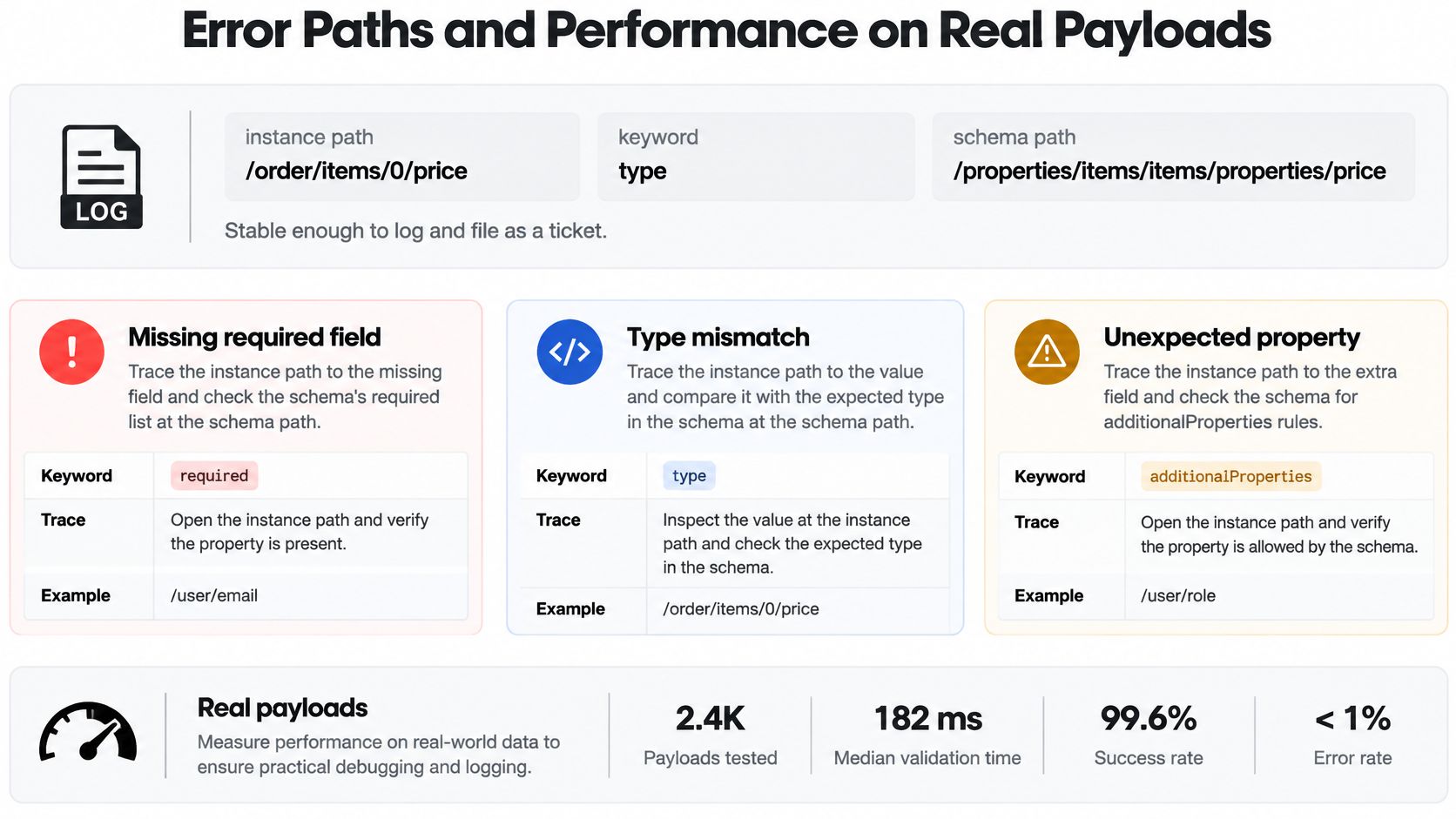
| What you see | Usual cause | Fix |
|---|---|---|
| required | Field missing from the instance | Fix the producer, or make the field optional if the contract allows it |
| type | JSON type does not match the schema | Reject, or coerce once at the boundary and document it |
| additionalProperties | Unknown field on a closed object | Keep the closed schema, or strip only if the contract is open |
| format | Date, email, or uri was not rejected | Enable format assertion or check it in application code |
| $ref resolution | Schema id or relative URI did not load | Fix the base URI and schema loader; fail startup if refs are broken |
| unevaluatedProperties | Leftover fields after allOf | Use only on drafts that support it; expect annotation cost |
I would read that table as triage, not documentation. A required failure points at the producer, a type failure points at your boundary policy, and an additionalProperties failure means your closed contract worked as designed. An unresolved $ref is different, since it's your deployment that's broken, so fail at startup instead of returning a validation error to a blameless client.
For ETL, validate each record, send failures to a side channel with their path, and fail the whole batch only when the file is atomic. Rejecting ten thousand good records because one line has a bad quantity is rarely the policy anyone intended.
Measure Your Own Payloads
Don't trust one throughput number. The published Java validator benchmark reports approximately 6,777 validations per second for one specific workload, but also about 971 MB of garbage-collection allocation per second and roughly 165 KB allocated per operation, while explicitly warning that results vary with schemas and data. The same source recommends caching and reusing compiled JsonSchema instances, which tells you more about production cost than the headline rate does.
Switching libraries is often less valuable than compiling schemas once, reusing validator objects safely, and measuring allocation.
Run your own invoices through cold and warm JVM states, split parse time from validate time, and record p50, p95, and p99 latency alongside throughput, allocation, and GC pauses. Probe pathological cases separately, including deep nesting, uniqueItems on large arrays, expensive regular expressions, wide $ref graphs, and allOf or anyOf branches. The JSON Schema Benchmark from the Katydid project evaluated 45 schemas in 2025, which is a good reminder to test a corpus rather than one tidy document.
Wiring the Validator Into APIs and ETL Pipelines
A payment API that parses JSON, writes it, then validates is a gate installed after the damage. Put validation after parsing and before any write, return HTTP 400 with the failure list, and keep failed payloads out of tables, topics, and object storage. Pin the gate to Draft 2020-12 so every service answers the same question.
In an ETL job, validate each record before commit. Send failures to a dead-letter channel with instance path, keyword, and record id, then let clean records load unless the file is atomic. Share one compiled schema across endpoints and jobs so $ref resolves against the same base, and review API integration best practices before retries and backoff sit in front of that gate.
Logging and Retention
Log error paths, not full payload values, and set a retention period for those logs. GDPR applies to personal data in invoices and payslips whether processing is manual or automated, so retention rules and processing records have to cover validation logs too. Treat format as annotation-only unless an assertion is enabled, because an “email” that passed under annotation mode can still be undeliverable. The same dead-letter pattern appears in pipeline guidance for embodied AI teams: route the bad record aside, store the reason, and keep the clean stream moving.
Where the JSON comes from scanned invoices, payslips, or delivery notes, Matil lets users create custom extraction schemas by specifying field names, types, and descriptions, and receive structured JSON that follows that definition. Normal processing is synchronous, so one document returns structured data immediately for real-time integrations, while Async returns results by webhook and Batch accepts hundreds of documents in a single request for nightly imports. Users can create custom schemas and classifiers without writing machine learning code. Your Java validator then checks that output before it reaches finance or compliance systems.
If you are evaluating how to stop retyping those documents, start at extraction. Keep the validator yours, pinned to your draft and your contract, and measure allocation on your own payloads before blaming the library.
If your schemas are ready but your JSON still starts life as PDFs and scans, Matil turns invoices, delivery notes, payslips, and KYC documents into structured JSON against extraction schemas you define, so your Java validator receives data worth checking. Send one document synchronously for a real-time flow, or submit batches for nightly work, and keep Draft 2020-12 as the final gate before anything reaches your ledger.


