Schema Definition for Document Extraction: A Practical Guide
Learn what schema definition means for document extraction, how to design JSON schemas that work, and how Matil.ai maps diverse documents into one trusted

You can have perfect OCR and still ship broken data. The gap usually appears later, when invoice totals, line items, dates, or KYC fields land in the ERP with no shared contract behind them. Schema definition closes that gap, because it turns messy document output into a predictable JSON shape that downstream systems can trust.
Why Document Extraction Starts with Schema Definition
Finance teams often receive supplier invoices in dozens of layouts, while operations teams process delivery notes, payslips, and KYC packs at the same time. The documents don't need to look alike. The output does.
That's why schema definition matters. It gives extraction a contract, so one invoice can become the same JSON structure as the next, even when the source PDF looks completely different. Without that contract, every downstream system has to guess whether a field is missing, renamed, nested differently, or unreadable.
The contract between the document and the system
A document extraction pipeline is only useful when the result can be consumed by something else, such as an ERP, accounting tool, compliance workflow, or review queue. The schema is the bridge. It tells the pipeline what to return, how to name it, and which values need validation before they move forward.
Practical rule: if the output can't be checked automatically, it isn't ready for automation.
That is where manual work gets expensive. A person can spot a suspicious invoice line or a missing tax ID in seconds, but they can't do it consistently across hundreds of documents without creating delays and rework. For a useful comparison, teams evaluating public-sector workflows often look at resources like Software for Government contracting because the same contract mindset applies, even when the documents are very different.
The shift is simple. OCR reads text. Schema definition tells the system what that text is supposed to become.
What a Schema Definition Is
A schema definition is a machine-readable contract for structured data. It specifies the fields an extraction system may return, the shape and meaning of each value, the evidence needed to support it, and the rules that determine whether the result can enter a workflow. An example payload shows one record. A schema defines the language that every record must follow.
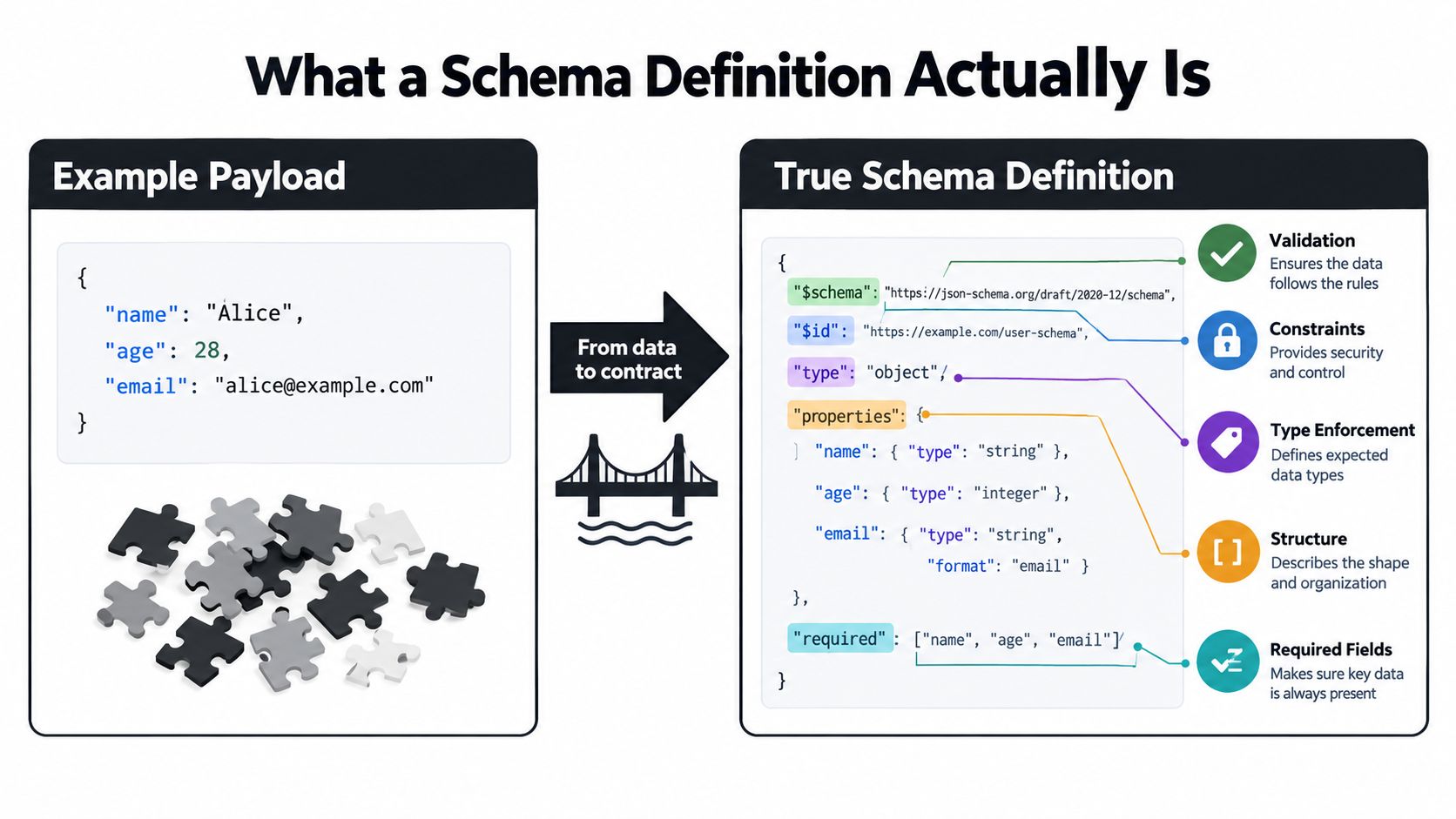
A practical schema often begins with $schema and $id, then declares type, properties, and required. Together, these controls establish the data structure and identify the dialect validators should apply. For document extraction, the contract can also connect a value to its source location or confidence requirement, creating an evidence layer rather than treating every extracted string as equally reliable.
From example to contract
An example JSON object is a sample, like one completed form on a desk. A schema is the rulebook used to process every form that follows. If a system receives only a sample invoice, it may imitate the arrangement once, but it has no dependable basis for deciding whether a later result is incomplete, malformed, or semantically wrong.
Formal standards developed around this need. The W3C's XML Schema Recommendation established a formal approach to structure and datatypes for XML, while the JSON Schema specification applies the same contract-oriented principle to JSON systems. They serve different ecosystems, but both make machine-readable validation possible.
A schema therefore operates in layers: structure defines what may exist, semantics define what each field means, evidence supports the extracted value, and operations determine how failures are handled. That layered control lets different document layouts map to one trusted JSON contract, including through Matil.ai's flexible schema system.
A schema is not merely a list of fields. It turns “some text was found” into a payload that another system can interpret, validate, and use.
Designing Fields, Types, and Validations That Catch Real Errors
A schema starts catching errors when each field is designed as a control, not just a label in a JSON object. type tells the pipeline what kind of value is allowed. required says which values must exist before downstream systems can trust the payload. properties sets the allowed shape, and additionalProperties prevents extra fields from slipping in because one supplier changed a header or one OCR pass guessed wrong.
That is the structure layer. It answers, “Does this payload fit the contract?” Real document extraction also needs a semantics layer that answers, “Does this value make sense for this field?”
An invoice total can be numeric and still be wrong. A tax identifier can match the expected length and still be implausible. A currency code can be present and still fall outside the accepted business set.
Structural rules versus business rules
Good schema design combines structural checks with domain checks so the pipeline can reject payloads that look tidy but fail in practice. Keywords such as enum, pattern, minimum, maximum, and multipleOf turn extracted text into machine-checkable acceptance criteria. For background on the markup side of structured data, see schema markup explained.
A payslip schema, for example, can require pay-period fields, restrict currency to an approved list, and reject negative amounts where they have no business meaning. A KYC schema can require identity-document fields and constrain identifier formats with patterns. The point is not to pile on rules. The point is to place the right rule at the right layer.
| Validation Keyword | What It Constrains | Document Example |
|---|---|---|
type |
Data shape, such as string or number | Invoice total must be numeric |
required |
Presence of mandatory fields | Invoice number, customer ID |
properties |
Named field structure | Payslip earnings and deductions |
items |
Repeated array members | Invoice line items |
additionalProperties |
Unexpected fields | Extra columns in a supplier feed |
enum |
Allowed values | Currency code, document type |
pattern |
Text format | Tax ID or passport number |
minimum |
Lower numeric bound | Quantity or payable amount |
maximum |
Upper numeric bound | Approved limit or cap |
multipleOf |
Numeric increments | VAT or monetary precision |
Validation also needs to distinguish different failure states. Missing means no value was found. Null means the pipeline determined that no value exists for that field. Low confidence means a value was extracted, but the evidence is weak and the result should not pass as final without review. Those states should not collapse into the same empty string.
For a concrete implementation pattern, see schema validation in document pipelines. Across tools, the goal is the same. Stop bad payloads before they reach accounting, compliance, or downstream automation.
Why line items deserve special care
Line items need more than “array of objects.” Each row is a small record with relationships inside it. SKU, quantity, and unit price belong together. If one appears without the others, the JSON can still look valid while the document meaning is already broken.
A useful rule is simple. Validate the field. Validate the meaning of the field. Then validate how fields relate to each other.
That layered control system, structure, semantics, evidence, and operations, is what lets very different document layouts map to one trusted JSON contract, including in flexible schema systems such as Matil.ai.
Handling Arrays and Evolving Document Structures
Arrays are where document extraction often breaks. A receipt with three product lines can be flattened into two. A delivery note can lose a row. A logistics document can mix positional data with repeated items, and no one notices until reconciliation fails later.
JSON Schema Draft 2020-12 handles that more cleanly than older array patterns. It uses prefixItems for positional tuples and items for the remaining array elements. That distinction matters. A tuple is correct when each position has a fixed meaning. A repeated line-item collection is better modeled as an array of objects, each with required fields such as SKU, quantity, and unit price.
Model the shape that the document actually has
If duplicate values are invalid, use uniqueItems. If the document must contain at least one line, use minItems. If schema composition could accidentally let through extra fields, combine unevaluatedItems with a tight additionalProperties policy. Those controls keep a growing document format from drifting into ambiguity.
For a routing and transformation example, teams often use convert PDF to JSON workflows to separate raw page content from structured extraction logic. The same rule applies whether the input is a bill of lading, a receipt, or a customs document.
| Array Pattern | When to Use It | Common Risk |
|---|---|---|
prefixItems |
Fixed-position tuples | Fields swapped by position |
items |
Homogeneous repeated rows | Mixed row types |
minItems |
At least one entry required | Empty line-item arrays |
uniqueItems |
Duplicates are invalid | Repeated codes or IDs |
unevaluatedItems |
Strict post-composition control | Extra fields slipping through |
Make schema changes like product changes
Schemas should evolve the same way software does, with versioning and testing. Before rollout, validate representative historical documents against both the current and candidate schema. Watch which fields start failing. Additive changes are usually safer than tightening a rule too early, especially in workflows that receive mixed formats.
Heterogeneous document sets need routing, not just extraction. One workflow might receive invoices, receipts, IDs, and logistics papers. If the schema can't separate them cleanly, the output contract becomes a guessing game instead of a control system.
How Matil.ai Applies Schema Definition in Practice
Matil.ai applies schema definition as part of the extraction pipeline, not as an afterthought. The workflow starts by classifying the document, then applying the right extraction logic, then validating the output against a JSON contract. That means the model adapts to the schema, not the other way around.
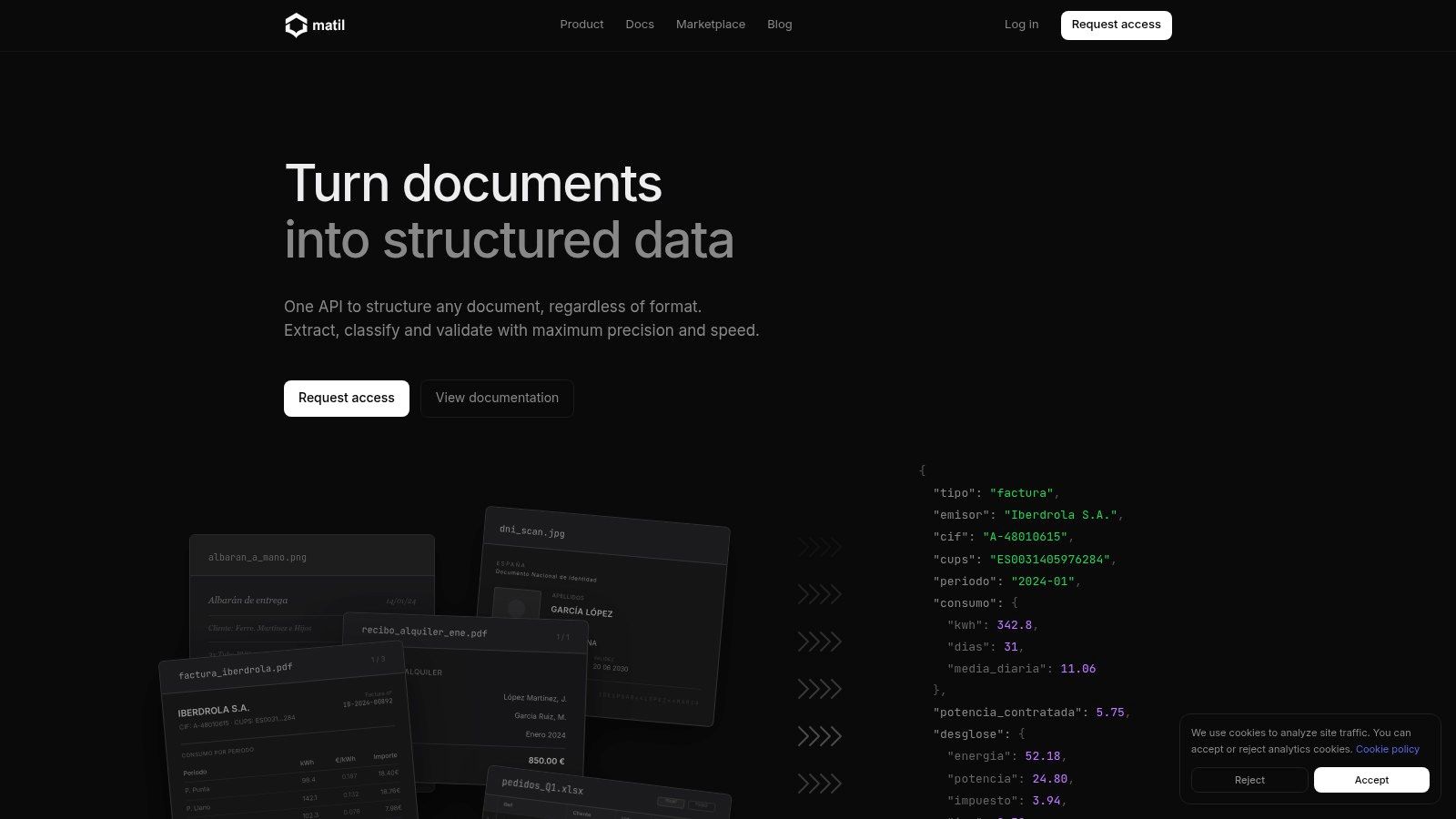
The practical value shows up quickly in mixed environments. One pipeline can handle electricity and gas bills, payslips, identity documents, bank statements, purchase receipts, insurance policies, and logistics documents such as Bills of Lading, DUAs, and ocean freight rates. Each document family can map into its own schema while still returning structured JSON through the same API.
A simple workflow from file to trusted JSON
A clean implementation usually follows this pattern:
- Classify the document so the right schema is selected.
- Extract the content from the PDF or image.
- Validate the output against the schema rules.
- Route exceptions for review when a field is missing or low confidence.
That last step matters more than many teams expect. If the output contract is strict, the pipeline can reject malformed payloads before they reach finance or compliance systems. If the document is standard, the result is a structured JSON object that downstream automation can use immediately.
The same logic also helps with custom layouts. A niche supplier format doesn't need a long training cycle if the fields, types, and validations can be defined directly. In practice, that's the difference between fitting the document into a rigid template and letting the schema define the trusted shape.
For developers who want a more technical validation pattern, Pydantic model validation is a useful adjacent concept because it shows how defined fields and validation rules create predictable machine behavior.
Later in the pipeline, orchestration can split documents, group pages, and send each part to the right extractor. That keeps one invoice, one receipt, or one logistics packet from being treated like a generic blob of text.
Why Schema Design Is What Makes Accuracy Trustworthy
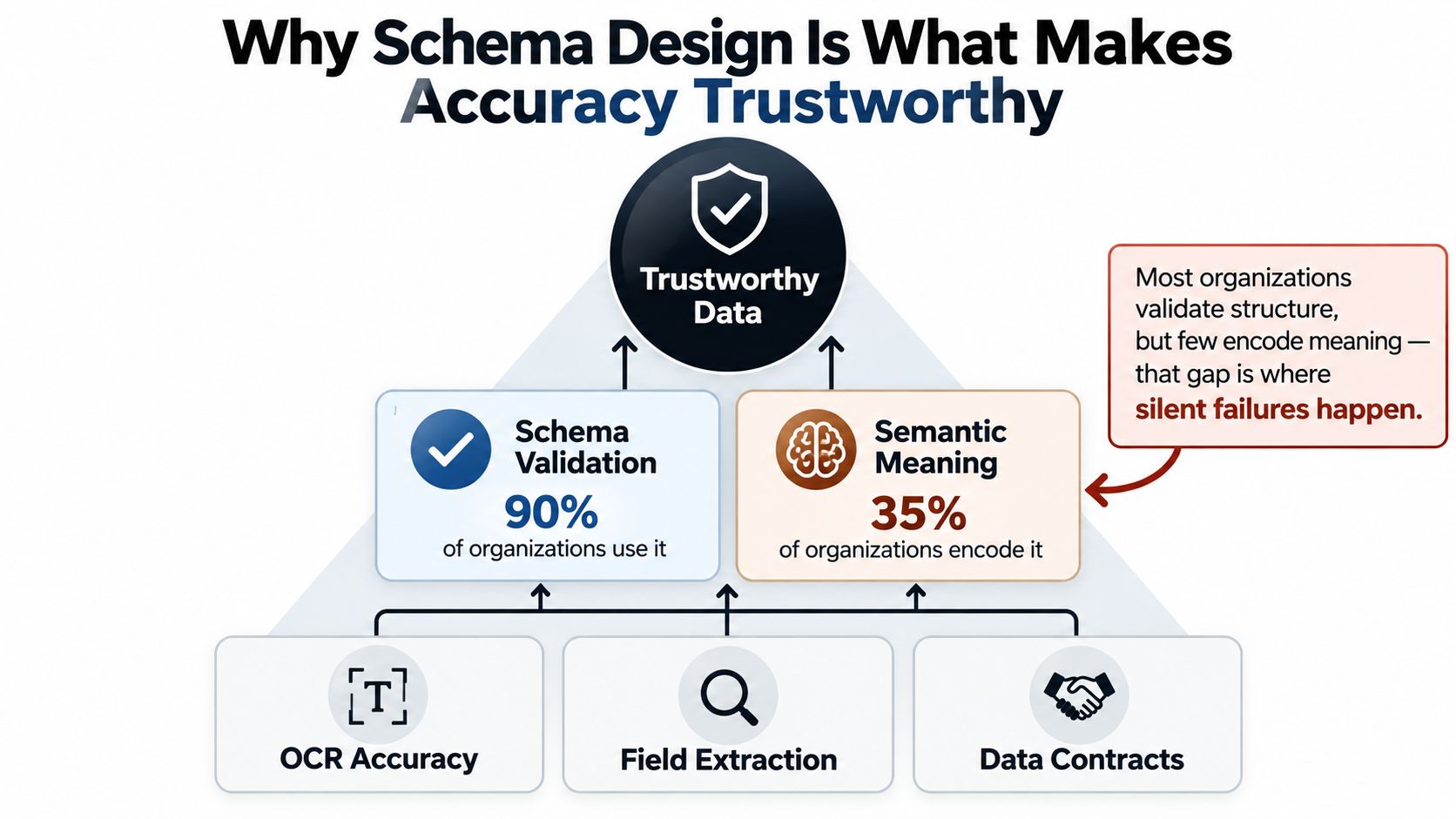
OCR accuracy is only part of the story. A document can be read correctly and still be wrong in the ways that matter to operations, finance, or compliance. That's why schema design has to encode more than field names. It has to capture structure, meaning, evidence, and operational expectations together.
The layered control model
A useful schema works across four layers. Structural rules confirm the payload is shaped correctly. Semantic and business rules check whether the value makes sense in context. Evidence and provenance show where the value came from. Operational expectations define how confident, fresh, or reviewable the result must be before it enters the next system.
That distinction matters because validation alone does not prove correctness. A payload can be valid and still contain the wrong amount, a misread date, or an identifier that looks plausible but doesn't belong to the document. The gap is exactly where silent failures happen.
The most useful schemas make that gap visible. They distinguish between values that are absent, values that are deliberately null, and values that were extracted with too little confidence. Then the downstream workflow can route those cases to review instead of treating them as success.
Where teams get trapped
A lot of teams stop at format checks. They make sure the JSON parses, the fields exist, and the types match. That's necessary, but it's not enough for real operations.
Most teams validate structure first. The harder work is making sure the structure actually means what the business thinks it means.
The result is simple. Better schema design doesn't just reduce bad records. It makes every accepted record more trustworthy.
Governing Schemas Across Documents, Teams, and Versions
Schema governance is a product problem, not just a technical one. Documents change, suppliers change layouts, regulations shift, and teams add new fields over time. If the schema lives outside version control, every one of those changes becomes a risk.
That's why mature teams version schemas alongside their transformation code. Additive changes can be rolled out cleanly. Breaking changes need explicit coordination, legacy mapping, and tests against representative documents. If one workflow handles invoices today and customs forms tomorrow, routing rules matter as much as field definitions.
For broader operational context, AI strategies for unstructured data is a useful reference because the same governance problems show up across unstructured workflows, not just document extraction.
A lightweight governance loop
- Version the schema: keep the contract beside the code that uses it.
- Test the change: run historical documents through the candidate schema before deployment.
- Monitor the drift: watch for field-level rejection patterns after rollout.
- Deprecate carefully: keep old and new versions alive when producers move at different speeds.
Document-heavy enterprises rarely run one schema family. They run many. That is why governance, versioning, and routing are the bottlenecks, not the syntax itself.
If you're evaluating how to automate this kind of workflow, Matil.ai gives you a practical path from raw PDF or image to validated JSON, with classification, extraction, validation, and orchestration in one pipeline. If you're exploring schema-driven document extraction, visit Matil and see how a flexible contract-based workflow fits your documents.


