Ocean Bills of Lading: AI Data Extraction Guide
Learn how AI data extraction automates ocean bills of lading processing. Discover how platforms like Matil eliminate manual entry and reduce logistics errors.

A logistics team starts the morning with a familiar queue: scanned ocean bills of lading, carrier PDFs, house and master documents, customs endorsements, and spreadsheets waiting for manual entry. The document may look like a simple form, but a single missed weight, container number, or consignee can delay release, create a compliance exception, or trigger another round of checking. This is why AI data extraction from ocean bills of lading matters. The objective isn't merely to read text, but to convert legally significant shipping documents into reliable, structured data.
The Operational Reality of Ocean Bills of Lading
An ocean bill of lading sits at the center of several connected workflows. A freight forwarder may receive a carrier document, a customs team may need its cargo details, a bank may examine it for a documentary transaction, and an operations team may use it to coordinate release. Each department sees a different task, but they all depend on the same underlying fields being correct.
An ocean bill of lading has three distinct roles. It serves as a receipt confirming that the carrier received the goods, evidence of the contract of carriage, and, where the document has that legal character, a document of title that can support lawful delivery or transfer of the rights evidenced by the document. The ICC explanation of electronic bills of lading describes these functions and explains why cargo description, quantity, and condition affect liability and disputes.
Practical rule: Treat every extracted field as operational data with legal consequences, not as text copied from a PDF.
The document's importance also explains why shipping teams still work with so many legacy formats. Ocean bills of lading trace their modern legal roots to medieval maritime commerce. Historical accounts place early merchant shipping registers around 1063, identify a standalone document similar to a modern bill of lading in 1390, and describe an instrument close to today's form by 1600. English commercial law reinforced its title function in Lickbarrow v Mason in 1793, while the Hague Rules of 1924, the Visby Amendments of 1968, and the SDR Protocol of 1979 shaped the Hague-Visby framework used for many international shipments. These milestones are documented in this historical account of international ocean bills of lading.
That history created a durable document, not a uniform digital interface. A team handling bills of lading for imports may receive a clean native PDF from one carrier, a scanned multi-page form from another, and a house bill with handwritten or stamped additions from a forwarder. The legal function stays recognizable while the visual structure changes constantly. For a concise foundation, see this guide to what a bill of lading is in shipping.
Essential Data Fields and Carrier Variations
The first mistake in an extraction project is to define success as “all text captured.” Operations teams need relationships between fields, not an undifferentiated text block. The consignee must be separated from the notify party, the port of loading from the port of discharge, and the gross weight from a measurement value. A usable pipeline also needs to preserve page location, confidence, and the connection between a container and its seal.
A complete ocean bill of lading commonly contains the following fields:
| Data Field | Operational Purpose |
|---|---|
| Shipper | Identifies the party tendering the cargo and supports document matching. |
| Consignee | Determines the named receiving party or the party to whose order the document is issued. |
| Notify party | Routes arrival and release communications without automatically granting delivery rights. |
| Carrier | Identifies the contractual carrier and supports document and liability checks. |
| Vessel and voyage | Connects the document to the planned maritime movement. |
| Port of loading | Identifies where the ocean leg begins. |
| Port of discharge | Identifies the maritime destination and supports routing checks. |
| Cargo description | Provides the commercial and operational description used across shipping and compliance workflows. |
| Package count and type | Supports reconciliation with packing lists and declarations. |
| Gross weight | Enables transport, customs, and cross-document validation. |
| Measurement | Captures cargo volume where supplied. |
| Container number | Links the document to the physical transport unit. |
| Seal number | Helps verify container identity and integrity. |
| Freight terms | Distinguishes arrangements such as prepaid and collect charges. |
| Release instructions | Indicates how the carrier should handle delivery or document surrender. |
| Signature and issue date | Supports execution, auditability, and document review. |
These fields are based on common bill-of-lading requirements described in this ocean bill of lading template reference. The Hague-Visby Rules also require, on the shipper's demand after the carrier receives the goods, details such as leading marks, package count or quantity, weight as furnished by the shipper, and the apparent order and condition of the goods, as set out in the Hague-Visby text.
Why one schema rarely fits every carrier
Carrier variation is not a cosmetic inconvenience. One operator may place vessel and voyage near the top of page one. Another may put them in a narrow header beside a booking reference. A forwarder may use “place of receipt” and “place of delivery,” while a carrier form emphasizes the ocean ports. Tables may split across pages, repeat headings, or use abbreviations that only make sense within that carrier's workflow.
House and master bills create another layer. The party named as shipper on a master bill may differ from the shipper on a house bill, even though both documents relate to the same cargo. An extraction system that overwrites one value with another loses the distinction that operations and compliance teams need.
The practical target is therefore a canonical data model with document-specific mapping. Store normalized fields such as port_of_loading, port_of_discharge, container_number, and gross_weight, but retain the original label, page, raw value, and confidence. That approach supports ERP and TMS integration without pretending that every carrier uses the same form. Teams comparing formats can also use this explanation of a VICS bill of lading to understand how industry-specific layouts add mapping requirements.
Why Traditional OCR Fails on Complex Freight Paperwork
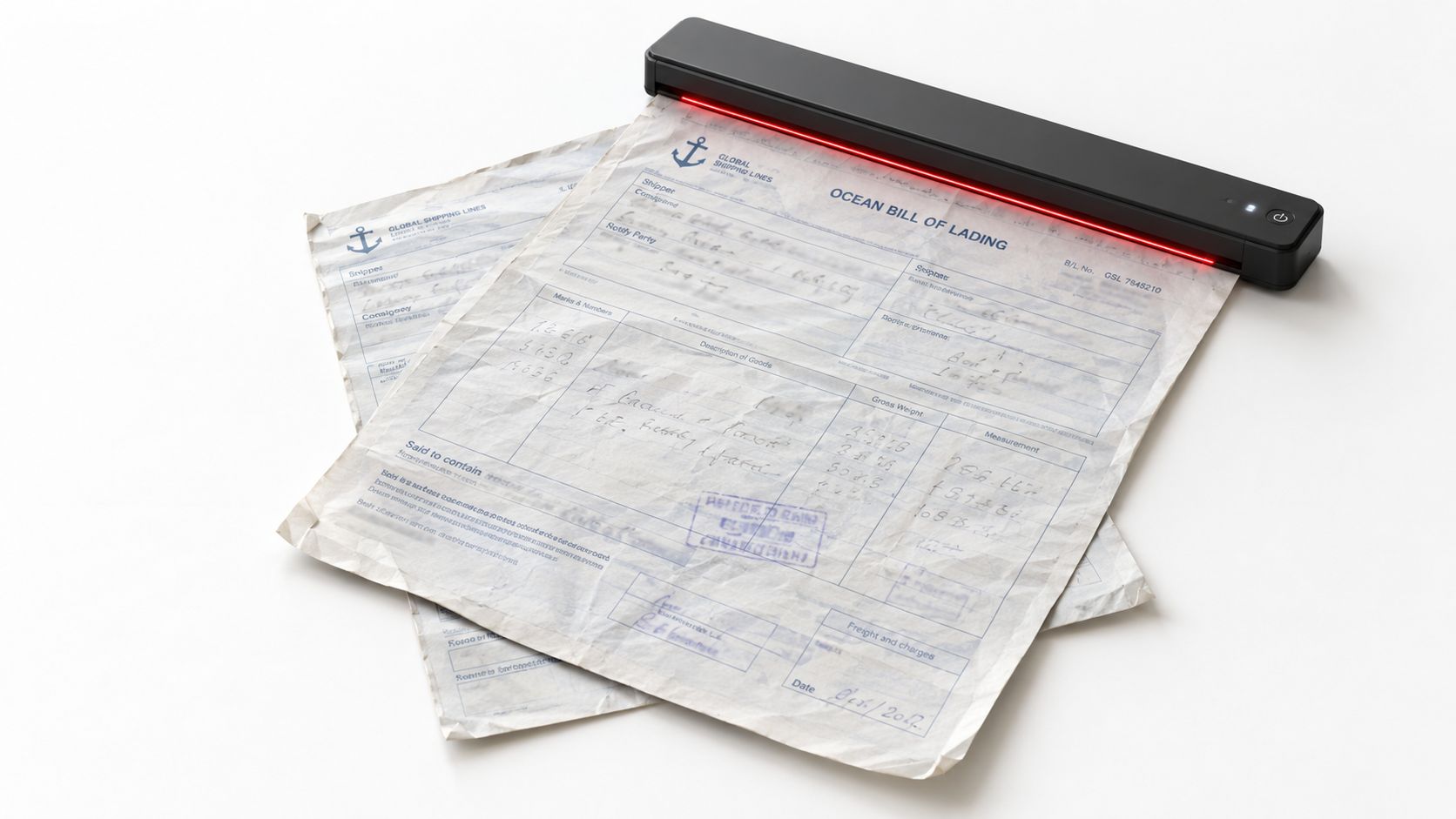
Basic OCR answers a narrow question: which characters appear in this image? Ocean freight operations need a broader answer: which value belongs to which field, which row belongs to which container, whether a stamp changes the apparent status, and whether a handwritten correction should be reviewed.
Legacy OCR often reads a page from top to bottom. That approach can capture “45” and “450” but lose whether one is a package count and the other is a weight. It can extract a company name without knowing whether the name belongs to the shipper, consignee, carrier, or notify party. Nested tables, split rows, rotated pages, faint scans, and repeated headers make the problem worse.
The failure points teams see in production
Stamped signatures and port annotations create a second reading problem. A printed carrier clause may sit next to a handwritten customs note, while an endorsement crosses a table boundary. Traditional OCR may recognize marks without classifying their role. It may also merge text from adjacent columns or treat a stamp as noise.
Multi-page documents expose a further weakness. Page two may contain container details that complete a cargo table started on page one. A text-only process often returns a flat sequence, so downstream software can't tell which container belongs to which package line. Manual reviewers then reconstruct the document, defeating the purpose of OCR.
The hidden cost isn't limited to keystrokes. A wrong cargo weight can create a reconciliation exception. A misread consignee can hold a release instruction. An omitted qualification about apparent condition can affect review by legal, insurance, or claims teams. When volume rises, a basic OCR workflow usually adds more human checking rather than removing it.
The operational test: If a reviewer must rebuild the document's structure after OCR runs, the system has transcribed the page but hasn't extracted the business data.
How AI Extraction Handles Multi-Page Logistics Documents
Modern document extraction combines OCR documents, visual analysis, classification, contextual interpretation, and validation. It doesn't treat a bill of lading as a stream of characters. It treats the file as a document with pages, regions, tables, fields, and relationships.
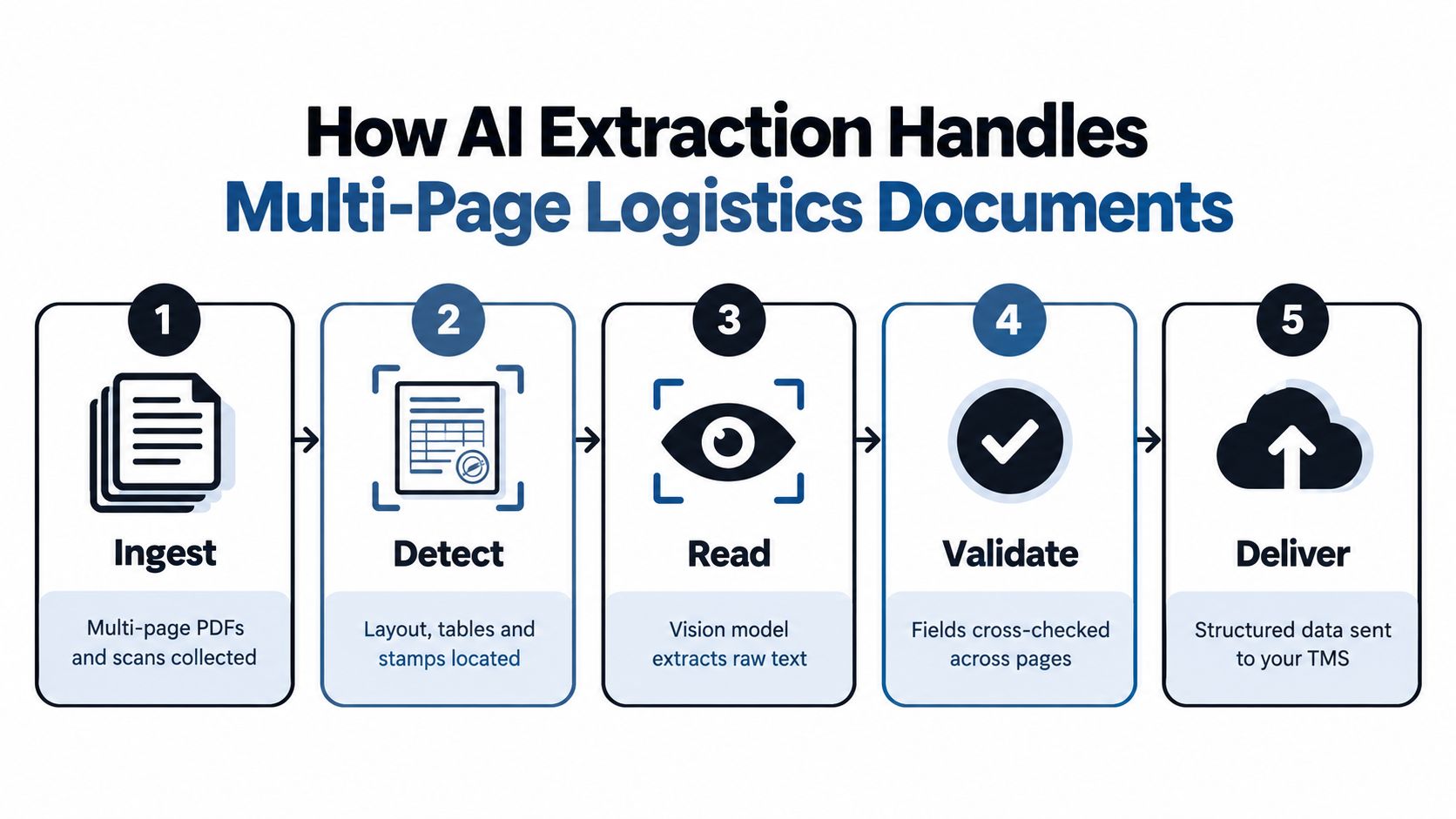
A practical pipeline usually follows these steps:
Ingest the source files. The system accepts native PDFs, scans, photographs, and mixed document sets. It keeps page order and identifies whether a file contains one document or several documents bundled together.
Classify the document. A classifier distinguishes a bill of lading from a packing list, invoice, customs declaration, or sea waybill. Classification matters because each document type requires a different field schema and validation logic.
Analyze the layout. The vision layer detects headers, tables, labels, signatures, stamps, and repeated page structures. It uses position and grouping to understand that a value sits under “gross weight,” rather than merely appearing somewhere near the phrase.
Read with context. Contextual OCR extracts printed text, numbers, and relevant handwritten or stamped content. It can associate a container number with its seal and cargo line, even when the table continues on another page.
Validate and deliver. Rules check formats, required fields, cross-page consistency, and relationships between values. The result should be structured JSON that a TMS, ERP, customs workflow, or review queue can consume directly.
You can see the same principle applied to broader PDF workflows in this guide on how to extract data from PDF files. The key distinction is that extraction doesn't end when text is recognized. It ends when the output can support an operational decision.
The embedded walkthrough provides another way to understand the movement from document input to structured output:
Validation should be explicit. A system can check that a container number follows the expected structure, that a weight is numeric, that a required port exists, and that a house bill's parties don't conflict with the related master bill without flagging every variation as an error. Low-confidence fields should go to a human review queue with the source page and region attached. That gives the reviewer a targeted exception instead of another full manual transcription.
Streamlining Workflows with Matil Data Extraction
A useful automation design separates reading, understanding, and control. Reading turns pixels into text. Understanding maps text to fields and relationships. Control applies validation, routes exceptions, records provenance, and sends approved data to the next system. Treating OCR as the complete solution leaves the last two responsibilities to people.
Matil combines OCR, document classification, validation, and workflow orchestration through an API. Its logistics capabilities are intended for documents such as bills of lading, sea waybills, customs declarations, and ocean freight material. A team can define the output schema around its own operational model, including parties, vessel and voyage information, ports, cargo, containers, weights, and freight terms.
The platform's documented positioning includes precision above 99% in multiple use cases, alongside pre-trained models, rapid customization, JSON output, automatic document classification, PDF splitting, and traceability. The relevant result isn't a headline accuracy figure in isolation. It is whether the system identifies uncertain values, preserves evidence, and makes exceptions visible before data reaches a customs, finance, or release workflow.
What technical teams should evaluate
- Integration surface: A simple API should accept the document, return structured data, and expose errors or review states without forcing the engineering team to build a document-processing layer from scratch.
- Schema control: Pre-trained models reduce initial effort, while configurable fields and validations handle carrier-specific layouts and internal requirements.
- Mixed-file handling: Automatic classification and splitting matter when an inbox contains a bill of lading, invoice, packing list, and declaration in one PDF.
- Security posture: GDPR, ISO 27001, AICPA SOC alignment, and a zero data retention policy address the concerns of compliance and enterprise architecture teams. They still need to verify the applicable contract, deployment terms, and data-processing arrangements.
- Operational traceability: Store the extracted value, source location, validation status, and correction history so a reviewer can explain how the data entered the downstream system.
This is different from building a collection of ad hoc scripts around a generic OCR engine. Scripts can be useful for narrow, stable templates, but carrier variation quickly turns them into a maintenance burden. Teams researching adjacent automation patterns may find these web scraping projects useful for understanding where custom extraction logic fits, although shipping-document processing needs document-aware models rather than page text alone.
Real-World Use Cases and the Electronic Adoption Gap
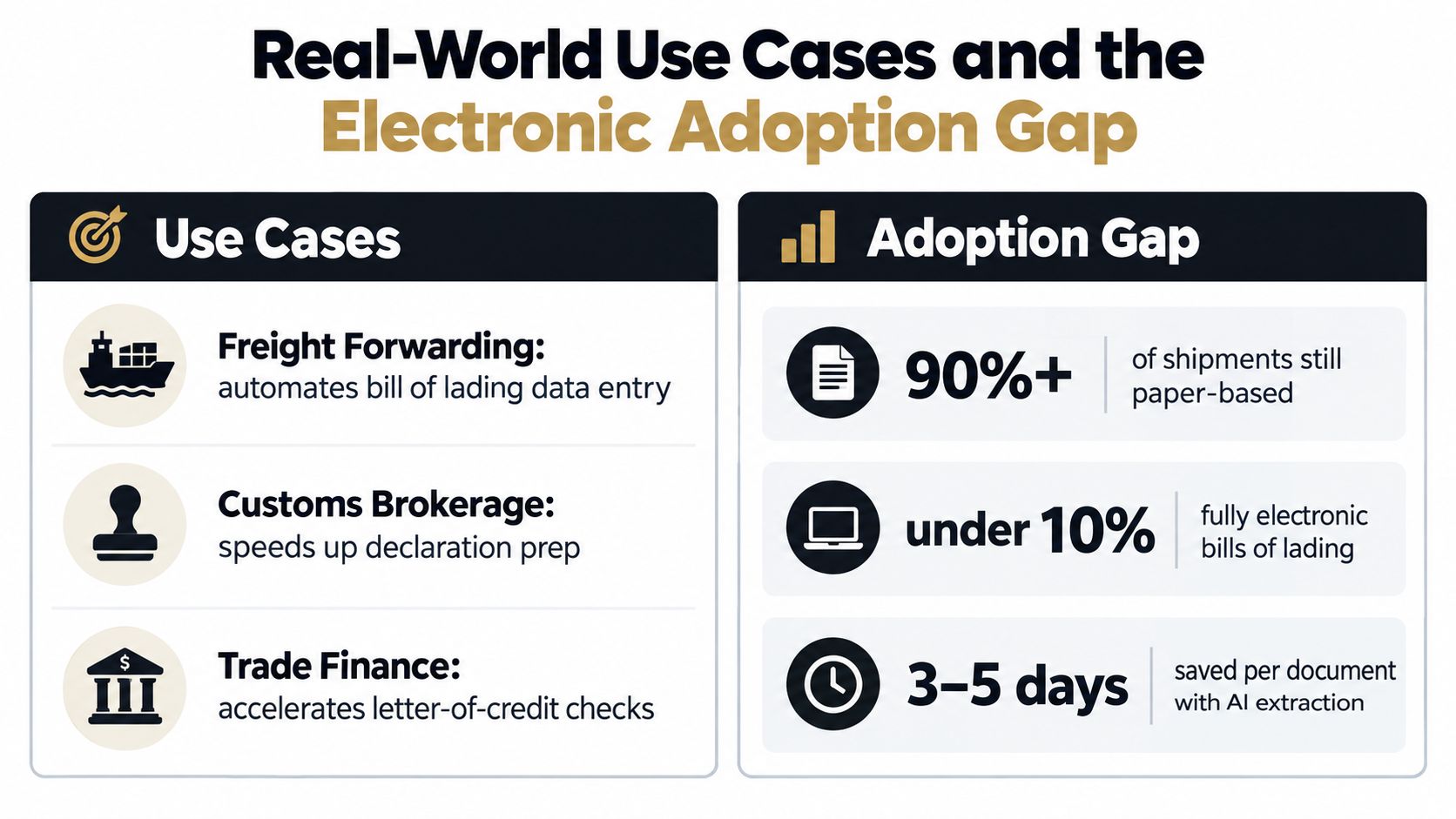
The strongest business case for extraction isn't limited to one department. The same structured bill-of-lading data can support freight forwarding, customs brokerage, trade finance, compliance, and carrier reconciliation.
Where the data creates immediate value
Freight forwarding teams can extract shipper, consignee, notify party, vessel, voyage, ports, cargo lines, containers, seals, weights, and freight terms into a shipment record. That reduces rekeying across house and master documents and makes mismatches easier to identify.
Customs brokers can use structured cargo descriptions, quantities, weights, and transport references to prepare declarations and route missing or inconsistent fields for review. The system doesn't replace a broker's judgment. It gives the broker a better-controlled starting point.
Trade finance teams can route bills of lading into document review workflows. Fields such as carrier, vessel, loading and discharge ports, shipment status, signature, and consignee can be checked against transaction requirements before an analyst spends time on a full examination.
The adoption story for electronic bills of lading needs careful interpretation. One industry summary estimated that about 11% of global bills of lading were issued electronically in 2025, compared with roughly 2% in 2022 and 5% in 2024, as reported by FIDI's electronic bill of lading coverage. ICC reported broader eBL adoption rising from 33.0% in 2022 to 49.2% in 2024, while dual-format usage rose from 28.0% to 41.7% in the same period in its global eBL adoption survey.
Those figures aren't necessarily contradictory. “Using eBL” may include partial or dual-format activity, while another measure may count fully electronic bills across global trade or container shipments. Legal recognition, carrier interoperability, customs requirements, and corridor-specific workflows still determine whether a digital document can move through the entire chain. A PDF emailed between parties isn't automatically an electronic transferable record with controlled title.
Why paper extraction remains part of the target architecture
S&P Global's PIERS database reported 16,060,444 bills of lading processed in 2023, with over 2 billion data fields and an average of 44,001 bills processed per day, as described on its trade-data platform page. That scale shows why shipping documents are valuable data assets, but it also shows why a company can't wait for every corridor and counterparty to become fully digital.
A resilient architecture supports both paths. It consumes structured eBL data when the transaction provides it, and it extracts reliable fields from paper originals, scans, and PDFs when it doesn't. AI extraction is therefore not merely a temporary bridge. It is the compatibility layer for the mixed-format reality that will remain while legal and operational adoption develops unevenly.
Operational Benefits of Intelligent Document Automation
The practical advantage of intelligent document automation is control over the entire workflow, not just faster character recognition. A well-designed pipeline reduces manual entry, validates high-risk fields, and routes exceptions to people with the context needed to resolve them.
The main benefits are operational:
- Faster processing: Teams can move documents from an inbox into a shipment or review workflow without waiting for every field to be typed manually.
- Fewer transcription errors: Structured extraction reduces copy-and-paste mistakes in names, ports, weights, package counts, container numbers, and references.
- Better compliance control: Validation rules can flag missing fields, inconsistent values, and mismatches between related documents before they become release or declaration problems.
- More consistent review: Every exception can include the source page, extracted value, and reason for escalation, creating a clearer audit trail.
- Scalable operations: Processing additional documents doesn't require a matching increase in manual data-entry capacity, although exception handling and governance still need ownership.
The trade-off is that automation requires careful implementation. Teams need a canonical schema, carrier samples, field-level validation, confidence thresholds, review rules, and a plan for monitoring changes in document formats. Broader document workflow automation insights can help teams frame that operating model, but the final design should reflect the company's carriers, systems, jurisdictions, and release controls.
The right question for a CTO or logistics manager isn't whether OCR can read a bill of lading. It is whether the organization can turn mixed-format shipping documents into validated, traceable data without hiding uncertainty. That is the difference between digitizing paperwork and automating a document process.
If you're evaluating ocean bill-of-lading automation, Matil combines OCR, classification, validation, and workflow orchestration to return structured data from complex logistics documents through an API. Visit Matil to assess how its pre-trained models, customizable schemas, enterprise security controls, and zero-data-retention approach could fit your freight, customs, finance, or compliance workflow.


