Billing of Lading Explained: Types, Fields and Automation
Billing of Lading explained: what it is, its main types, key data fields and how to automate extraction from every shipment.

A bill of lading is a document the carrier issues to acknowledge receipt of the goods, record the terms of carriage and, when it's negotiable, transfer control of the cargo to whoever holds it. Those three jobs on one sheet are why a single mistyped name can hold a container at the terminal while storage charges climb.
Picture the desk of anyone who handles import paperwork. A scanned bill lands at 9am, the bank wants the original by Thursday, the customs broker is asking about a weight that doesn't match the packing list, and someone has already emailed a corrected copy that nobody is sure replaces the first one. None of that is unusual. The document is small, but it sits at the junction of money, cargo and law.
Getting it right means understanding the parts, then the fields, then what breaks when a human or a system gets those fields wrong.
What a Bill of Lading Is and Which Type Applies
A bill of lading is a document issued by the carrier that confirms receipt of goods, records the terms of carriage and, when negotiable, transfers control of the cargo.
Plenty of people search for "billing of lading", and the phrase turns up in forwarded emails and in some logistics software. The correct term is bill of lading, usually shortened to B/L or BoL. It comes from "to lade", meaning to load, because the document began as a receipt for cargo going over the rail and into the hold.
Three functions that travel together
- Receipt. The carrier confirms how many packages it took and in what apparent condition. A note about a torn carton or a missing pallet goes here and stays on the record.
- Evidence of the contract of carriage. The bill records the route, the freight terms and the duties the carrier accepts. It's evidence of a contract rather than the contract itself, which matters when a booking note or service agreement sits alongside it.
- Document of title. Issued "to order", the bill lets the holder claim delivery or transfer the right to the cargo while the goods are still at sea.
The United Nations framework behind much of this treats bills of lading as transferable documents and requires an electronic equivalent to preserve the information held in the paper instrument, as UNCITRAL's notes on transferable records set out.
That third function explains why accuracy isn't cosmetic. A mismatch between the consignee name, the negotiability wording and the transport contract reference doesn't stay inside the document. It reaches the release authorisation, the bank's document check, the customs filing and, eventually, the claim file.
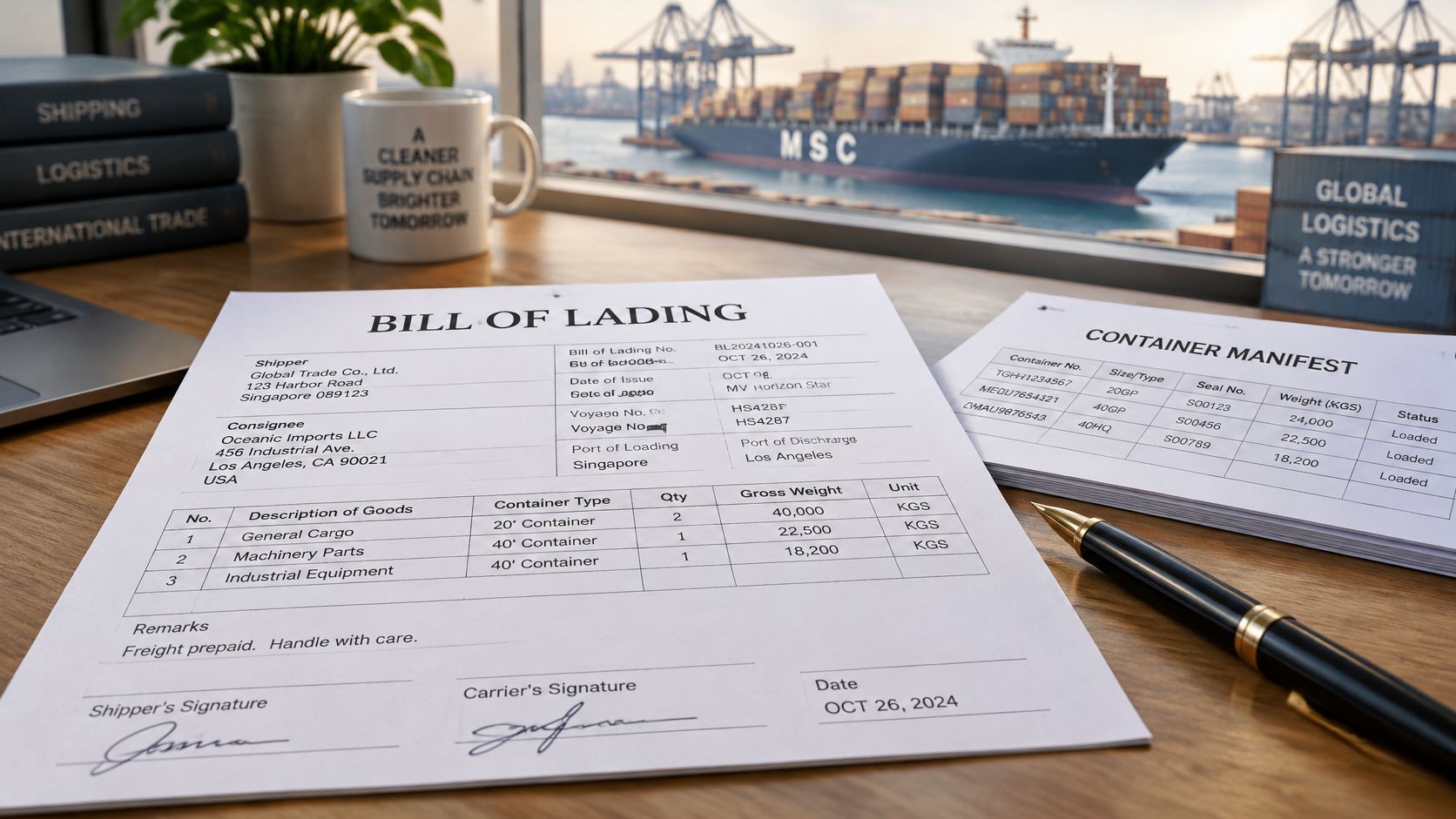
Who touches it, and why the volume matters
Six parties usually handle the same bill: the shipper, the carrier, the consignee, the freight forwarder, the bank financing the transaction and the customs broker clearing it. Maritime transport carries around 80% of the volume of international trade in goods, with an even higher share for many developing economies, according to UNCTAD's Review of Maritime Transport.
The first decision when a bill lands on your desk is negotiability. Is it issued to order, meaning negotiable and transferable by endorsement, or straight to one named consignee? Get that wrong and every downstream step inherits the error.
| Type | Negotiable | Typical use | What to check |
|---|---|---|---|
| Straight bill of lading | No | Named consignee receives the goods, common in intra-company trade | Consignee name matches the importer |
| Order bill of lading (to order) | Yes | Goods sold while in transit and financed by a bank | Endorsement chain and current holder |
| Bearer bill of lading | Yes | Rare; transfers by handing over the paper | Usually avoided because of the risk of loss |
| Clean bill of lading | Depends on form | Goods shipped with no damage or shortage remarks | No claused notes on packaging or condition |
| Claused (unclean) bill of lading | Depends on form | Goods shipped with visible damage or a noted shortage | Remarks match what the bank will accept |
| Through bill of lading | Depends on form | One carrier covers a multimodal route across several legs | Each leg and transfer point is listed |
| Master bill of lading | Depends on form | Issued by the ocean carrier to the freight forwarder | Reference matches the house bill numbers |
| House bill of lading | Depends on form | Issued by the forwarder to the shipper | Links back to the master bill number |
| Sea waybill | No | Non-negotiable; fast release to a known consignee | Consignee identity confirmed before release |
| Electronic bill of lading (eBL) | Depends on platform | Digital record transferred within a registry | Control held by the right party |
The two comparisons that confuse readers most
Clean versus claused is about condition, not about type. A clean bill carries no remark about damaged packaging or short delivery. A claused bill does, and that remark alone can be enough for a bank to refuse payment under a letter of credit, so compare the remark with the credit terms before the vessel sails.
Master versus house is about who issued what. The ocean carrier issues the master bill to the forwarder, and the forwarder issues the house bill to the actual shipper. They cover the same container and must cross-reference each other. When only the house bill reaches the broker, someone has to chase the master bill number before release.
Practical rule: read the face of the bill before you touch a scanner and answer five questions. Is there a document number, are the parties named exactly as on the invoice, do the ports match the routing, is it negotiable, and is it clean?
If your team handles the whole shipment folder, supply chain documentation covers how the invoice, packing list and delivery note link back to the bill.
Key Data Fields on a Bill of Lading
Fields on a bill are connected, not independent. A wrong port doesn't just create a bad row in a database. It sends the release instruction to the wrong terminal, and the container stays where it is while the clock runs.
| Field | What it holds | Why it matters |
|---|---|---|
| Bill of lading number | Unique document reference | Links the bill to invoices, releases and claims |
| Shipper | Party that sends the goods | Must match the seller on the commercial invoice |
| Consignee | Party entitled to receive the goods | Drives release; "to order" changes who can claim |
| Notify party | Party informed on arrival | Receives arrival notices but does not own the cargo |
| Carrier and vessel | Ocean carrier, vessel name and voyage | Confirms the transport contract and sailing |
| Port of loading | Port where the cargo is loaded | Used for customs filings and freight calculation |
| Port of discharge | Destination port | Sets duties, delivery point and release timing |
| Cargo description | Goods, marks and numbers | Must match the invoice and packing list |
| Package count and gross weight | Number of units and total weight | Checked against the packing list and manifest |
| Freight terms | Prepaid or collect, and where payable | Decides who pays and which invoice applies |
| Date and place of issue | When and where the bill was issued | Checked against shipping dates for late presentation |
The three fields that cause the most trouble
The consignee field holds either a named company or the words "to order". That wording decides who can claim the cargo, so a misspelled company name on a straight bill can stop delivery entirely while an incorrect endorsement on an order bill leaves the holder unable to prove entitlement.
The notify party is the field readers mix up most often. This party receives the arrival notice, and that's all. It doesn't own the goods and it can't collect them. When a clerk copies the notify party into the consignee box, the carrier has a release instruction naming the wrong company.
Cargo description, package count and gross weight have to agree with the packing list and the commercial invoice. Customs systems need more than a description: the WCO's e-commerce technical specifications call for quantities with their units, geographic locations, product type and value, plus an invoice number as a distinct data element. A bill that says "450 cartons" while the invoice says 480 will be queried before release.
Cross-checks worth running before any extraction starts
- Weight and package count: bill against packing list against manifest.
- Ports: port of loading and discharge against the freight terms and the routing on the booking.
- Shipper name: against the seller on the commercial invoice and, where one exists, the letter of credit.
- Issue date: against the shipping window, because a late bill is a presentation problem, not a typing problem.
Write these into a schema with data types, required flags and validation rules first. Extraction that starts from a field list rather than a schema produces tidy text and no control.
The Legal Weight of Paper and Electronic Bills of Lading
A bill of lading carries legal weight because it evidences the contract of carriage and, when negotiable, represents a transferable right to the cargo. The modern framework starts with the Hague Rules, signed in Brussels on 25 August 1924 by 26 states, which set carrier duties on seaworthiness and care of the goods, gave carriers defined exceptions and package-based limits, and imposed a one-year time limit on cargo claims, as UNCTAD's review of the carriage regime records.
Moving that framework to a screen is not a formatting exercise. For an electronic bill of lading to work as a legally equivalent transferable record, the system has to identify the record, preserve its integrity and maintain exclusive control that can pass from one party to another. The UNCITRAL Model Law on Electronic Transferable Records sets that standard, and it has practical consequences: a paper bill and its electronic replacement can't both stay live, so one is surrendered before the other takes effect.
Recognition is spreading but isn't universal. The UK's Electronic Trade Documents Act 2023 gives qualifying electronic trade documents the same legal effect as paper under English law, and Singapore and Bahrain have adopted legislation based on the UNCITRAL model, as Lester Aldridge's review of eBL adoption explains. Some legal systems still tie negotiability to a physical instrument.
Legal validity and operational acceptance are separate tests. A document can satisfy a statute and still be rejected by a bank desk, a customs intermediary or a trading partner that hasn't updated its process.
Three questions settle most disputes before they start:
- Which law governs the document? Look at the governing law clause, not the flag of the vessel.
- Which parties must accept an electronic version? Map carrier, shipper, consignee, bank, insurer, port and courts separately, because each can say no on its own.
- What fallback applies if one party refuses it? Define who converts to paper, who holds control during the switch, and how the lineage is recorded.
Where Manual Bill of Lading Processing Breaks Down
The same shipment arrives in three different shapes. One carrier sends a clean PDF, another sends a phone photo taken at an angle under poor light, and a third sends a fourteen-page scan where the bill sits on top of a packing list and a customs form. Staff then retype the same values into the ERP, the bank portal and the customs system.
Electronic bills remain a minority format despite the operational case. The Digital Container Shipping Association reports that eBL adoption was approximately 4% in 2024, against 2.1% in 2022, and that users working in both paper and electronic formats rose from 28% to 42% between 2022 and 2024, according to its five-year review of container shipping digitalisation. Any workflow that assumes a standard electronic record will fail on the first mixed folder of the week.
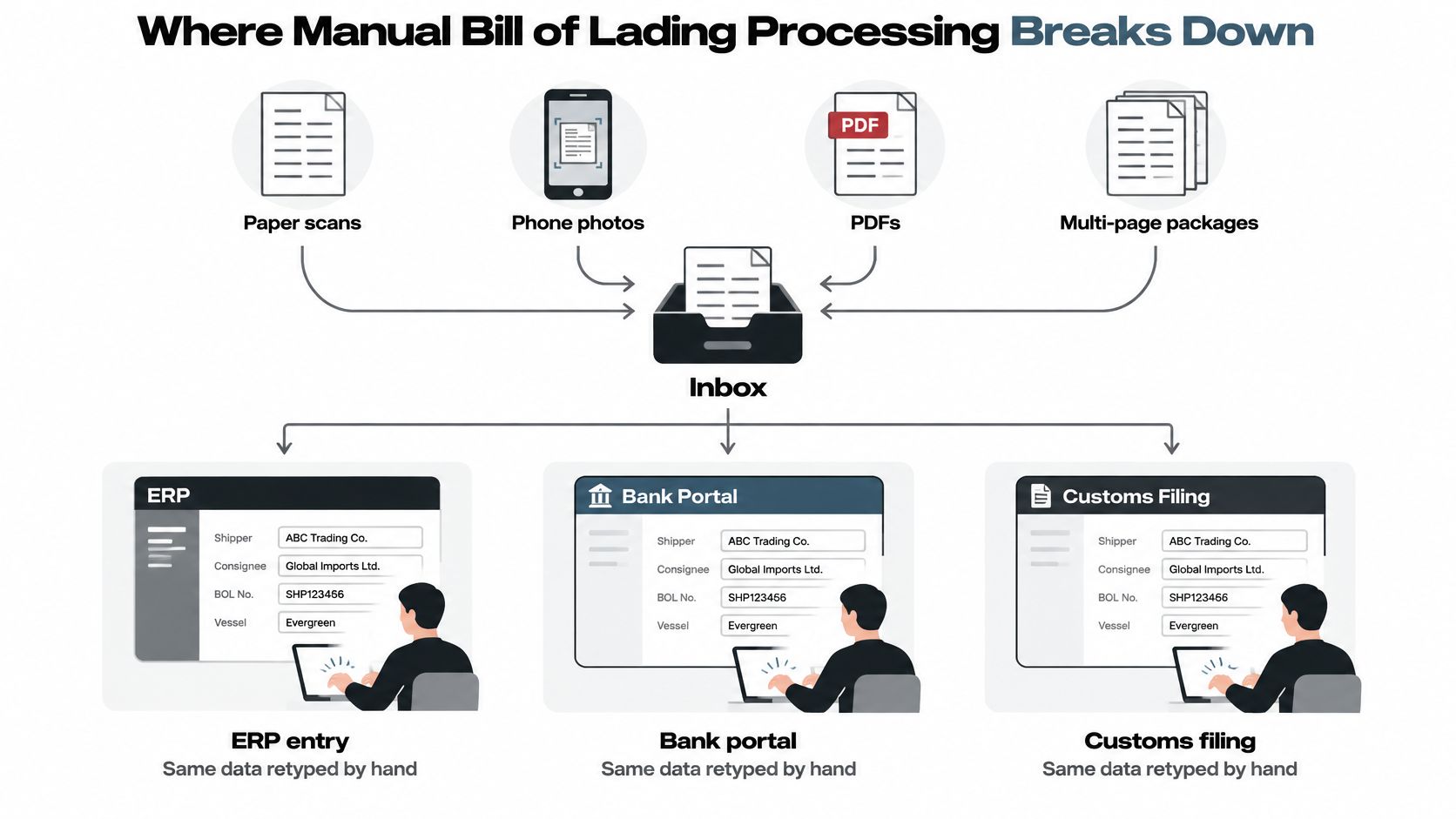
The failures are concrete and they're expensive. A wrong consignee name adds days to release while the carrier checks who is entitled to the goods. A typo in gross weight pulls the container into a customs query that takes a broker half a day to answer. A claused remark that never made it into the typed copy can stop a letter of credit payment after the vessel has already sailed.
The cost drivers repeat across operations:
- Rework from keying errors: each correction means a call, an email and a new document version.
- Delayed release and demurrage: free time expires while paperwork is fixed.
- Duplicate documents by email: two "final" versions circulate and nobody knows which one controls.
- Staff hours per shipment: the same fields, entered three or four times, by three or four people.
Basic OCR can't catch any of this, because it reads characters rather than meaning. It can't tell the consignee from the notify party, it can't see that 12,400 kg on the bill contradicts 14,200 kg on the packing list, and it can't notice that a remark on page 4 changes the payment position.
The coordination problem goes beyond choosing a platform. In May 2025 the Digital Container Shipping Association announced the first standards-based interoperable eBL transaction and restated an industry objective of 100% eBL adoption by 2030, a target rather than an outcome. Shipping lines, forwarders and banks have made commitments; beneficial cargo owners haven't matched them collectively, and questions about court acceptance remain open.
How Automated Extraction Reads a Bill of Lading
A working pipeline treats a bill as a document with a lifecycle, not as an image with text on it. Here is the sequence in the order it runs.
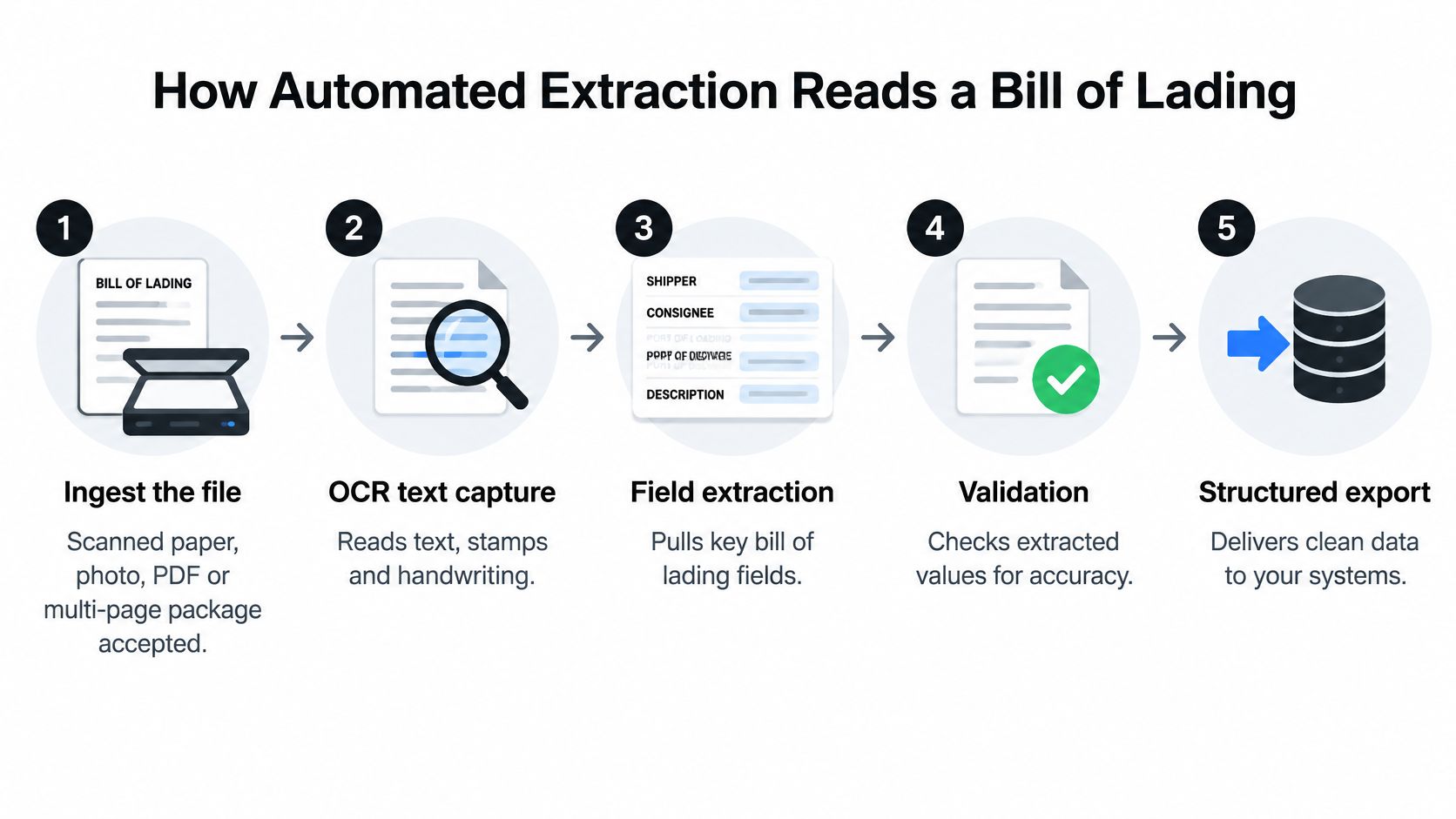
The seven stages in order
- Ingest the file. Scanned paper, a photo, a digital PDF or a multi-page package all enter the same queue.
- Read the text. OCR captures printed text along with stamps and handwritten remarks, which is where the awkward information usually hides.
- Classify each page. A page is a bill of lading, an invoice, a packing list or a customs declaration, and mixed packages get split before extraction.
- Extract into a fixed schema. Bill number, parties, ports, vessel, cargo description, package count, weight and freight terms land in defined fields.
- Validate across documents. The consignee matches the credit, the weight matches the packing list, the ports match the freight terms, the totals add up.
- Route exceptions to a person, with the source page highlighted so review takes seconds instead of a search.
- Push approved data into the ERP, the bank portal or the customs filing.
Customs practice shapes stage five. The WCO's guidance on import and export formalities says declarations should be limited to the particulars needed for duties, taxes, statistics and enforcement, based on international standards for electronic data exchange. That's an argument for traceability: every extracted value should be checkable against its source page, because the filing built on it is legally relevant.
Say a twelve-page shipment arrives with a claused remark on page 4. The system splits the package, classifies the bill, flags the remark as an exception, and lets the routine fields flow onward while a person reviews the one decision that affects payment.
Platforms such as Matil.ai combine OCR, classification, validation and workflow in a single API, with pre-trained models for bills of lading and customs declarations and custom models when a document differs from the standard set. Matil reports accuracy above 99% across several use cases, and each extracted value can be traced back to the page it came from. For teams redesigning the surrounding process before picking a tool, how Wisely approaches AI consulting covers the workflow side of the same problem.
Security teams should check the claims that matter to them before a pilot: GDPR, ISO 27001 and AICPA SOC alignment, a zero data retention policy and pre-trained models that can be personalised quickly. If you're comparing engines on measured performance, this OCR accuracy comparison shows how the numbers are produced.
Decide Whether to Automate and How to Start
A bill of lading error can do more than create a typing correction. A wrong consignee may delay cargo release; an incorrect freight term may affect payment. Automate when document volume is steady, fields must be re-entered across systems, or errors cause operational delays. Keep people responsible for decisions about title, negotiable bills, and claused remarks.
Five steps to a baseline you can defend
- Count the work. Record bills processed each month and the time spent entering and re-entering their details.
- Choose five fields tied to release or payment on your trade lane. These might include consignee, bill number, port of discharge, package count, and freight terms.
- Gather about 50 sample documents. Include paper scans, angled phone photos, and mixed multi-page packages. A clean sample alone will not show how the process handles difficult pages.
- Measure accuracy by field and track exceptions. An overall score can hide a misread field that controls cargo release or payment.
- Set rules before go-live. Define validation checks and assign an owner to each exception type, such as a wrong consignee, missing endorsement, weight mismatch, or unclear remark.
A useful test case is a 12-page mixed package with an illegible page 4. Ask how the process identifies the affected field, preserves its source, and routes the decision for review.
Matil offers pre-trained models for bills of lading and customs declarations, as well as a model that processes complex ocean freight rates and surcharges. Its API supports three modes: Normal returns structured data synchronously for real-time integrations; Async sends results by webhook when they are ready; and Batch lets users submit hundreds of documents in a single request for imports. The service is for businesses, not consumers. For integration details, see this guide to an API for data extraction.
Run a pilot on your own sample and compare field-level accuracy and exception rates with the baseline. Those results help show whether automation addresses the specific points where manual processing creates delays or payment risk.
Matil turns bills of lading and customs declarations into validated, structured data through one API, with classification, field-level validation, and an exception route for decisions that need human review. If you are considering automation for a document flow that relies on retyping and email, you can visit Matil to see how extraction, validation, and workflow fit together, then test it against a sample of your own shipments.


