8 Data Validation Techniques for Document Accuracy 2026
Explore 8 data validation techniques for document extraction, from schema checks to confidence scoring, that cut errors in invoices, KYC and logistics.

A payment is ready to approve, but the extracted amount belongs to the subtotal column. A supplier record looks new because someone scanned its tax identifier incorrectly. A KYC file contains a plausible identity number that belongs to nobody. These data validation techniques help catch errors before they reach your ERP, database, or compliance file.
Document data extraction turns information in PDFs and images into structured fields. Data validation checks whether those fields meet the rules required for their intended use. They're different jobs. OCR can recognize a value confidently without establishing that it's correct.
The operational cost appears later. Accounts payable investigates a mismatch, an administrator merges duplicate suppliers, or a compliance analyst reopens an accepted file. If your automation sends every readable document downstream, you haven't removed manual work. You've moved it somewhere harder to manage.
Build layers, not a single pass-or-fail test
Start with structure, then check identifiers, calculations, reference records, and relationships across documents. Each layer catches errors that another layer can't. The distinction is useful when reviewing approaches such as how CEFCore validates loan records, where individual fields need rules that reflect their downstream use.
Keep the original document alongside the extracted values and validation results. A reviewer should be able to identify what failed, inspect the evidence, and correct the record without starting the extraction again.
1. Schema and Data Type Validation
Posting a payslip starts with types, not with whether the numbers add up. Schema validation is the first layer in the stack: it checks that extracted data has the expected fields, types, and required values. It runs after OCR and before calculations, database writes, or ERP posting.
Define gross salary and net salary as decimals, currency as an allowed code, and the pay period as dates. On identity documents, a missing expiry date is a different case from a category that has no expiry. Required fields follow the document type, not one template for every file.
This layer catches an invoice total returned as text, or a supplier name returned empty. A wrong amount that is still a valid decimal passes. Structural schema checks catch format and type errors only. They cannot detect a wrong value that is still well-formed. Arithmetic checks and cross-document checks have to take that work later.

Make missingness explicit
Empty strings, nulls, unreadable fields, and inapplicable fields are different failures. Each one needs a different action.
- Missing required field: Hold the record before posting.
- Unreadable field: Send the relevant image region for review.
- Inapplicable field: Accept the omission only when the document category allows it.
- Unexpected field type: Keep the raw value. Do not coerce it.
Start with the fields the downstream transaction uses. Add requirements after you see real exceptions, not because a template has more boxes.
The trade-off is strictness versus false holds. A schema that demands every box on a form will stop legitimate documents that never had that field. A schema that treats every empty cell as optional will post incomplete invoices.
Store the schema version with the document classification and the extraction result. Then you can explain why an older record passed under an earlier definition.
2. Format and Pattern Validation (Regular Expressions)
A delivery note contains a product code with a letter where your catalog requires a digit. The field passes a text-type check, but it won't join to the product record.
Pattern validation checks the shape of a value. Regular expressions, length rules, and allowed-character checks can flag truncated identifiers, unexpected punctuation, and OCR substitutions such as O for 0.
NIST input-validation guidance distinguishes syntax from semantics and includes character set, length, numerical range, and acceptable values among the checks. Apply that distinction directly: a well-formed tax identifier isn't necessarily a real tax identifier.
Normalize carefully before matching
Remove surrounding whitespace and standardize harmless separators where the identifier specification permits it. Preserve the original extracted string so reviewers can distinguish normalization from correction.
For electricity bills, validate the Spanish CUPS supply-point code before attempting to match the customer account. For delivery notes, use the SKU pattern belonging to that supplier or catalog, rather than assuming every product code follows the same convention.
- Test accepted examples: Include different suppliers, layouts, and legitimate identifier variants.
- Test rejected examples: Include truncation, inserted spaces, and visually similar characters.
- Inspect rejection logs: Determine whether failures come from extraction, an outdated pattern, or a new legitimate format.
Practical rule: A pattern can establish that an identifier is well-formed. It can't establish who owns it.
Avoid automatically replacing every ambiguous character. A correction that produces a valid-looking identifier can be more dangerous than an obvious failure. Use the pattern to narrow the review, then confirm the value against the image or an authoritative record.
3. Checksum and Check-Digit Validation
Check-digit validation tests the mathematical relationship built into an identifier. Unlike a regular expression, it can reject a string whose length and character pattern look correct.
IBANs, Spanish NIF and NIE identifiers, GS1 GTIN product identifiers, and ISO 6346 container numbers use check mechanisms. They don't share the same algorithm, so route each identifier to the appropriate validator after identifying its type.
In a KYC workflow, extract the identity number, normalize permitted formatting, and calculate its expected check character. If the result disagrees with the document extraction, hold the field for review rather than accepting a plausible-looking number.

Separate transcription checks from identity proof
A passing checksum means the identifier satisfies its mathematical rule. It doesn't prove that the identifier was issued, remains active, or belongs to the person submitting it.
The European Commission's electronic identity guidance describes an identification and trust-services framework. That's a separate concern from accurately extracting text from an identity document.
Apply the same distinction in logistics. A container number on a Bill of Lading can pass its check-digit test yet refer to the wrong shipment.
- Validate before lookup: Reject malformed inputs before making unnecessary external requests.
- Show the evidence: Give reviewers the identifier and its original image region.
- Keep separate outcomes: Record format, checksum, registry, and ownership checks independently.
Don't rewrite a failed identifier merely to make its checksum pass. Several edits may produce mathematically valid alternatives. The correct result must come from source evidence, not from whichever candidate satisfies the algorithm.
4. Arithmetic and Cross-Field Consistency Checks
Arithmetic validation checks whether related amounts reconcile within a document. Cross-field validation also covers logical relationships, such as whether a payment date is compatible with the invoice's status.
For invoices, compare quantity multiplied by unit price with the line amount. Reconcile lines to the subtotal, then account for discounts, charges, and tax before comparing with the final total.
The European Commission's VAT invoicing guidance identifies required invoice information, including applicable VAT rates, VAT amounts, and relevant breakdowns. Presence checks establish that the fields exist. Reconciliation tests whether the extracted amounts agree.

Reconcile the document's actual calculation model
Don't impose the same equation on every invoice. Some suppliers round tax by line, others by tax group. Credit notes, deposits, and withholding also change how the payable amount is derived.
For payroll, reconcile gross pay, deductions, reimbursements, and net pay according to the payslip's structure. Subtracting every visible deduction can fail when the document includes employer contributions that don't reduce the employee's net payment.
Show the expected result, extracted result, difference, and applied tolerance together. Reviewers shouldn't have to reconstruct the calculation.
Document tolerances by currency and calculation method. Use decimal arithmetic for money, and retain the calculation inputs for audit.
These checks also matter after extraction when financial teams calculate debt-to-equity and debt-to-EBITDA formulas. Correct arithmetic can't rescue a ratio built from fields mapped to the wrong accounting concepts.
5. Reference Data and Master Data Lookup
Reference validation checks whether an extracted value exists in an authoritative dataset and belongs to the expected entity. This moves the workflow beyond plausible text.
An accounts payable team can compare the supplier identifier on an invoice with its supplier master, then verify that the payment details match the approved account. A delivery-note pipeline can match extracted SKUs against the product catalog before booking inventory.
For EU suppliers, a VAT-number check through VIES can support tax validation. Keep that outcome separate from supplier approval, bank-account authorization, and invoice approval. They answer different questions.
Treat the reference source as a dependency
An unmatched value doesn't automatically mean bad extraction. It may indicate a new supplier, a stale catalog, an integration delay, or an unavailable registry.
- Identifiers: Prefer exact matching after controlled normalization.
- Names: Use approximate matching to suggest candidates, not select an entity.
- Unavailable references: Record the lookup as unavailable, not invalid.
- Unmatched records: Route them to an owner who can update the master or correct the extraction.
The guide to validation rules in a database explains where database-level controls fit alongside document validation. A foreign-key constraint protects the stored relationship, while intake checks can give reviewers more useful context before insertion.
Version reference records and retain effective dates. A supplier's historical address shouldn't fail solely because its current master record contains a newer address.
Governance deserves operational attention: Precisely's data-integrity planning analysis reports that 45% of surveyed organizations identified inconsistent data definitions and formats. Agree on field meaning before automating comparisons, or teams will reject correct records for the wrong reasons.
6. Confidence Scoring and Human-in-the-Loop Review
Confidence-based routing directs uncertain extractions to human review. It's a prioritization mechanism, not proof that high-scoring fields are correct.
Treat model confidence as a score until you've calibrated it against labeled examples. A model can confidently read the wrong column, and a low-confidence value can still be accurate. Business-rule failures should therefore override automatic acceptance when the field carries material risk.
For a Bill of Lading, a reviewer might need to inspect a difficult container number while the system retains already validated consignee details. For KYC, an uncertain identity number should remain unresolved even when the name and address are clear.
Set thresholds by consequence
Use stricter acceptance criteria for bank details, identity fields, and payment amounts than for descriptive text. Avoid a document-wide average that lets easy fields conceal a dangerous error.
- Calibrate by field: Compare confidence bands with independently labeled values.
- Review accepted records: Sample automated passes to find silent errors.
- Track review outcomes: Separate extraction corrections from legitimate business exceptions.
- Measure throughput: Monitor how much work reviewers receive and how long exceptions remain open.
The distinction between activity and an operating process matters. A survey of U.S. information-services and data professionals found that 75% actively performed validation, while 51% had established data-quality processes.
For identity workflows, tax ID validation should combine confidence routing with identifier-specific checks. A reviewer needs the source image, extracted value, failed rules, and a clear acceptance action.
Don't let corrected records disappear into a queue history. Use them to improve extraction definitions, test cases, and routing thresholds.
7. Cross-Document Consistency Validation
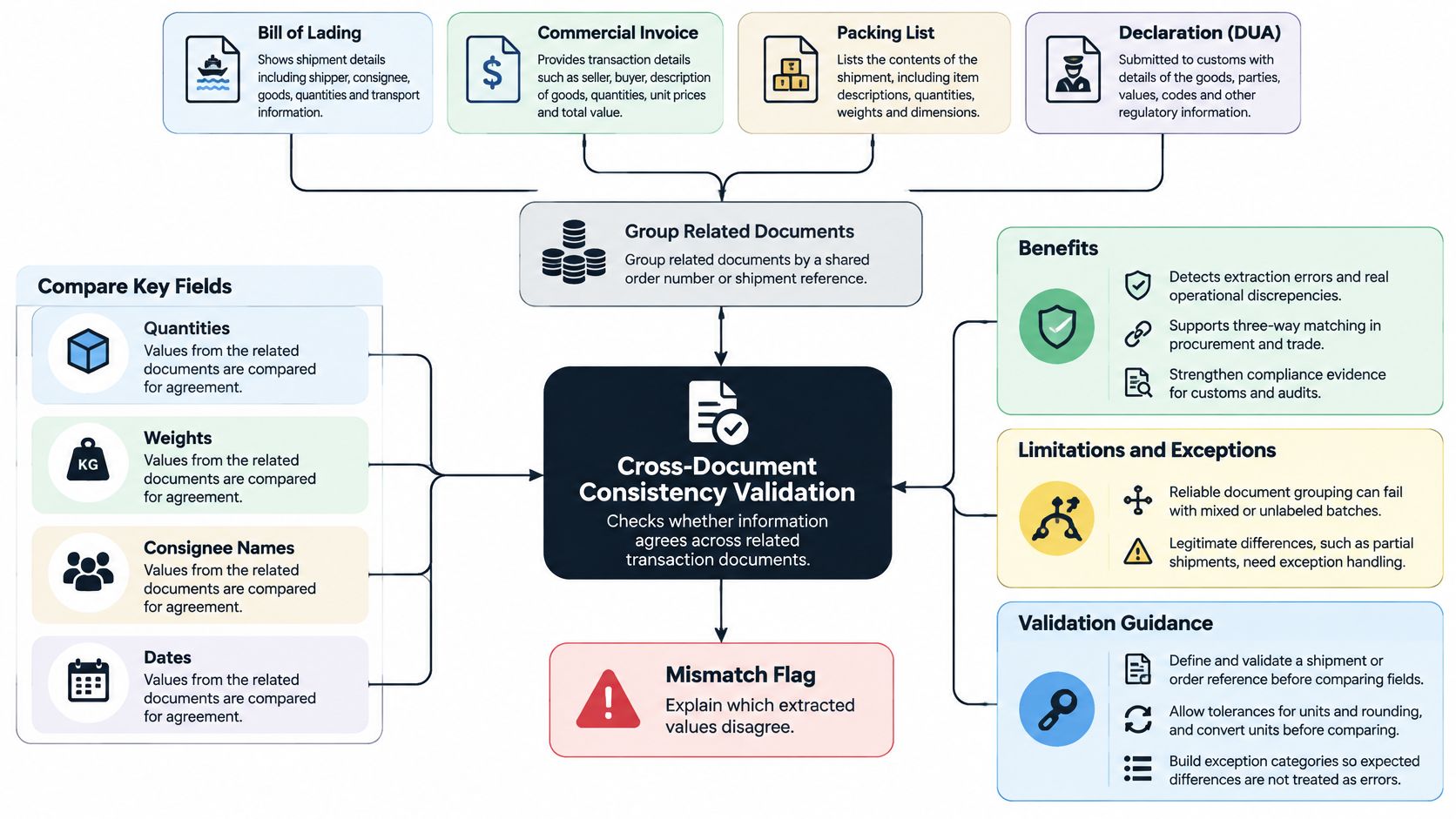
A commercial invoice, packing list, Bill of Lading, and customs declaration can each pass their individual checks while disagreeing about the shipment.
Cross-document validation compares related records within the same transaction. It checks shared references, parties, quantities, weights, and dates after confirming that the documents belong together.
Use a relationship map to define which documents and fields should be compared.
Establish the grouping before comparing values
Use a shipment, purchase-order, or transaction reference to assemble the document set. Don't group records solely because they share a supplier name.
A freight forwarder can compare gross weight on the Bill of Lading with the DUA before submission. An importer can compare invoiced quantities with delivery-note quantities and route a shortfall for investigation.
Normalize units before comparing. Also distinguish gross weight from net weight, packages from individual items, and ordered quantities from received quantities. Otherwise, the system will generate exceptions that describe normal business differences.
The workflow below offers another way to consider document-processing steps.
Give exceptions meaningful categories:
- Missing document: The expected counterpart hasn't arrived.
- Extraction mismatch: A value may have been read incorrectly.
- Business discrepancy: The documents accurately describe conflicting quantities or terms.
- Expected difference: A partial delivery or approved amendment explains the mismatch.
This distinction prevents reviewers from correcting valid source data to force agreement. Cross-document validation should expose discrepancies, not erase them.
8. Duplicate Detection and Anomaly Checks
Duplicate detection identifies repeated submissions. Anomaly detection identifies unusual records that deserve investigation. Neither should rely on an invoice number alone.
Supplier numbering schemes can overlap. A repeated filename can contain a corrected document, while different filenames can contain the same invoice. Compare normalized supplier identity, document number, amount, currency, and relevant dates.
A study published by ACM classifies data errors into outliers, duplicates, rule violations, and pattern violations. The practical implication is that clean formatting and correct calculations don't eliminate the need to compare records with history.
Separate exact duplicates from suspicious similarity
For accounts payable, an already approved invoice with the same supplier and document number should trigger a hold. A similar amount from the same supplier may only warrant review, especially when recurring invoices are expected.
Use document hashes to detect identical files, but don't depend on them alone. Rescanning or changing PDF metadata can produce a different file representing the same business document.
- Exact business duplicate: Hold posting and show the previously processed record.
- Possible duplicate: Compare dates, line items, and amendment status.
- Unusual amount: Compare with a relevant supplier or expense-category baseline.
- Unusual volume: Investigate missing pages, repeated batches, or capture changes.
An anomaly is a reason to investigate, not a verdict that the data is wrong.
Seasonal purchases, annual renewals, and credit notes can legitimately depart from historical patterns. Give finance or operations owners responsibility for reviewing those rules.
Protect the integration too. Use stable transaction keys and idempotent posting so retries don't create duplicate ERP records after an otherwise successful validation.
How each data validation technique compares
| Item | Main error it catches | Needs external data | Best for |
|---|---|---|---|
| Schema and Data Type Validation | Missing required fields or values in the wrong format or type | No | Ensuring extracted output matches a predefined structure |
| Format and Pattern Validation (Regular Expressions) | Malformed identifiers and character-level OCR errors | No | Checking codes, IDs, and other structured strings |
| Checksum and Check-Digit Validation | Misread characters in identifiers with check digits | No | Verifying eligible IDs, bank accounts, barcodes, and container codes |
| Arithmetic and Cross-Field Consistency Checks | Totals or related values that do not agree | No | Validating invoice amounts, taxes, and payslip calculations |
| Reference Data and Master Data Lookup | Values that are invalid or do not match the expected entity | Yes; requires reference data or registries | Confirming suppliers, products, and identifiers exist |
| Confidence Scoring and Human-in-the-Loop Review | Uncertain extractions that may need human correction | No | Routing low-confidence fields for review |
| Cross-Document Consistency Validation | Conflicting values across related documents | Requires related documents | Matching trade, logistics, or procurement documents |
| Duplicate Detection and Anomaly Checks | Duplicate records and unusual values | Historical data helps identify anomalies | Preventing duplicate payments and flagging suspicious transactions |
Layer Your Checks, Then Measure What Gets Through
No single validation technique establishes document accuracy. Start with schema and identifier checks, add arithmetic and reference validation, then compare related documents and processing history. Use confidence routing to direct human attention where uncertainty remains.
The operating principle is straightforward: acceptance should depend on evidence appropriate to the field's risk. A readable description may need little intervention. A changed bank account needs stronger controls, even if every character was extracted confidently.
Measure outcomes rather than rule counts
Track field-level accuracy against labeled samples, review rates, false rejections, and errors discovered after acceptance. Measure completeness and freshness too. A pipeline can report perfect validation results while failing to receive documents.
DATAVERSITY's data-management trends survey reports that 62% of participants experienced incomplete data. That's why teams should reconcile received documents, extracted records, and destination-system acknowledgments rather than inspecting only the records that reached validation.
A practical rollout follows a controlled sequence:
- Define acceptance: Document required fields, calculation rules, reference sources, and exception owners.
- Test representative samples: Include poor scans, unfamiliar layouts, amendments, and legitimate edge cases.
- Run in observation mode: Review proposed decisions before allowing automated posting.
- Release by risk: Automate stable document types and lower-risk fields before expanding.
- Retest changes: Evaluate schema, model, reference-data, and business-rule updates before production.
Keep rule versions, effective dates, and reviewer decisions with each result. Otherwise, a later audit may apply today's policy to yesterday's transaction and produce a misleading failure. The same operational discipline applies beyond finance, including workflows discussed in these error-checking tips for veterinary practices.
Evaluate the whole document workflow
Matil isn't just OCR. It combines OCR, classification, validation, and workflow orchestration through a simple API, with pre-trained models and rapidly customizable extraction schemas. Its reported accuracy is above 99% in multiple use cases, but that isn't a guarantee for your documents; its evaluation feature tests ground-truth datasets, tracks precision and recall per field, and detects regressions before production.
Security belongs in the evaluation too. Matil offers GDPR, ISO 27001, and AICPA SOC security and compliance standards, alongside a zero data retention policy. Results still require client supervision and express acceptance.
Choose the workflow that can explain its decisions, expose uncertainty, and demonstrate performance on your own documents. More rules aren't automatically better. Better controls catch consequential errors without forcing reviewers to spend their day dismissing predictable false alarms.
Matil offers document extraction, classification, validation, and automation through one API, with field-level evaluation against your labeled samples. Visit Matil to discuss your document types and arrange a personalized assessment of the checks your workflow needs before production.


