Enterprise Document Security: A Practical 2026 Playbook
A practical 2026 playbook on enterprise document security covering threat landscape, encryption, IAM, DLP, secure document pipelines, compliance, and vendor

Your finance team is clearing an invoice backlog. Someone uploads a supplier PDF to a personal AI account to extract the payment details, while your security dashboard shows no unusual activity in the approved document repository. Enterprise document security has just failed outside the system you were monitoring.
The Moment an Invoice Reaches a Public AI Tool
The employee wasn't trying to disclose business information. They were trying to finish a task that your approved workflow made unnecessarily difficult. But the invoice may contain bank details, personal information, contractual terms, or attachments that the employee never reviewed.
Treat that upload as an unauthorized disclosure requiring assessment, not automatically as a confirmed breach. Establish what left the organization, which account received it, what processing terms applied, and whether deletion is possible.
The financial stakes justify dedicated attention. IBM's 2025 Cost of a Data Breach research examined 600 breached organizations and reported a USD 4.44 million global average breach cost. That's context for the risk, not a prediction of what an invoice upload will cost your business.
Protect the journey, not just the destination
Enterprise document security is the discipline of protecting documents and their derived data throughout processing, access, transfer, retention, and deletion. A secure repository is one component, not the complete architecture.
Build your program around these pillars:
- Threat environment: Identify upload interfaces, integrations, employee devices, and developer credentials that could expose document data.
- Data classification: Decide which documents require which handling restrictions.
- Encryption and key management: Protect content and control who can decrypt it.
- Access control and identity: Authorize people and machines separately.
- DLP and monitoring: Inspect sensitive content before it leaves approved boundaries.
- Secure processing: Govern extraction, validation, temporary artifacts, and delivery.
- Compliance and auditability: Preserve evidence that controls operated.
An approved API should have defined identities, processing terms, destinations, and audit events. A personal browser account may have none of those enterprise controls.
Practical rule: Approve a document-processing route, not merely a product name.
A zero-data-retention AI policy can limit what an approved processor keeps. It can't undo an earlier upload to an unapproved service. Give employees a usable approved route, then enforce the boundary around it.
How Document Threats Are Shifting in 2026
A document can leave the enterprise before it reaches its approved repository. A staff member may upload an invoice to an unsanctioned AI tool, or an attacker may exploit an upload service or steal an integration token. Set priorities by examining the actual processing path, from intake through connected systems.
Use the visual below to start a review of document-workflow exposure. Rank risks against the findings in the cited reports, then test whether your controls cover the entry points those findings make relevant.
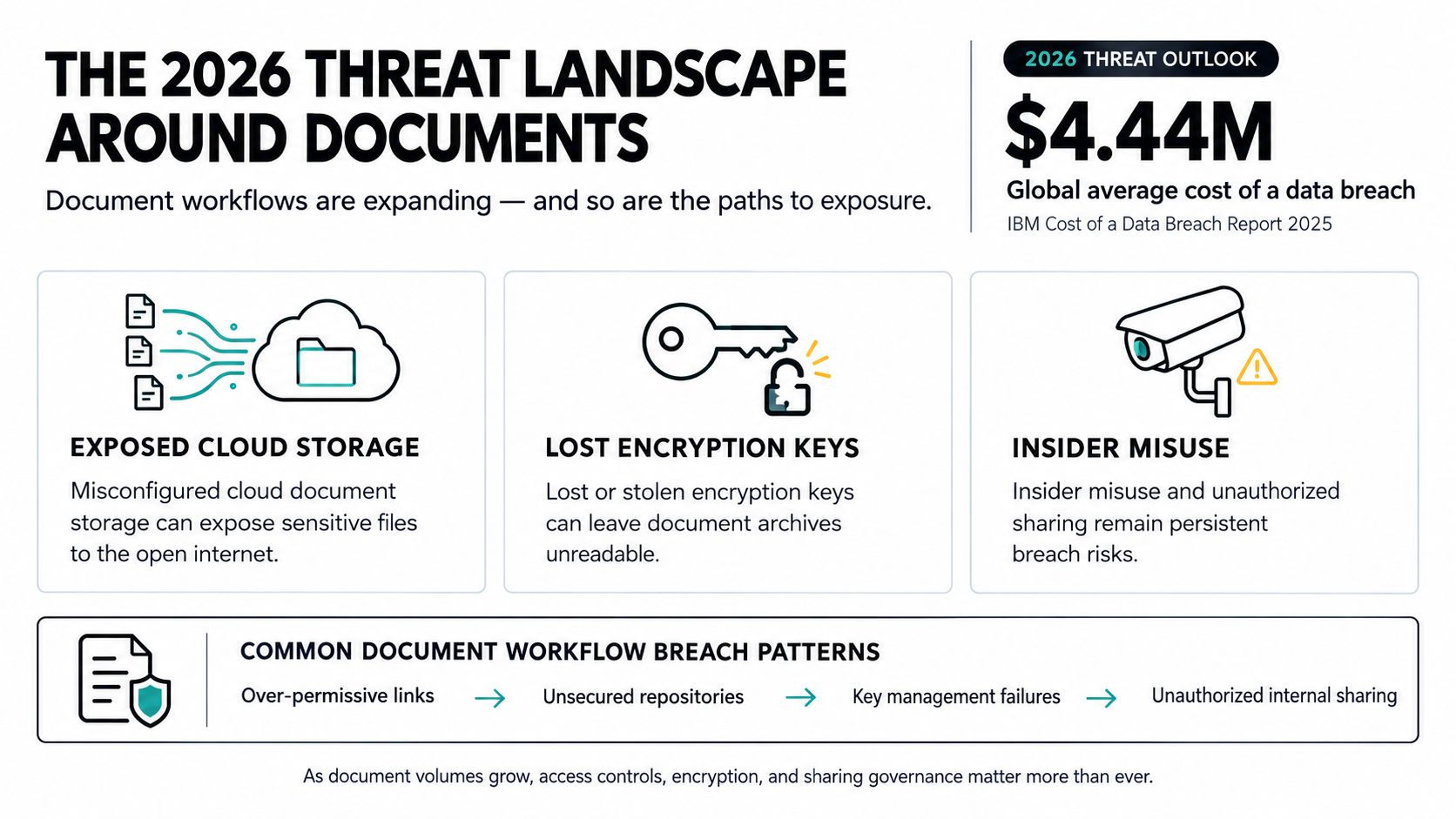
IBM's full breach report found compromised customer personally identifiable information in 53% of studied breached organizations. Shadow AI was associated with 20% of the studied breaches. Treat extracted customer data and unsanctioned AI uploads as explicit threat-model categories. Require vendors to document their retention terms, including whether a zero-retention promise covers prompts, extracted content, logs, and temporary files.
The Verizon 2025 DBIR executive summary analyzed 22,052 incidents, including 12,195 confirmed breaches. Vulnerability exploitation increased 34%. Compromised credentials provided initial access in 22% of reviewed breaches, while secrets leaked in GitHub repositories had a 94-day median remediation time. These findings make token scope, revocation, and remediation speed operational requirements, not documentation exercises.
Translate attacker behavior into workflow failures
| Attacker focus | Entry point to examine | Document-specific consequence |
|---|---|---|
| Opportunistic exploitation | Upload portals and processing services | Unauthorized access to submitted files or processing infrastructure |
| Credential abuse | Employee accounts and service identities | Legitimate-looking downloads, exports, or extraction requests |
| Supply-chain compromise | OAuth integrations and developer tokens | Access extending into connected repositories and business systems |
Ask the team to prove whether a stolen integration token can retrieve historical documents, how quickly upload services receive security fixes, and whether revocation disables credentials across every connected component. Require evidence from a test, not a policy statement.
For smaller subsidiaries or newly acquired teams, Cloudvara's guide to document safety for SMBs can support the review. Apply the same architectural questions at every company size.
Treat the video below as a discussion prompt. The statistics above come from the cited reports.
Assign an owner, detection method, and containment action to every entry point. A threat model should drive incident decisions, including which keys to revoke and which processing routes to suspend.
Classifying Documents Before You Protect Them
Start with the document's business purpose and contents. A delivery note containing SKU quantities doesn't necessarily need the same restrictions as a passport scan, payslip, or confidential board decision.
I recommend public, internal, confidential, and restricted as an operational classification scheme. These are proposed policy labels, not a claim that every enterprise must use the same taxonomy.
Make the labels visible where employees work.

Assign handling rules with each label
| Classification | Example | Recommended handling |
|---|---|---|
| Public | Approved published material | Allow external distribution after publication approval |
| Internal | Routine operating instructions | Keep within corporate workspaces and employee identities |
| Confidential | Supplier contracts, invoices, delivery notes | Limit access to the relevant business process and approved integrations |
| Restricted | Identity evidence, payslips, sensitive board records | Require explicitly authorized roles, controlled exports, and documented retention |
Classify by content and context, not filename. A utility bill containing a CUPS identifier may also identify a customer. A Bill of Lading or DUA customs document may disclose commercially sensitive trading relationships.
Use existing metadata fields in your DMS, ERP, or intelligent document processing platform. Kogifi's resource on AI and SharePoint document control is relevant when assessing how classification will fit existing document-management workflows.
Your internal template should answer:
- Ownership: Which business owner approves access and exceptions?
- Location: Which storage and processing destinations are permitted?
- Retention: Which legal or business rule determines when deletion becomes due?
- Disposition: What happens to originals, derived records, backups, and legal holds?
- Transformation: Can a masked version satisfy the downstream task?
Use data masking when a recipient needs a document's operational content without its full identifying details. Keep the unmasked version under its original controls.
Don't label everything restricted. That forces reviewers to treat routine documents and high-risk identity evidence alike. Instead, require documented escalation when classification is uncertain, and give reviewers enough context to resolve it.
Encryption and Key Management as a Lifecycle
Encryption protects content only while decryption privileges and key material remain controlled. If the same application identity can access every archive and every key, your encryption architecture provides little separation after that identity is compromised.
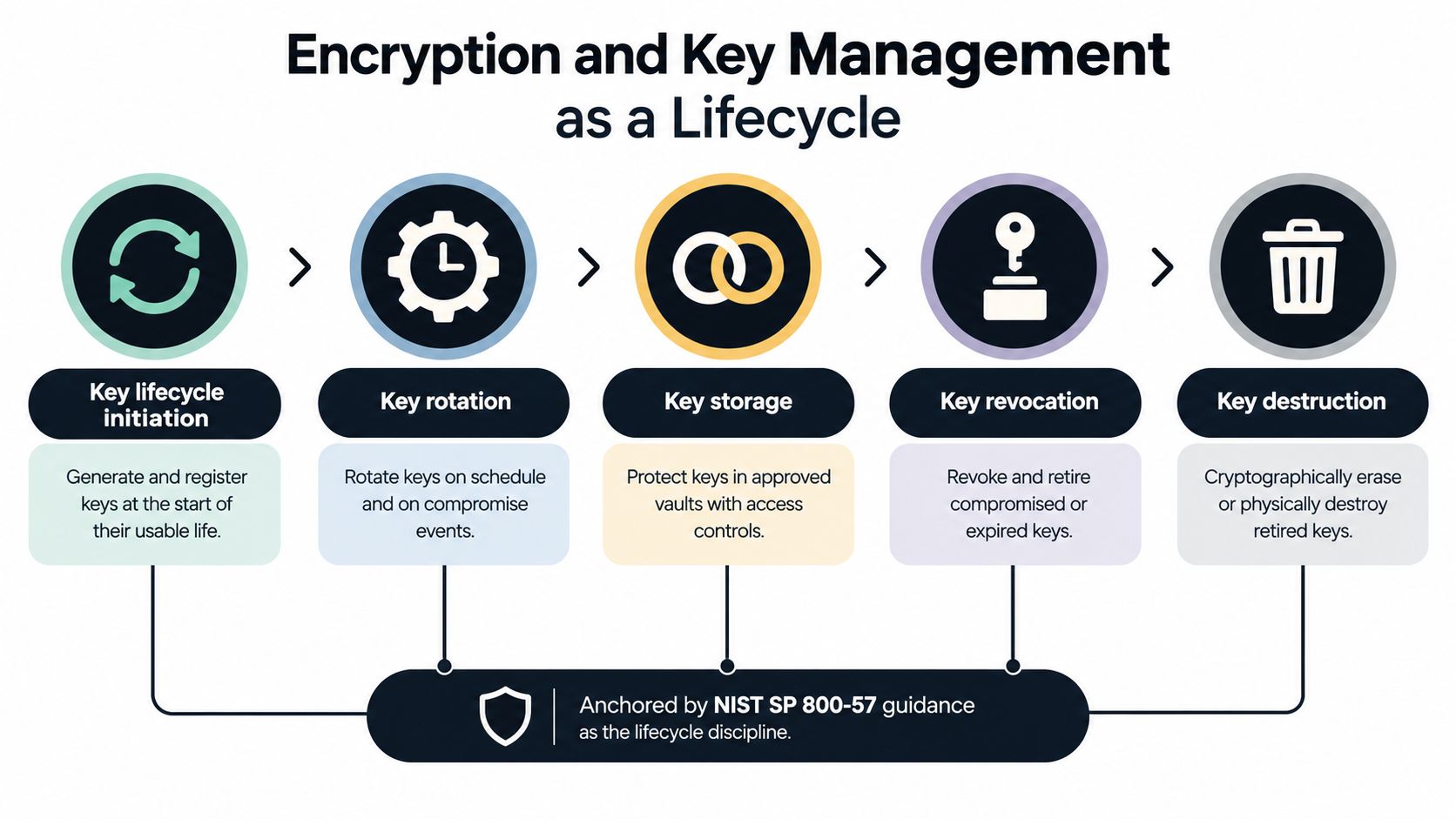
NIST SP 800-57 defines key management across secure generation, storage, distribution, use, suspension, revocation, and destruction. It also recommends that a key generally serve one purpose and that unnecessary secret material and intermediate cryptographic results be destroyed.
Use that lifecycle as the operating model, rather than treating encryption as a deployment setting.
Separate storage protection from decryption authority
Prefer a managed, hardware-backed key management service where feasible. Avoid ad-hoc encryption that leaves key files alongside the encrypted documents or embeds secrets in application configuration.
Separate keys according to meaningful security boundaries: production versus testing, tenants, data classifications, and cryptographic functions. Don't create arbitrary complexity, but don't let convenience turn every historical document into the same compromise domain.
Require a key register containing:
- Accountability: Owner, authorized applications, and approval authority.
- Permitted use: The purpose of the key and the data boundary it protects.
- Cryptoperiod: The approved usage period and rotation triggers.
- Revocation: The procedure for disabling access after suspected compromise.
- Recovery: Dependencies, recovery permissions, and tested restoration steps.
- Destruction: Evidence that retired material is no longer available.
Rotation needs an integration plan. Identify how historical records remain readable, which applications need updated references, and how you'll detect failed decryptions. Revocation also needs a containment plan that doesn't depend on the compromised identity.
A key-management plan that nobody has tested is an assumption about recoverability.
Document these decisions in the system security plan. Test recovery using authorized personnel and controlled evidence, not a production emergency.
Finally, coordinate key destruction with retention obligations and legal holds. Encryption doesn't justify keeping invoices indefinitely, and destroying a shared key without dependency analysis can make records unavailable when the business still needs them.
Access Control, Identity, and DLP Monitoring
An accounts-payable clerk, controller, external auditor, third-party integrator, and RPA bot shouldn't inherit the same document permissions. Their tasks differ. Their access should differ too.
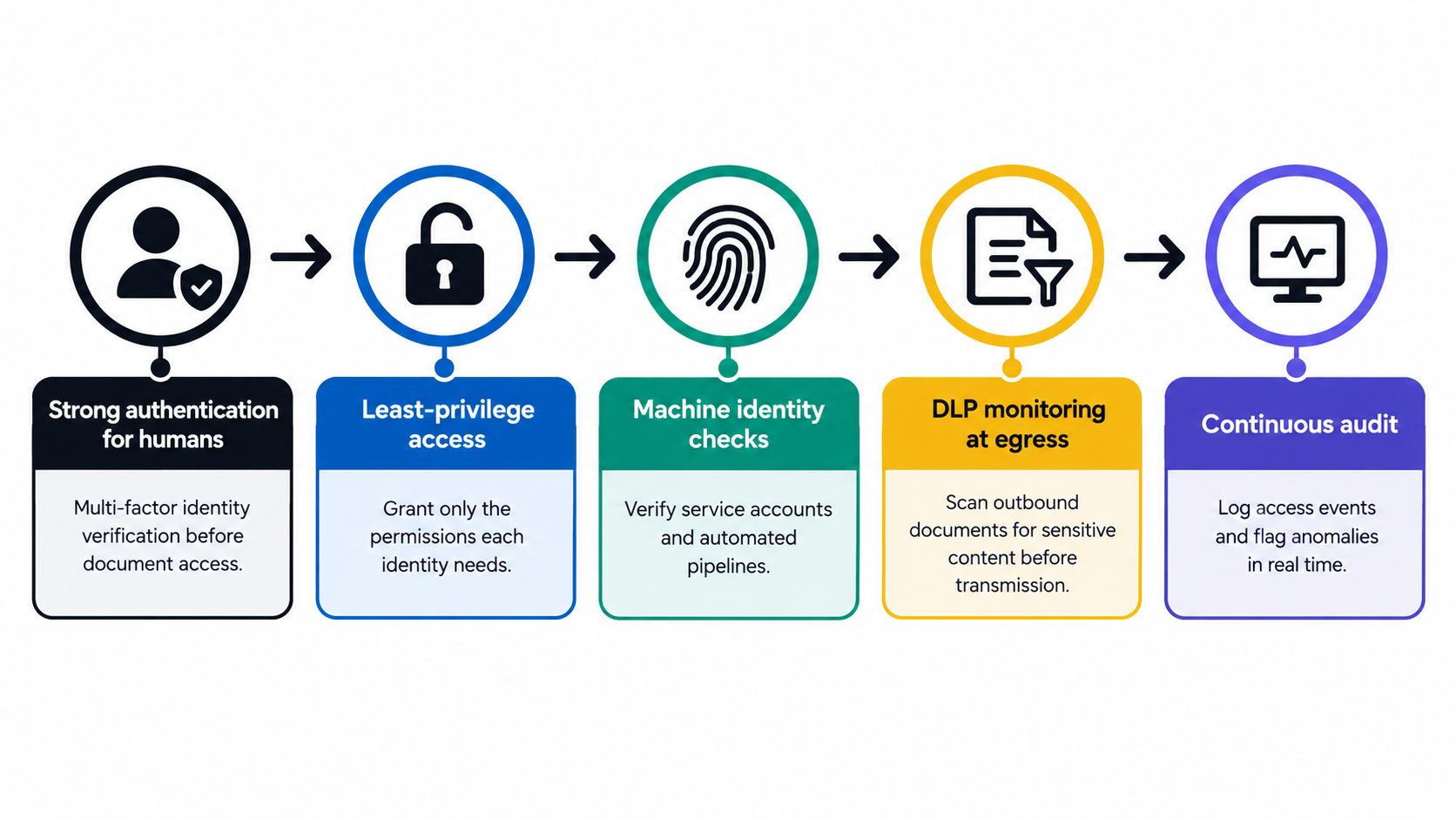
Build an access decision that evaluates identity, business role, document classification, device context, requested action, and destination. A successful login is only the beginning.
The diagram below shows how to connect identity checks with outbound inspection and ongoing review.
Design roles around actions and fields
Give the AP clerk access to assigned invoice exceptions. Let the controller approve payment-relevant corrections without granting identity-document access. Make an external auditor's access limited to the agreed evidence set, and prevent an integrator from browsing documents merely because it can submit extraction jobs.
For machines, use distinct service identities with scoped permissions. Developers shouldn't need production document access to troubleshoot schema errors. Return sanitized diagnostics whenever possible.
Extracted JSON needs authorization too. A bot permitted to receive an invoice total doesn't automatically need the supplier's bank account, every page image, or the original attachment.
Inspect disclosure before it happens
Harmonic's GenAI data-exposure resource describes analysis of more than 1 million prompts and 20,000 uploaded files across over 300 AI and AI-enabled SaaS applications: 21.86% of uploaded files contained sensitive data, and PDFs accounted for more than half of uploads. It also reports that 82% of data pasted into AI tools came from unmanaged personal accounts.
Application-level DLP won't adequately address a workflow that bypasses the application. Require:
- Before upload: Inspect content and validate the destination against the approved AI inventory.
- At the browser and endpoint: Address personal accounts, copy-paste, and file transfers.
- Before analytics: Redact or tokenize unnecessary identifiers.
- During access: Detect unexpected bulk downloads, unusual destinations, and changes in service behavior.
- For exceptions: Record the approver, business justification, allowed scope, and expiry.
Tune these controls against legitimate work. Blocking an approved invoice process without a practical alternative encourages workarounds. Measure false positives and investigate bypass attempts rather than celebrating alert volume.
Building a Secure Document Processing Pipeline
Document data extraction converts unstructured files into structured information that business systems can validate and use. OCR recognizes text. Classification identifies the document type. Validation checks whether extracted fields satisfy business rules. Automation routes the result or sends an exception to a reviewer.
Yes, you can automate invoice extraction. But readable text isn't the acceptance criterion. The acceptance criterion is a validated record delivered to an authorized destination with traceable evidence and controlled processing artifacts.
Pipeline Stages and Security Controls
| Pipeline stage | Required controls | Audit signal |
|---|---|---|
| Ingestion | Authenticate the sender, inspect uploads, enforce approved routes | Submitter, classification context, accepted or rejected upload |
| Classification | Apply handling rules and escalate uncertainty | Assigned label, rule version, reviewer decision |
| Extraction | Isolate processing, restrict artifact access, constrain output | Processing identity, configuration version, field provenance |
| Validation | Check schema and business rules, route exceptions | Failed checks, corrections, approval identity |
| Delivery and deletion | Authorize destinations, reconcile delivery, remove expired artifacts | Destination receipt, deletion result, unresolved retention exception |
Don't assume the original file is the only sensitive object. Temporary page images, OCR text, previews, validation traces, caches, support attachments, and exports belong in the architecture inventory.
Give each object an owner and a disposition rule. A failed job shouldn't leave an unrestricted diagnostic bundle behind.
Evaluate extraction and governance together
Matil.ai is one option for this architecture. Its published offering combines OCR, classification, validation, and workflow orchestration through an API, with pre-trained document models, configurable structured output, and customization for additional document types.
Evaluate its stated GDPR, ISO 27001, AICPA SOC, and zero-data-retention posture through the same evidence process you apply to alternatives. Test extraction precision on your documents and critical fields; a broad accuracy claim isn't a substitute for your acceptance test.
Use representative workflows rather than a polished demonstration:
- Invoices: Replace rekeying with field extraction and approval checks. The intended result is fewer manual handoffs without weakening payment controls.
- Payslips: Extract authorized fields into a restricted HR workflow, keeping unrelated employee details out of diagnostics.
- KYC: Preserve source evidence and route verification decisions separately from text recognition.
- Logistics: Extract SKU quantities, shipment details, and customs fields, then validate them against the receiving system's requirements.
Vendor requirement: Define zero retention by artifact, subprocessor, exception, and deletion trigger. Don't accept it as an unexplained slogan.
Ask whether customer content trains any model, whether human reviewers can access raw files, and whether abuse monitoring, retries, support cases, or backups create retained copies. Require contractual answers.
For finance, operations, and legal teams, the benefits should come from eliminating duplicate entry, catching inconsistent fields, and routing exceptions. Scale the approved process, not the number of uncontrolled document copies.
Mapping Compliance to Concrete Platform Requirements
A compliance badge doesn't tell your CIO whether the invoice-processing endpoint, relevant subprocessors, or production operating procedures were included in the assessment. Procurement needs evidence tied to the service you'll use.
GDPR Article 32 requires security measures proportionate to processing risk. It identifies pseudonymization and encryption, ongoing confidentiality, integrity, availability and resilience, prompt restoration of access, and regular testing of security measures.
Turn frameworks into acceptance evidence
| Framework or obligation | Evidence to request | Contract or acceptance requirement |
|---|---|---|
| GDPR Article 32 | Risk assessment, security measures, recovery tests | Defined responsibilities and ongoing control evaluation |
| ISO 27001 | Certificate scope and Statement of Applicability | Confirm the purchased service falls within the assessed boundary |
| AICPA SOC 2 | Applicable report, exceptions, customer responsibilities | Identify which controls your organization must operate |
| FATF Recommendation 10 | Verification design and source-evidence handling | Separate extraction output from identity verification decisions |
Use the ISO 27001 compliance requirements resource to prepare review questions. Don't let certification terminology replace examination of the underlying evidence.
For KYC, FATF's digital-identity guidance explains Recommendation 10's requirement to identify customers and verify identity using reliable, independent documents, data, or information. Its risk-based approach considers a digital-ID system's technology, architecture, and governance. Extracting a passport number isn't an identity-verification decision.
For invoice automation, require a documented validation specification that distinguishes mandatory fields, conditional fields, and business-specific checks. Security protects the record; validation determines whether it's fit for the intended transaction.
For legal teams evaluating external collaboration, Bizbe, Inc.’s best practices for secure deal documents provides a relevant discussion resource. Still require your own access, export, and audit acceptance criteria.
Ask vendors to demonstrate restoration, authorized key recovery, incident escalation, and control testing. Attach material commitments to the agreement, including subprocessor handling and breach-notification obligations.
A Practical 90-Day Rollout and Vendor Scorecard
Use 90 days as a proposed implementation window, not a guarantee. Narrow the initial scope to a document type with a clear business owner, measurable acceptance criteria, and manageable integration dependencies.
Sequence the rollout
- Weeks one to two: Inventory approved and unapproved routes. Classify the pilot documents, threat-model the workflow, and assign control owners.
- Weeks three to six: Implement scoped identities, key controls, and outbound inspection. Test legitimate tasks and attempted bypasses.
- Weeks seven to ten: Deploy the pilot pipeline. Exercise failed extraction, retries, reviewer corrections, delivery rejection, and deletion.
- Weeks eleven to twelve: Assemble audit evidence, test recovery, close material findings, and decide whether expansion is justified.
For an invoice pilot, the European Commission's full VAT invoice requirements specify identifiers, supplier and customer details, relevant dates, descriptions and quantities, unit prices, discounts, and VAT breakdowns. Conditional requirements include applicable exemption references or “reverse charge” wording. That makes invoice automation a structured validation problem, not merely text recognition.
Score vendors on evidence
| Evaluation axis | What should determine the decision |
|---|---|
| Security posture | Tested isolation, key controls, recovery, and assessment scope |
| Extraction capability | Critical-field performance and usable exception handling |
| Integration surface | Scoped API access, delivery controls, and diagnostic safety |
| Governance | Enforceable retention, training restrictions, and audit evidence |
| Total operating cost | Reviewer effort, integration maintenance, and incident workload |
Compare OCR-only tools, full IDP suites, and AI-extraction platforms against the same workflow. Don't reward a feature that your team can't govern.
Look for evidence that the program works: blocked prohibited uploads, usable approved processing, reviewable field provenance, successful deletion, and tested containment. Re-test after major vendor updates, new AI capabilities, and relevant regulatory changes.
The opening scenario should trigger a controlled response, not disappear into an unmanaged browser session. Your objective is enforceable boundaries with a productive alternative.
Matil offers API-based document extraction that combines OCR, classification, validation, and workflow automation. If you're evaluating secure document processing, visit Matil and request a pilot covering your critical fields, retention requirements, and audit evidence before committing to a rollout.


