Traceability Requirements Explained for Teams
Master traceability requirements for document pipelines with audit trails, lineage, GDPR checks and Matil.ai automation.

An auditor asks for the invoice, delivery note, lot code, receiving record, and customs document behind one shipment. Your team finds several PDFs in different folders, a spreadsheet with a slightly different supplier name, and an OCR export with no page reference. The files exist, but nobody can prove how the values connect.
That is the practical problem behind traceability requirements. Traceability-complete document processing must show what happened, when it happened, which product or customer was involved, and how every important value was obtained from an original source.
Why Traceability Requirements Catch Teams Off Guard
A shared folder can preserve documents without preserving the chain of events. An invoice may show a product and quantity, while a delivery note records a shipment and a receiving system records a different date. If those records use inconsistent identifiers, a reviewer still has to reconstruct the relationship manually.
That work becomes difficult during an audit, recall, investigation, or customer dispute. Finance may own the invoice, logistics may hold the Bill of Lading, compliance may retain the review record, and an operations system may contain the only reference to the physical movement. Each team has part of the story, but no reliable join between the parts.
Document traceability means maintaining those joins. A useful pipeline connects:
- Commercial records, such as invoices, purchase orders, receipts, and credit notes.
- Physical movement records, including delivery notes, Bills of Lading, receiving records, and customs documents.
- Identity and compliance records, such as passports, identity cards, verification results, and review decisions.
- Processing evidence, including the source file, page location, extraction version, validation result, and reviewer action.
The difference matters because isolated OCR fields aren't evidence of an event. A quantity without its document identity, page location, unit, product reference, and related transaction can't reliably support a recall or regulatory response.
Practical rule: A traceability pipeline should let a reviewer move from a normalized value back to the original document, then forward to the transaction or event that used it.
The European Union's food traceability framework illustrates this clearly. Regulation (EC) No. 178/2002 uses a “one step back, one step forward” principle, requiring businesses to identify immediate suppliers and the businesses supplied, except where the recipient is the final consumer. For products of animal origin, EU Implementing Regulation (EU) No. 931/2011 clarifies information such as the names and addresses of supplying and receiving operators.
The result is a mental shift. Traceability isn't a PDF archive. It's a verifiable chain connecting documents, transactions, products, people, and physical movements.
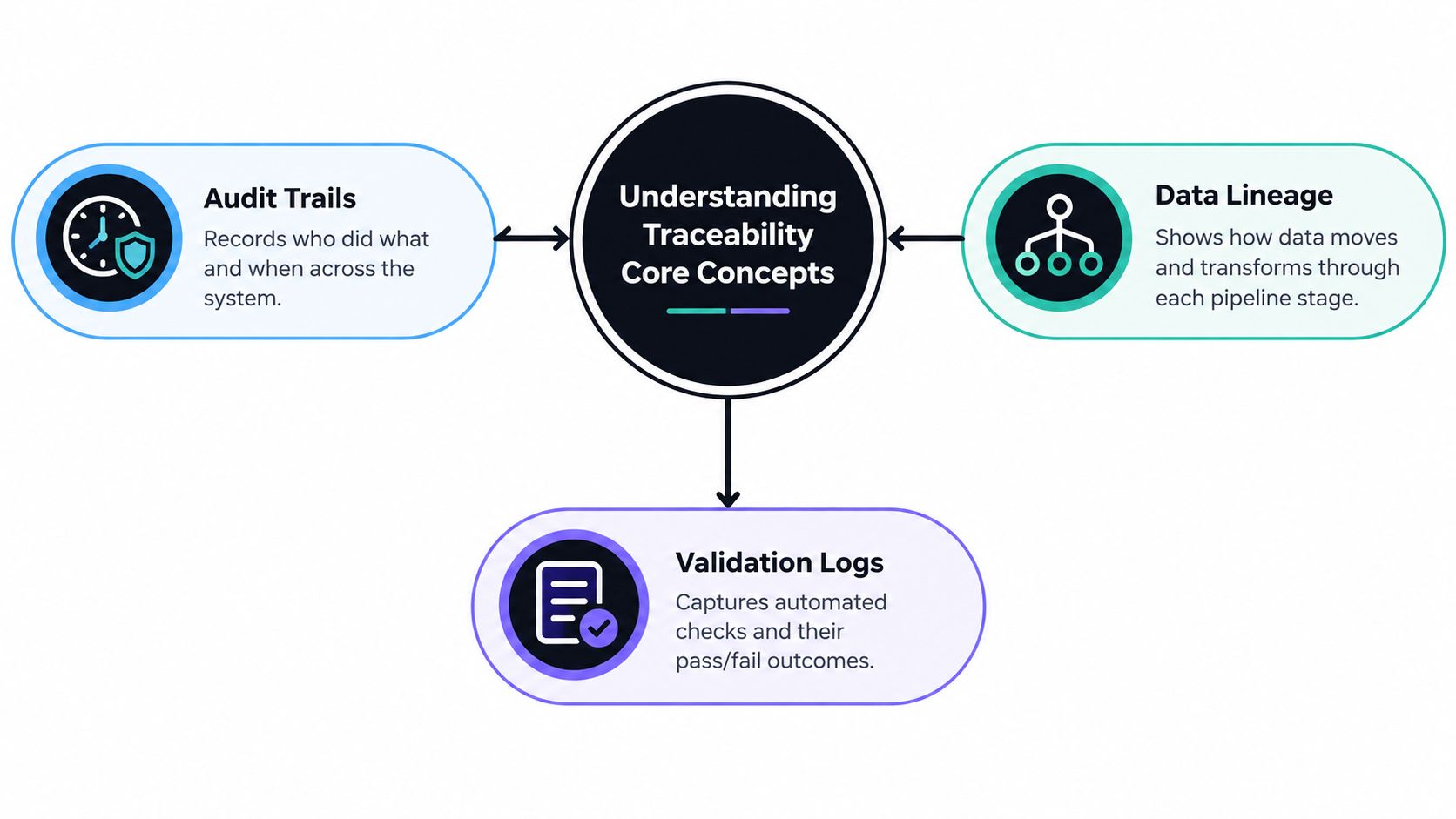
How Audit Trails Data Lineage and Validation Logs Work
A document moves through a pipeline much like a parcel moves through a warehouse. The original scan is received, classified, opened, transformed into structured data, checked, reviewed when necessary, and exported to another system. Each stage should leave evidence.
Audit trails record actions
An audit trail answers who did what and when. It can show when a document entered the system, which service processed it, who reviewed an exception, who approved a correction, and when data was exported.
This layer focuses on system activity. It doesn't necessarily explain where an individual value came from. For example, an audit trail might show that a user approved an invoice record, but it won't prove whether the invoice number came from page one or from a manually typed note.
Data lineage preserves origin
Data lineage answers where did this value come from, and how did it change? A traceable value should connect to the originating document, page, region or coordinates, document version, extraction model, and workflow version.
For an invoice total, that might mean storing the normalized amount in JSON alongside the source file identifier and the page region containing the total. For a lot code, it should also preserve the relationship to the shipment, receiving event, or transformation record.
Matil's document traceability capabilities provide a useful reference point for thinking about source-to-output relationships. In operational workflows, the same principle applies to service records, where repair ticketing software can connect an issue, the work performed, the responsible user, and supporting documents.
Validation logs show control decisions
Validation logs answer what checks ran, and what happened? A rule might compare the invoice quantity with the delivery note, check whether a supplier identifier follows the expected format, or flag a mismatch between a lot code and a receiving record.
A strong log records the rule, the input values, the result, the timestamp, and any human decision. It should distinguish an automated pass from an exception that a reviewer corrected.
ISO 22005 frames traceability as a designed management system. It calls for a system that is verifiable, consistent, results-oriented, cost-effective, practical, compliant with applicable regulations, and capable of meeting defined accuracy requirements. Its scope includes objectives, regulatory requirements, material flows, information needs, procedures, documentation, coordination across organizations, and retention periods. The ISO 22005 traceability standard supports a minimum architecture built around stable identifiers, structured extraction, contradiction checks, source links, and appropriate access and retention controls.
Consent records cover personal data
Consent and lawful-processing records answer why was personal data collected, used, or retained? This matters most for identity documents, payslips, bank statements, and KYC records. A traceable workflow should connect the document to the relevant processing purpose, access controls, retention decision, and review history.
Confidence scores help prioritize review, but they aren't enough by themselves. An auditor must be able to reproduce how a value was obtained and verify it against the original record. Human review should focus on low-confidence fields and cross-document contradictions instead of forcing people to recheck every extracted value.
Regulatory Traceability Requirements You Must Know
Different frameworks use different terminology, but they create a common operational demand: structured information must remain linked to the event, party, product, or document that gives it meaning.
| Regulation or framework | Key identifier | Core documents | Retrieval rule |
|---|---|---|---|
| EU food traceability framework | Supplier, recipient, product, and transaction relationship | Invoices, delivery notes, shipment records, batch data | Records must support supplier and recipient identification across the chain |
| U.S. FDA Food Traceability Rule | Traceability lot code linked to Key Data Elements | Invoices, Bills of Lading, receiving records, transformation documents | Required records must be retrievable for an FDA request |
| FATF customer due diligence | Verified customer identity and source provenance | Passports, identity cards, independent data, transaction records | Evidence must support onboarding and ongoing monitoring |
| WCO Data Model | Standardized customs and shipment data elements | Cargo declarations, consignment notes, invoices, packing lists, permits | Data should be reusable for electronic submission and exchange |
The FDA model is event-based. Covered firms handling foods on the Food Traceability List must record Key Data Elements for Critical Tracking Events such as harvesting, cooling, initial packing, shipping, receiving, and transformation. Each element must link to the relevant traceability lot code, which becomes the join key across product and custody records.
The EU model emphasizes chain relationships. It requires businesses to identify immediate suppliers and recipients, creating a practical need to connect commercial transactions with physical product movements. Teams should therefore capture supplier, customer, product, batch, shipment, and transaction data in structured records instead of relying on unsearchable attachments.
FATF applies a similar logic to KYC, even though the subject is a customer rather than a product. Recommendation 10(a) requires regulated financial institutions to identify customers and verify identities using reliable, independent source documents, data, or information. Ongoing due diligence also requires institutions to scrutinize transactions against their knowledge of the customer, business, and risk profile.
The WCO approach focuses on harmonization. Its Data Model provides reusable definitions and electronic messages for declarations, cargo movements, inspections, permits, and licensing. For teams working with customs documentation, the goal isn't merely to read a PDF. It's to map information into consistent fields that can support declarations and downstream controls. Teams dealing with formal reporting may also find reporting help from Visbanking useful when reviewing how regulatory data is organized.
These frameworks differ in scope, but their document implications align:
- Identify the relevant entity, product, lot, shipment, or customer.
- Preserve the original evidence.
- Link structured values to the event and source.
- Validate relationships across documents.
- Retrieve or export the evidence in a usable format.
For a broader view of control expectations around service providers, see what SOC 2 compliance involves.
Compliance Checklist for Document Processing Pipelines
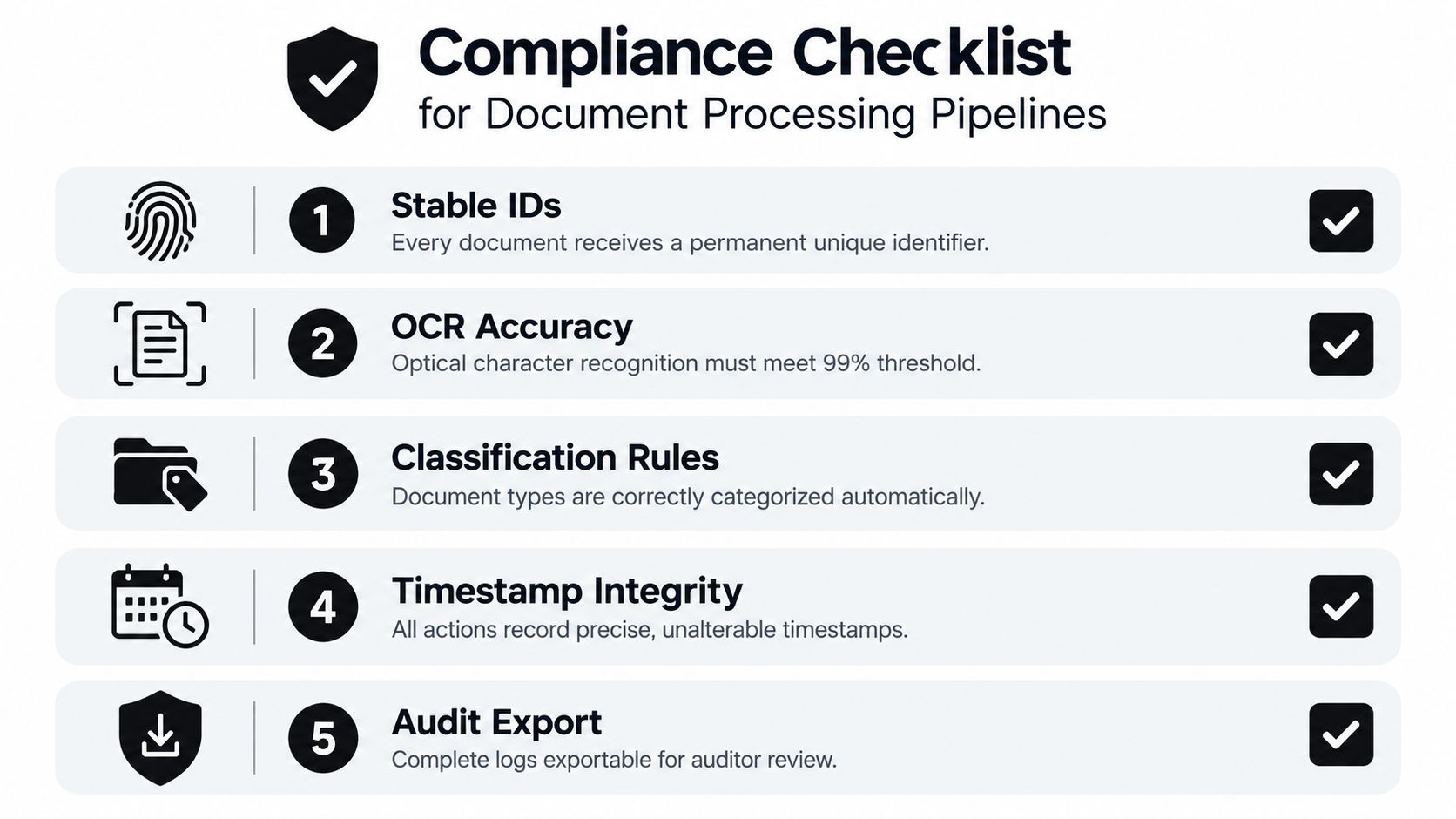
A pipeline is only as strong as its weakest join. Use the following checklist to test whether your extraction process creates regulator-ready evidence rather than isolated fields.
1. Assign stable identifiers
Give every source document a permanent unique identifier. Store document type, version, ingestion time, supplier or customer reference, and related transaction identifiers.
Evidence to retain: the original file, checksum or equivalent integrity record, document version, and links to downstream records.
2. Combine OCR with classification and validation
OCR reads text. It doesn't decide whether a page is an invoice, identify a Bill of Lading, or determine whether a quantity agrees with a receiving record. A complete workflow should classify documents, extract fields, validate relationships, and route exceptions.
The FDA's event-and-identifier model requires product descriptions, quantities, units of measure, dates, locations, trading partners, and traceability lot codes to remain connected to relevant events. A useful guide to data types for regulatory compliance can help teams organize the fields needed for governance workflows.
3. Preserve the lot or transaction join key
For food traceability, retain the traceability lot code as a primary join key across invoices, Bills of Lading, receiving records, and transformation documents. For KYC, the equivalent may be a customer or case identifier. For logistics, it may be a shipment, container, consignment, or declaration reference.
A record without its join key may still be readable, but it isn't reliably traceable.
4. Keep immutable source evidence
The FDA permits original electronic records or true copies, including scans and photographs. Preserve the source image alongside normalized JSON, extracted text, page coordinates, and the processing history.
5. Make review risk-based
Don't send every field to manual review. Route low-confidence values, contradictory dates, unmatched identifiers, and unusual document structures to a reviewer. Record the reason for review, the decision, and any correction.
6. Control access and retention
Limit access according to role and purpose. Retain records for the period required by the applicable business and regulatory context, and document deletion or retention decisions. Personal documents need particular care because the same evidence that supports compliance can create privacy exposure if stored or accessed without proper controls.
The pipeline should also produce a sortable export. A regulator or auditor shouldn't need to inspect hundreds of PDFs to locate a lot, event, customer, or shipment relationship.
A short training video can help nontechnical stakeholders understand how these controls fit into a processing workflow.
How Matil Supports Traceability Without Manual Work
A modern document pipeline has to do more than recognize characters. It must classify mixed files, apply validation rules, retain source context, and produce structured output that downstream systems can use.
Matil combines advanced OCR, classification, validation, and workflow orchestration through an API. It can process PDFs, images, and multi-page document sets, then return structured JSON with source relationships. Pre-trained models support documents such as invoices, delivery notes, payslips, identity documents, bank statements, insurance policies, Bills of Lading, customs declarations, and ocean freight records.
The important distinction is architectural. OCR produces text, while a traceability workflow preserves the relationship between the text, its source, its transformation, and its final use.
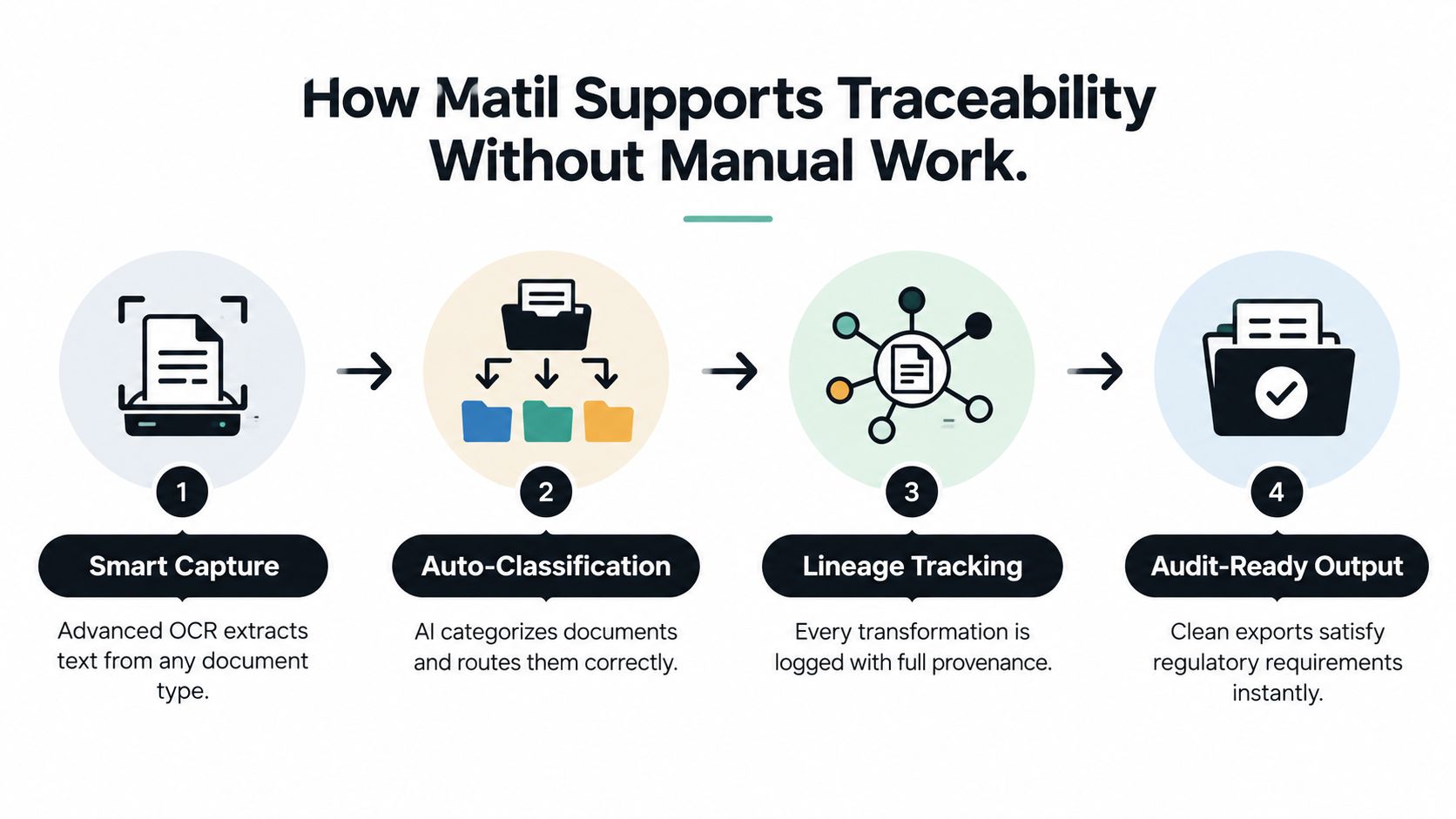
A typical workflow looks like this:
- Smart capture: OCR extracts text from scans, photographs, and PDFs.
- Automatic classification: The system separates document types and routes them to the correct model or workflow.
- Lineage tracking: Extracted values retain links to the original document and location, along with processing and validation context.
- Audit-ready output: The workflow returns normalized data and supporting evidence for review, export, or system integration.
Matil reports accuracy above 99% in multiple use cases, as stated in its publisher information, and supports pre-trained models plus rapid custom model creation. Those figures shouldn't replace your own validation. A compliance team still needs to test representative documents, define exception rules, and verify that the returned evidence satisfies its obligations.
The platform also supports GDPR, ISO 27001, and AICPA SOC controls, a zero data retention policy, and an SLA of over 99.99% availability, according to Matil's publisher information. These controls matter when teams process identity documents, financial records, and logistics evidence through an external service. Security claims should still be assessed against your procurement, legal, data-processing, and architecture requirements.
For technical teams, the practical benefit is a simple integration surface. An API or no-code workflow can accept documents, classify mixed sets, split PDFs, return JSON, and populate downstream templates. A deeper overview of an intelligent document processing platform can help teams compare this architecture with OCR-only tools.
Real Examples and Sample Artifacts for Audits
The clearest test is whether a reviewer can reconstruct an event without asking the original operator to remember what happened.
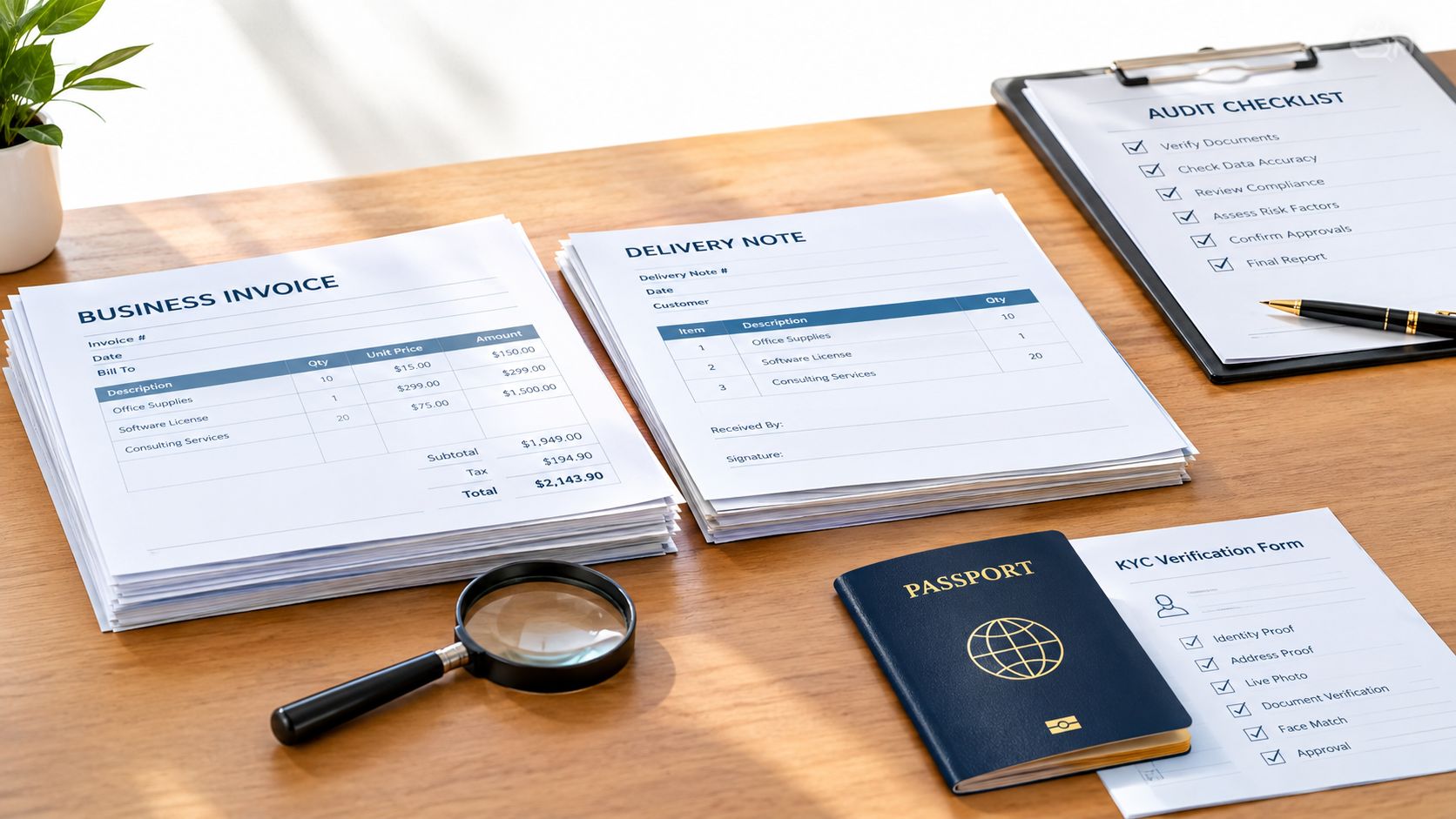
Invoice and delivery note
A finance team receives an invoice for goods that operations received several days earlier. The invoice contains the supplier reference and quantity, while the delivery note contains the shipment and receiving details. Manual entry creates a risk that the invoice line will be posted without a dependable link to the physical receipt.
A traceable workflow classifies both documents, extracts the supplier, product, quantity, unit, dates, and references, then links the records through a purchase order, shipment reference, or transaction identifier. The validation log records whether the quantity and product match, while the output retains the invoice page and delivery-note page supporting each value.
A useful audit package might contain:
document_id: INV-...
document_type: invoice
source_page: 1
supplier_reference: ...
product_reference: ...
quantity: ...
related_delivery_note: DN-...
validation_status: passed or review_required
The important artifact isn't the field list alone. It's the relationship between the fields and their sources.
KYC identity verification
A customer submits a passport or identity card during onboarding. FATF Recommendation 10(a) requires regulated financial institutions to identify customers and verify their identities using reliable, independent source documents, data, or information. The requirement is technology-neutral, so the institution can choose appropriate verification methods, but it remains responsible for showing how the identity decision was reached.
Extraction should capture identity fields while preserving the document image, source location, validation result, and reviewer action. A KYC record should also connect to the customer case and later monitoring activity, because ongoing due diligence under Recommendation 10(d) examines whether transactions remain consistent with the institution's knowledge of the customer and risk profile.
Bill of Lading and customs declaration
A logistics team receives a Bill of Lading, commercial invoice, packing list, and customs declaration. Each document may contain a shipment reference, goods description, quantity, weight, origin, destination, or party name. If those values remain trapped in separate PDFs, the team can't efficiently compare the commercial record with the declaration.
The WCO Data Model provides a reference structure for harmonized data definitions and electronic messages. A practical workflow maps extracted fields into a reusable shipment schema, preserves the source document and page location, and flags discrepancies before submission or investigation.
A regulator-ready export should allow the reviewer to sort by:
- Shipment or consignment reference
- Document type and version
- Product or goods description
- Quantity, unit, and weight
- Origin, destination, and location
- Trading partner
- Validation status
- Source page and region
This is what turns document extraction into operational traceability. The team isn't merely storing records. It's preserving a reproducible explanation of how the records relate.
Turning Traceability Requirements Into Daily Control
Traceability works when teams treat it as a daily data-control discipline rather than an activity reserved for audits. Every invoice, KYC document, delivery note, and customs record should enter the same basic cycle: capture, classify, extract, validate, link, retain, and export.
For logistics teams, WCO guidance supports electronic customs procedures and the use of data from commercial and transport documents such as consignment notes. The WCO also recommends using its Data Model to facilitate the submission and exchange of advance electronic data. This means a searchable PDF archive isn't enough. Shipment information must be structured for reuse while the evidence remains available for discrepancy investigations.
The same principle applies across departments:
- Finance needs invoice values linked to suppliers, orders, receipts, and approvals.
- Operations needs documents linked to movements, locations, quantities, and events.
- Compliance needs source provenance, validation decisions, retention controls, and access history.
- Technical teams need stable schemas, versioned workflows, exportable logs, and clear exception handling.
The decision rule is straightforward: if a value can't be traced to its source and linked to the event where it was used, it isn't operationally complete.
Matil offers API-based document extraction with OCR, classification, validation, workflow orchestration, and structured outputs that retain document context. If you're evaluating automation for invoices, payslips, KYC records, or logistics documents, Matil can be a practical option to assess against your traceability, security, and integration requirements.


