Ground Truthing Data: A Practical Guide for Document AI
Learn what ground truthing data is, why it matters for document extraction and AI accuracy, and how to build reliable labeled datasets at scale.

A finance team starts Monday with a shared inbox full of invoices. People open PDFs, copy totals, VAT IDs, and purchase-order numbers into an ERP, then check the same values again when a payment fails or an auditor asks for evidence. Extracting data from invoices automatically sounds like an OCR problem, but reliable automation depends on something deeper: a defensible reference for what each field means.
That reference is the subject of ground truthing data. It helps teams distinguish a convincing demo from a document pipeline that can be measured, reviewed, and improved without recreating the manual back office at a larger scale.
The Manual Back Office Problem AI Is Supposed to Solve
Manual invoice processing creates friction long before anyone notices a dramatic failure. An accounts-payable clerk may enter a supplier name correctly but transpose a total, miss a VAT identifier, or attach the wrong purchase order. A duplicate vendor record can then look like a routine data issue until finance has to explain an incorrect payment or reconstruct an audit trail from email attachments and screenshots.
The operational evidence is concrete. Industry reporting cited by Resolve Pay's analysis of manual versus automated invoice flows says roughly 39% of manually processed invoices contain at least one error. The same source places manual data-entry error rates between 1.6% and 15%, depending on invoice complexity, training, and verification procedures. Those figures aren't a prediction for every company, but they show why a small per-document defect becomes a control problem when a team processes large volumes.
Traditional OCR doesn't solve the entire workflow. It reads characters, but it may not know whether a number is an invoice total, a tax amount, a bank account, or a purchase-order reference. Document layouts change, tables break, scanned pages lose structure, and a plausible transcription can pass through downstream systems without anyone checking the source.
The hidden integrity cost
A document pipeline needs more than text recognition. It needs to preserve the relationship between a value, its location on the page, its document type, and the business rule that determines whether the value is acceptable.
That's where ground truthing enters. A reviewer verifies selected documents against reality, records the expected fields, and creates a benchmark for extraction quality. The benchmark can reveal whether a model fails on supplier names, totals, line items, or tax identifiers instead of hiding every defect inside one overall score.
Practical rule: Treat ground truth as a control asset. It should help a controller explain what was tested, which errors remain, and why a release is safe enough for its intended workflow.
Ground truthing also prevents a new bottleneck. Ground-truthed data is widely treated as the gold standard, but direct verification is expensive and difficult across large geographic or operational scales, as documented in the peer-reviewed urban food-environment study. For document AI, the implication is similar. Teams need sampled audits, exception handling, and repeated checks rather than full manual review of every production document.
What Ground Truthing Data Actually Means
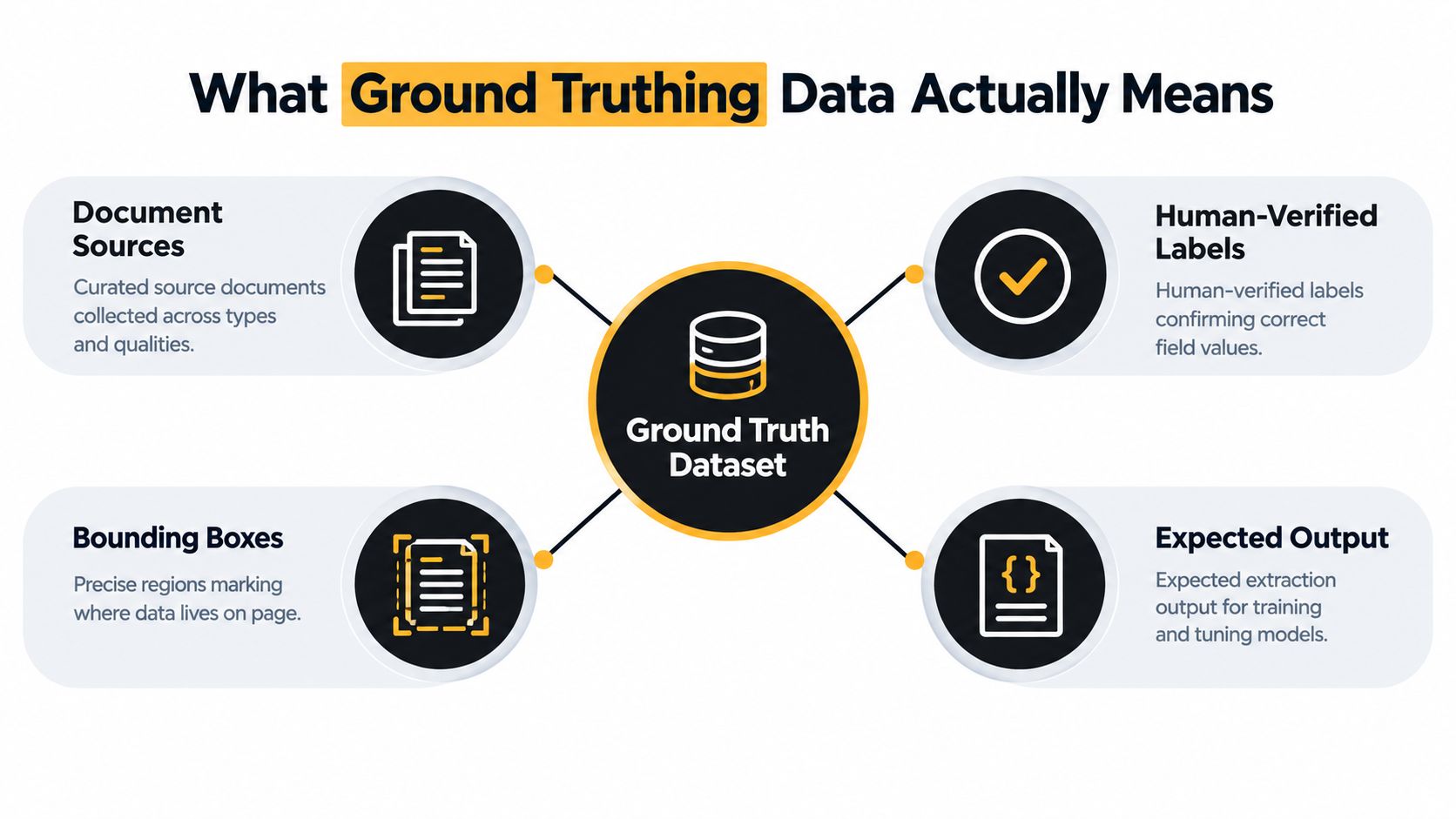
Ground truthing data is the process of creating a human-verified reference set that pairs source documents with correct field values, page regions, and expected extraction outputs. In document AI, a ground-truth record might say that a supplier's legal name appears in a particular region, that the invoice total has a normalized numeric value, and that a purchase-order number is absent rather than just unreadable.
The term can mislead people because it sounds like an objective fact waiting to be collected. In practice, the benchmark is constructed through annotation choices, disagreement rules, normalization decisions, and evaluation protocols. Recent work argues that ground truths should be documented as constructed artifacts with known limitations, while research on subjective labeling warns that reviewers can accept plausible machine suggestions instead of independently challenging them, as discussed in the 2026 paper on constructed ground truths and subjective labeling.
Three jobs for one reference set
A ground-truth dataset can support different parts of the machine-learning lifecycle:
- Training signal: Verified examples teach a model how fields appear across layouts and document types.
- Held-out evaluation: A protected sample tests a model on documents it hasn't learned from.
- Calibration benchmark: A stable reference helps teams compare model versions, schema changes, and production corrections.
These roles shouldn't be casually mixed. If a benchmark document enters training, later evaluation may look better without reflecting real generalization. NIST describes building ground-truth databases through methods such as high-accuracy sensor capture and interactive hand-labeling, then comparing system results against expected outputs derived from that reference in its ground-truth database methodology.
Why plausible labels can still be wrong
Silver labels generated from heuristics, legacy ERP exports, or model guesses can look useful because they contain familiar values. They may still encode old business rules, prior extraction mistakes, or assumptions about which field matters. A human reviewer must verify the source document and record the decision rule, especially for ambiguous cases such as credit notes, multi-page invoices, handwritten amounts, and invoices containing several totals.
The quality of the reference determines the meaning of every later metric. A larger benchmark helps only when it is correct and representative, as the literature on ground truth and evaluation in classification makes clear. The discipline therefore has four parts: sample the right documents, define annotation rules, measure agreement, and maintain quality over time.
How to Build and Validate a Ground Truth Dataset
A defensible dataset starts with coverage, not volume. The following four-stage checklist works for invoices, payslips, KYC documents, contracts, purchase orders, Bills of Lading, DUA forms, tickets, and receipts.
1. Sample the documents that can break the workflow
Build a coverage matrix across:
- Document classes: Invoices, statements, identity documents, logistics forms, and contracts.
- Sources: Vendors, subsidiaries, channels, and business units.
- Input conditions: Digital PDFs, low-quality scans, phone photos, handwriting, and multi-page files.
- Language and layout: Different languages, currencies, table structures, and field positions.
- Edge cases: Missing values, duplicated totals, amended documents, stamps, checkboxes, and unusual page order.
Avoid a convenient folder containing only clean documents. A representative sample should reflect the cases that reach production, including the documents most likely to trigger a payment, compliance, or logistics exception.
2. Write annotation standards before labeling
Create a living guideline for every field. It should define the field's meaning, accepted source region, normalization rule, missing-value behavior, and examples of both valid and invalid annotations.
For example, an invoice-total rule should state whether the expected value is the payable total, the amount before tax, or the amount after credit adjustments. A VAT-ID rule should explain how spaces, punctuation, country prefixes, and unreadable characters are handled. Store revisions in version control. Chat messages aren't a durable annotation contract.
For a useful companion on dataset curation methods, consult how truelabel curates training data. For document workflows, teams should also define the schema and validation behavior together, using schema validation for structured extraction as a practical reference point.
3. Measure independent agreement
Have two reviewers label an overlap sample independently. The overlap should focus on disagreement risk, not merely easy documents. Use an agreement metric such as Cohen's kappa or Krippendorff's alpha, then send conflicts to adjudication.
A low score usually signals a schema defect, unclear examples, or an unresolved business rule. It shouldn't automatically become a performance judgment about the annotators. The adjudicator's decision should update the guideline, and affected labels should be reviewed for consistency.
4. Run QA as a continuing process
Keep a golden set outside the training pool. Add adjudication queues for difficult cases, audit production samples periodically, and send recurring extraction errors back into the annotation guideline. Version the dataset whenever labels, schemas, or normalization rules change.
Use cost controls deliberately:
- Hard strata: Apply dual labeling and expert adjudication to ambiguous or high-risk documents.
- Routine strata: Use single labeling with a targeted spot audit where the rules are stable.
- Production exceptions: Review low-confidence or rule-breaking outputs instead of rereading every successful extraction.
The result is a smaller, stronger control system that can explain its own decisions.
A useful dataset record should preserve the source document, annotation version, reviewer decisions, disagreement history, adjudication outcome, and final expected output. That provenance lets engineering compare model releases while finance can trace a field-level decision back to evidence.
Accuracy Numbers That Actually Matter in Document AI
A single OCR percentage can hide the failure that matters most to a business process. Character accuracy measures recognized characters, field-level accuracy measures whether a specific entity is correct, and straight-through processing measures whether the document completes without human intervention. They answer different questions.
A technical explanation of OCR accuracy rate and error-rate mechanics shows why the distinction matters. 99% character accuracy corresponds to about 1% error, or roughly 50 errors in a 1,000-word document. At 99.5% accuracy, the same document can still contain about 25 errors. A small character defect in a narrative field may be harmless, while one wrong bank account or invoice total can stop payment or create financial exposure.
Evaluate the fields your workflow trusts
Document quality changes the error pattern. A benchmark from OCR accuracy by document type reports 99%+ field accuracy for digital PDFs, while handwritten forms and thermal receipts may fall to 60% to 80%. Mixed pipelines containing invoices, purchase orders, and utility bills are reported at 91% to 96% field-level accuracy before human review.
Use those figures as context, not as a substitute for your own benchmark. A practical test should separate document conditions and record the outcome per field.
| Field | Clean Digital | Low-DPI Scan | Phone Photo | Multi-Language |
|---|---|---|---|---|
| Supplier name | Compare exact and normalized values | Check dropped characters and punctuation | Check blur and perspective distortion | Check scripts, accents, and tokenization |
| Invoice total | Validate against visible total and arithmetic rules | Check broken decimal separators | Check glare and shadows | Check locale-specific number formats |
| VAT ID | Check character sequence and country format | Flag ambiguous characters | Route low-confidence values | Test country-specific prefixes |
| Line items | Compare row boundaries and quantities | Inspect table fragmentation | Check skew and occlusion | Check translated or mixed-language headers |
For each document class, report field-level precision, recall, exact-match accuracy, and semantic equivalence where formatting can vary. A confusion matrix can show whether the classifier confuses invoices with credit notes. Per-entity metrics can reveal that totals are stable while PO numbers regress after a schema change.
Teams evaluating broader AI systems can use production QA for LLMs for ideas on test-set design, regression checks, and evaluation traceability. For extraction-specific decisions, calculating error rate helps translate correct and incorrect fields into a measure stakeholders can interpret.
Accuracy is therefore a distribution across fields, document types, and input conditions. Procurement should ask for the distribution relevant to its workflow, not a headline score detached from the documents that drive payment, compliance, or shipment release.
Why More Labels Are Not Always the Answer
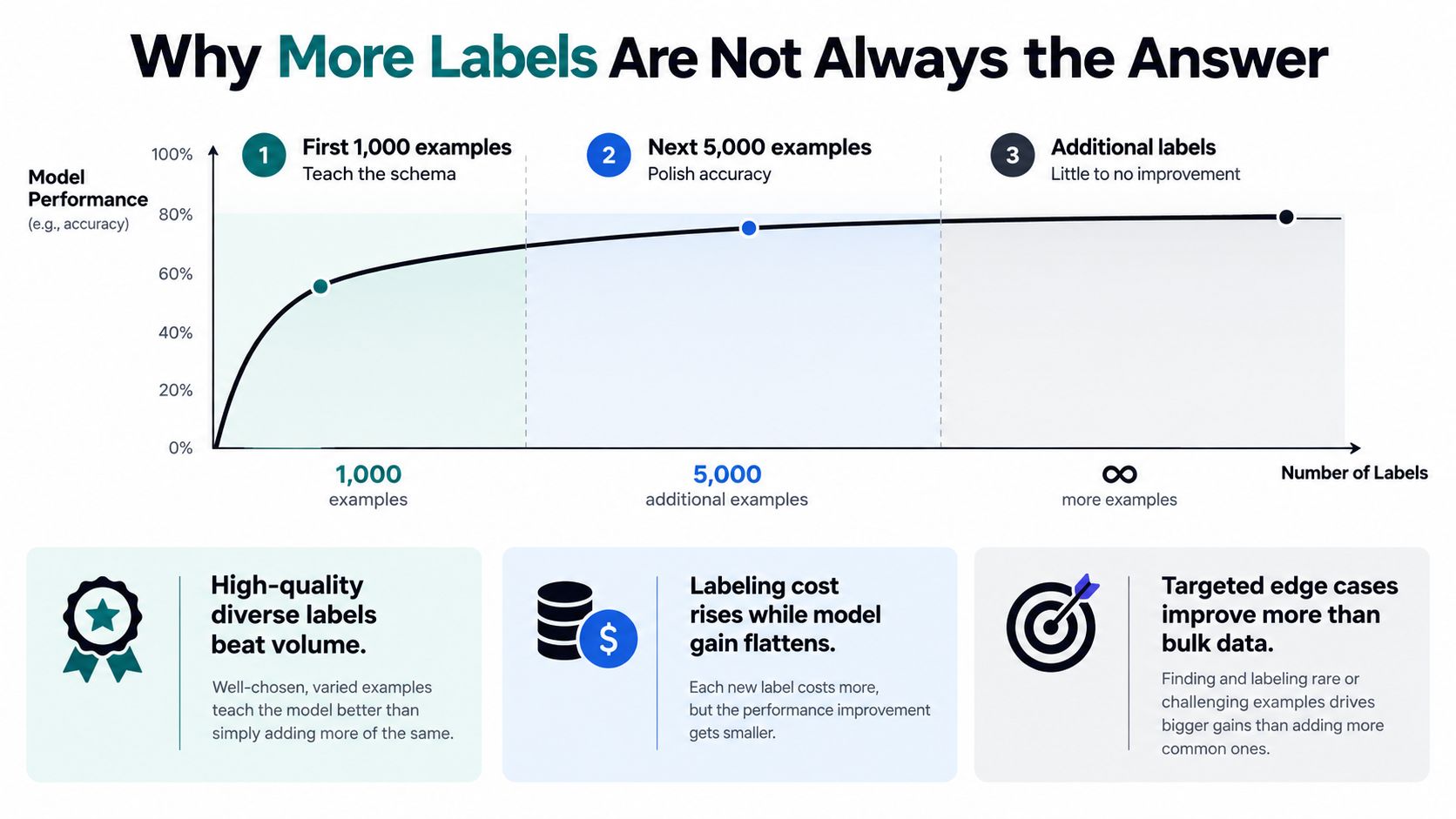
More labels can add coverage, but they can't repair a definition that reviewers interpret differently. Ground truthing data is a quality-design problem before it becomes a volume problem.
The evidence supports that view. In an AI-assisted labeling study, human labelers using predictive assistance were 6% more accurate than unassisted labelers, showing that workflow design can improve quality without relying only on additional model capacity, as reported in the study on AI-assisted labeling. The same research reported careful-labeling accuracies of 97.58%, 76.83%, and 60.08% across three datasets, compared with quick-labeling results of 97.58%, 72.08%, and 58.08%. The process changed the benchmark, even when the task and data remained the same.
Spend the next labeling hour where uncertainty is highest
Active sampling directs reviewers toward documents that are ambiguous, novel, or likely to expose a model weakness. A 2025 simulation study found that required annotations could be reduced by over 60% with only a small compromise in label quality, saving about 6.6 days of labor, according to research on annotation reduction through simulation.
That doesn't justify removing humans from the process. It supports selective verification. Independent market reporting also shows wide cost dispersion, from roughly $0.02 for a simple image label to $1.00 to $5.00 or more for medical items, while segmentation and video tasks are more expensive, as summarized in the same research source.
Use this decision checklist:
- Label more: Production contains a document type or edge case missing from the benchmark.
- Relabel better: Reviewers disagree, field rules changed, or a machine suggestion may have anchored decisions.
- Stop adding volume: New examples repeat known patterns and metrics no longer improve on representative evaluation slices.
- Verify selectively: Confidence is low, rules fail, or the document affects a high-risk downstream action.
The strongest benchmark is often fewer but better verified, with active review directed at uncertainty and drift.
Connecting Ground Truth to an Enterprise Document Pipeline
Ground truth becomes operational when it sits inside the document pipeline rather than in a forgotten spreadsheet. The flow starts when a PDF, image, or multi-page document enters an ingestion layer. OCR and layout analysis produce candidate text, regions, and page structure. Reviewers then compare those candidates with the source document and correct the fields that define the business outcome.
Ingestion and extraction need a shared contract
An invoice schema might include supplier identity, invoice number, dates, tax values, total, currency, purchase order, and line items. A KYC schema may require document type, name, identifier, expiration date, and issuing country. A logistics schema can focus on shipment references, consignor, consignee, package counts, weights, and customs information.
The schema is more than a list of JSON keys. It specifies what counts as the correct value, where evidence should appear, how values are normalized, and when a missing or contradictory field must stop automation. A document-processing platform should support common pre-trained fields as well as custom schemas for proprietary layouts, without forcing the business to rebuild the entire labeling system for every new document.
Classification and validation turn labels into controls
Classification decides which extraction logic applies. A mixed upload may contain an invoice, delivery note, bank statement, and identity document in the same file, so the system needs to identify document types and, where necessary, split pages before extraction.
The validation layer then compares predicted values with business rules and reference evidence. Rules can flag a total that doesn't reconcile, a VAT ID that fails its expected structure, a date outside the transaction window, or a missing field that requires human review. Confidence thresholds help triage the queue, but confidence alone isn't enough. A highly confident wrong value still needs a rule or comparison that can catch it.
Matil's role in this architecture
Tools such as Matil.ai combine OCR, classification, validation, and workflow automation through an API. Matil supports pre-trained extraction models, custom data structures, field-level validation, document classification, PDF splitting, and workflow orchestration, so teams can move from document intake to structured outputs and exception handling in one process. Its product materials describe precision above 99% in multiple use cases, and enterprise controls include GDPR, ISO 27001, AICPA SOC, and zero data retention, as stated in the publisher information.
Those capabilities still need a benchmark owned by the customer. A platform can propose fields, normalize values, and route uncertain documents, but the finance or compliance team must define what “correct” means for its records. Production checkpoints should include:
- Coverage: Confirm each document class has representative labeled examples.
- Agreement: Track reviewer consistency on protected golden sets.
- Field metrics: Report precision, recall, exact matches, and semantic matches by field.
- Drift: Sample recent production documents and compare them with the benchmark.
- Traceability: Retain source evidence, corrections, schema versions, and adjudication history.
A practical document process workflow should therefore include feedback from validation back into the reference dataset. When a human corrects an extraction, the correction isn't merely a one-off fix. It can become a reviewed example for a future model evaluation, provided the team approves its inclusion and records its provenance.
Putting It All Together and What to Look For Next
A reliable ground-truth program follows four decisions. Sampling covers the documents the business will receive. Annotation defines each field and edge case in writing. Agreement tests whether independent reviewers apply those rules consistently. QA protects the benchmark, monitors production behavior, and updates the reference when workflows change.
That sequence gives procurement and technical teams a practical evaluation checklist:
- Schema coverage: Can the system represent the fields, nested structures, tables, and document relationships your process needs?
- Annotation governance: Are guidelines versioned, reviewable, and connected to actual corrections?
- Evaluation isolation: Can you keep a golden set outside training and test model changes against it?
- Field-level reporting: Can the platform show which fields fail, on which document classes, under which quality conditions?
- Human review controls: Can low-confidence or rule-breaking outputs enter a queue without sending every document to manual processing?
- Export and portability: Can your team export ground-truth records, corrections, and evaluation results rather than becoming dependent on an opaque system?
Ground truth is a living enterprise asset
A benchmark should change when suppliers alter layouts, when a new country adds a document convention, when compliance rules change, or when production reveals an edge case. Each update should carry a version, rationale, reviewer decision, and effect on evaluation results. That audit trail matters as much as the extraction output in finance, legal, and compliance environments.
Security criteria belong in the same review. Ask whether the provider supports GDPR, ISO 27001, relevant SOC controls, zero data retention for training, access governance, and clear audit records. A team also needs to know whether it can retrieve corrected results, inspect evidence regions, and export its verified dataset if the vendor relationship changes.
The business case for document automation isn't “OCR versus humans.” It's a controlled combination of machine extraction, classification, validation, and selective human judgment. That approach can support invoices, payslips, KYC files, logistics documents, receipts, contracts, and statements while keeping the quality conversation specific enough for both engineers and controllers.
If you're evaluating a document AI platform, start with representative documents and a written schema. Require field-level metrics, protected test data, traceable corrections, and a clear review path before you discuss scale. Then compare solutions on how well they help your team maintain ground truthing data as a living quality system, not as a one-time labeling exercise.
Matil combines OCR, document classification, field validation, and workflow orchestration through an API for structured document extraction. Visit Matil to evaluate how its pre-trained and custom schemas, human-review workflows, GDPR and ISO 27001 controls, and zero data retention policy could fit a ground-truth-driven pipeline.


