Bill of Lading Number: What It Is and Where to Find It
Bill of Lading Number explained: what it is, where to find it on each B/L type, format rules and how to verify it before posting shipments.

The bill of lading number is the unique identifier a carrier or freight forwarder assigns to a bill of lading and its cargo; under US rules it starts with the issuer's four-letter SCAC, as required by 19 CFR 4.7a. That value tags the transport document. The physical container carries a separate identifier.
A shipping PDF, a supplier invoice, and a tracking page that rejects the number you just copied. Before trying another reference, work out who issued the document and which identifier your process needs. Quoting the wrong field to the wrong party is how mismatches get locked into a shipment file, so treat the number as a value to validate, not a label to copy.
What a Bill of Lading Number Is and Why It Matters
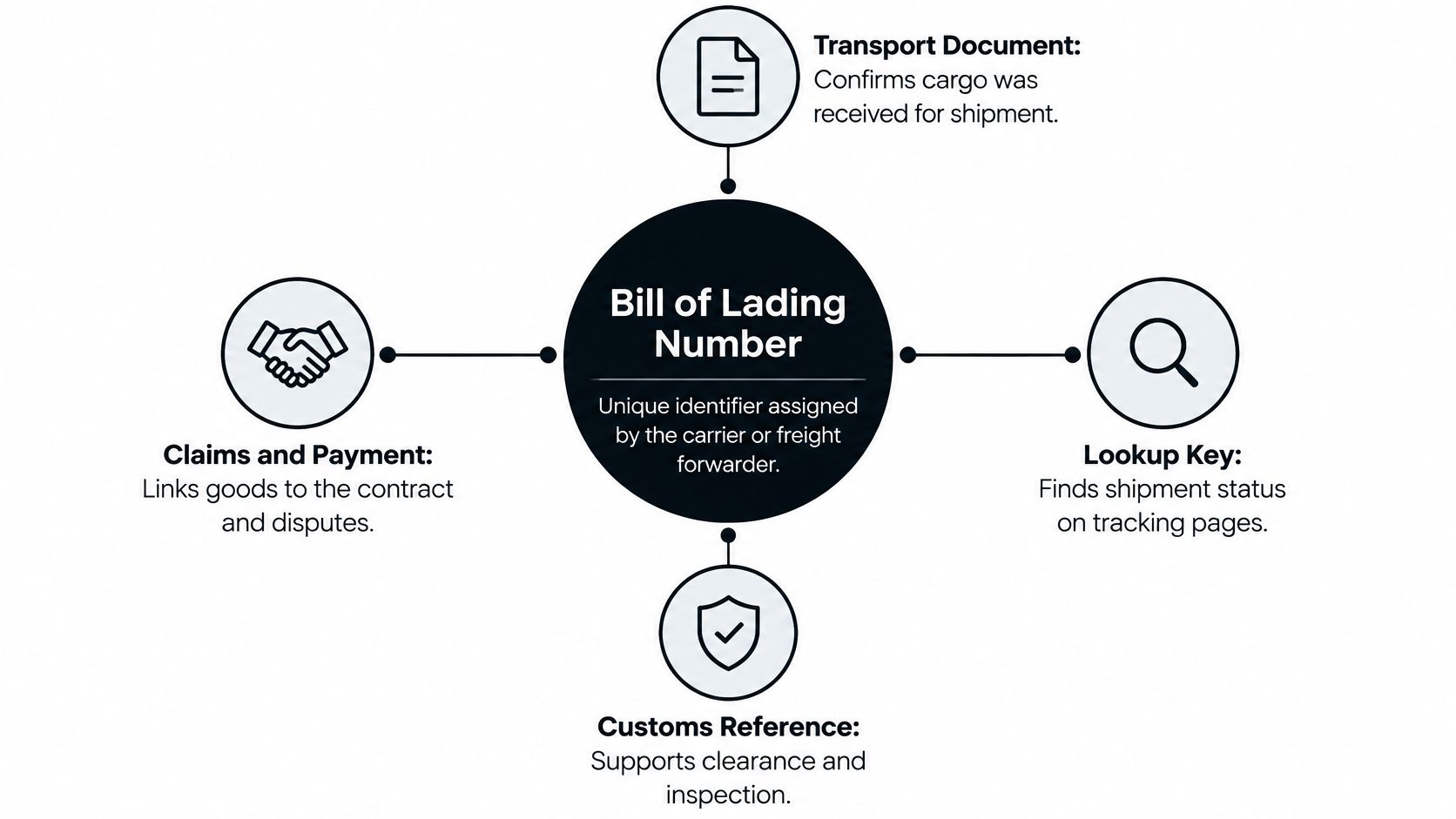
A bill of lading number identifies a particular transport document and the cargo transaction it records. The bill itself confirms receipt of cargo for shipment and records the carriage details.
Think of the number like a registration plate. It helps distinguish the paperwork you're handling from other shipment records, but it doesn't tell you everything about the cargo or its current status.
The BIMCO electronic bill of lading data standard defines “Bill of Lading No.” as an alphanumeric, “cargo-specific identifier”; the DCSA bill-of-lading standard describes the number as the main number used for tracking shipment status.
What the number lets you do
- Find the document: Locate the labelled reference on a paper bill, scan, or platform record.
- Ask about cargo: Quote the appropriate reference to the carrier or forwarder.
- Match records: Connect the transport document with invoices, customs records, and shipment entries.
- Organize scans: Index documents and link pages belonging to the same bill.
These uses depend on capturing the complete value. Dropping a prefix or changing a character can disconnect otherwise correct shipment information.
A container number identifies equipment. The B/L number identifies the document and its associated cargo transaction, which may cover several containers.
Practical rule: Treat the number as a control field, not a label to copy. Confirm the issuer before using it as your shipment key.
Where to Find the Number on Each Bill of Lading Type
Where the bill of lading number appears by document type
| Document type | Issued by | Where the number sits | What to check |
|---|---|---|---|
| Ocean master B/L | Carrier (ocean line) | Box labelled B/L No., usually top right on the face page | Starts with the carrier's SCAC, for example MAEU |
| House B/L | Freight forwarder | Header area, labelled House B/L No. or HBL No. | Starts with the forwarder's SCAC under US rules; differs from the master number |
| Seaway bill | Carrier | Labelled Seaway Bill No.; non-negotiable document | Same SCAC-plus-suffix pattern for the applicable US filing; confirm the label before use |
| Electronic B/L | Carrier through an eBL platform | Platform record and matching field on the printed or PDF copy | Copy matches the platform record; check current holder and status |
On an ocean master B/L, start with the face page rather than the terms-and-conditions pages. Look for B/L No., Bill of Lading No., or a similarly explicit label near the carrier's name.
Don't assume the largest reference in the header is correct. Booking references, customer references, and export references can occupy equally prominent boxes.
Locate it without guessing
- Find the labelled field. Read the complete value, including any prefix and leading zeros.
- Establish whether you're holding a master B/L, house B/L, or seaway bill. The document title is more useful than the file name.
- Identify the issuer. A forwarder's logo and signature block can explain why its number doesn't match the ocean carrier's reference.
- Compare the booking reference with your order to confirm you're examining the right shipment. The booking number and B/L number don't need to be identical.
A house bill normally carries the forwarder's own reference in its header. If the master reference also appears, capture both in separate fields rather than choosing whichever is easier to read.
Finding an electronic record
According to the ICC and FIT Alliance survey, 49.2% of respondents in 2024 used electronic bills of lading exclusively or alongside paper, up from 33.0% in 2022.
Open the actual platform record when you have access. Compare its identifier with the PDF or printed copy, then check whether the copy is a current representation of that record.
A downloaded PDF can be convenient for accounting without being sufficient evidence of current control. Keep the document identifier and platform reference together.
Number Formats, Prefixes and Length Rules
The US Customs regulation governing cargo declarations requires a unique bill of lading identifier of no more than 16 characters, beginning with the issuer's four-character SCAC followed by up to 12 letters, digits, or both, and prohibits reuse for three years after issuance.
That's a US regulatory format, not a universal rule for every reference printed on every shipping document. Select the relevant standard before deciding that an extracted value is invalid.
Common carrier SCAC prefixes
| Carrier | SCAC prefix |
|---|---|
| Maersk | MAEU |
| MSC | MSCU |
| Hapag-Lloyd | HLCU |
| CMA CGM | CMDU |
| COSCO | COSU |
| ONE | ONEY |
| Evergreen | EGLV |
| ZIM | ZIMU |
Use these as lookup examples, then verify the code against the carrier's published information and the actual issuing entity. A familiar shipping-line name doesn't justify adding a prefix that wasn't present in the document or required by the receiving system.
Preserve the value before normalizing it
Store identifiers as text. Spreadsheet and database numeric fields can remove leading zeros, while OCR cleanup can confuse a letter with a digit.
- Keep the raw capture: Preserve the original text and its page location.
- Create a validated value: Remove layout artifacts only under explicit rules.
- Retain meaningful characters: Don't strip letters just because another system usually receives numeric references.
The separate GS1 US shipper-created format uses a fixed 17-digit identifier with a check digit and barcode Application Identifier 402. That standard needs a different validator from the carrier-issued US customs format.
A format check proves that a value is plausible. It doesn't prove that it belongs to the shipment you're processing.
Avoid a global regular expression that rejects every unfamiliar document. Classify the number first, then apply the format associated with its issuer and purpose.
How It Differs From Container, Booking and PRO Numbers
Shipping identifiers compared by issuer and purpose
| Identifier | Issued by | What it identifies | Typical pattern |
|---|---|---|---|
| Bill of lading number | Carrier or freight forwarder | Transport document and cargo transaction | SCAC plus up to 12 characters for the applicable US format |
| Container number | Equipment owner or carrier | One physical container | Equipment prefix, serial number, and check digit |
| Booking number | Carrier at booking | Reserved space on a vessel | Carrier-assigned booking reference |
| PRO number | Carrier, often trucking | Carrier shipment reference for pickup and tracking | Carrier-assigned shipment reference |
| SCAC | Carrier code registry | Carrier company itself | Four letters, for example MAEU |
| Courier tracking number | Courier | One parcel inside the courier network | Internally generated parcel reference |
These fields often sit close together on the same page. They aren't interchangeable, even when they all relate to the same freight.
The Philippine Bureau of Customs guidance warns that internally generated courier tracking numbers may differ from the B/L number registered in its system, and that multiple parcels can be consolidated under one B/L number.
The same relationship problem appears with master and house bills. A master bill may connect to several house bills, while finance needs a particular house reference to reconcile a supplier document.
Choose the identifier by process
- Name the task: Customs filing, carrier tracking, invoice matching, or delivery confirmation.
- Identify the party whose system will receive the reference.
- Use the identifier registered in that system, not the most prominent number on the page.
- Keep equipment links: Retain container references as secondary reconciliation fields.
For vehicle shipments, Sunmax Motors' guide to international car export transit times provides useful planning context. Keep transit planning separate from identifier selection: an estimated journey doesn't establish which reference a carrier portal accepts.
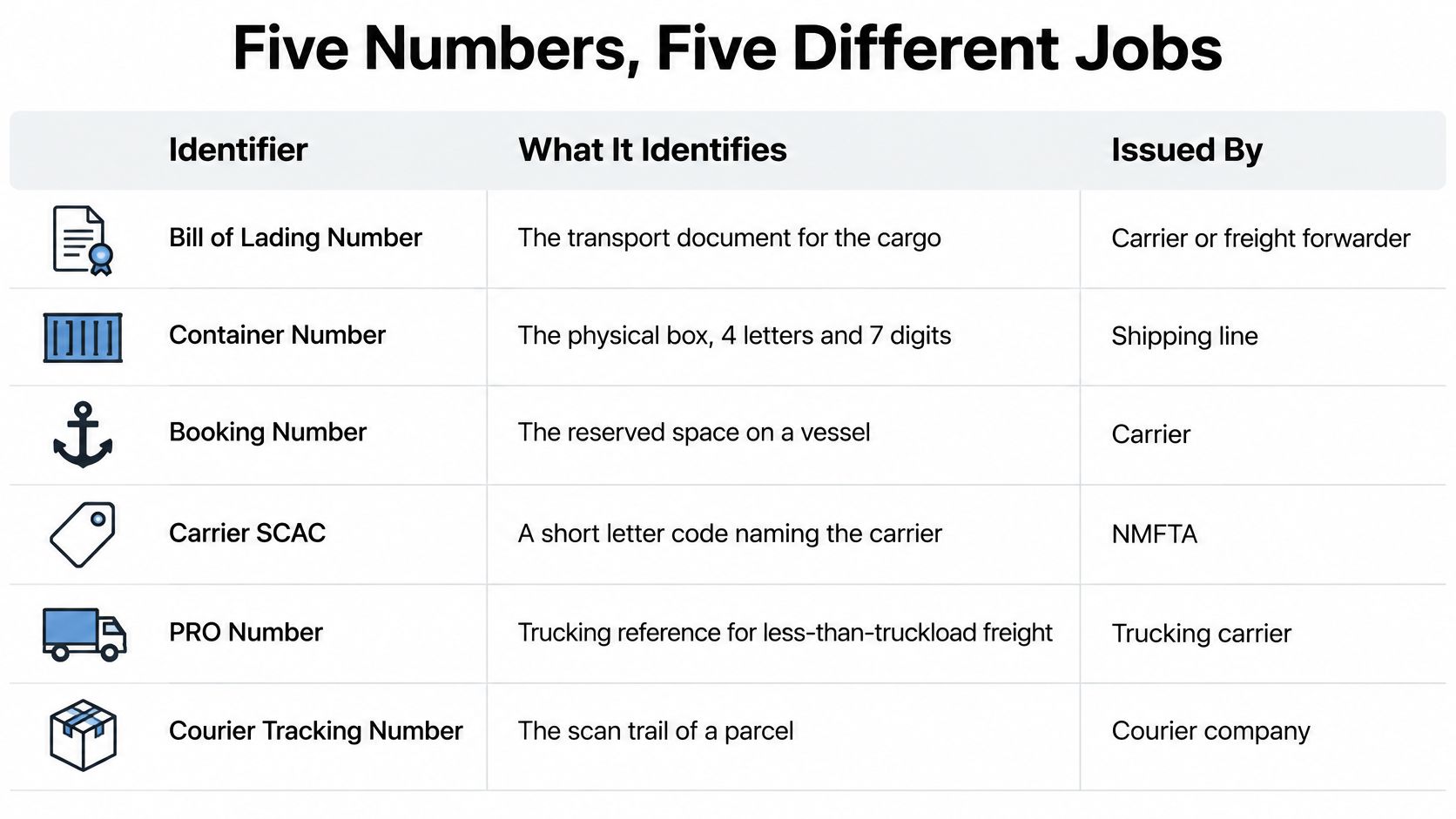
Build relationships between records rather than flattening all references into one field. A schema with separate master B/L, house B/L, booking, PRO, and courier fields prevents the next team from having to interpret the paperwork again.
How Carriers, Forwarders and Customs Use the Number
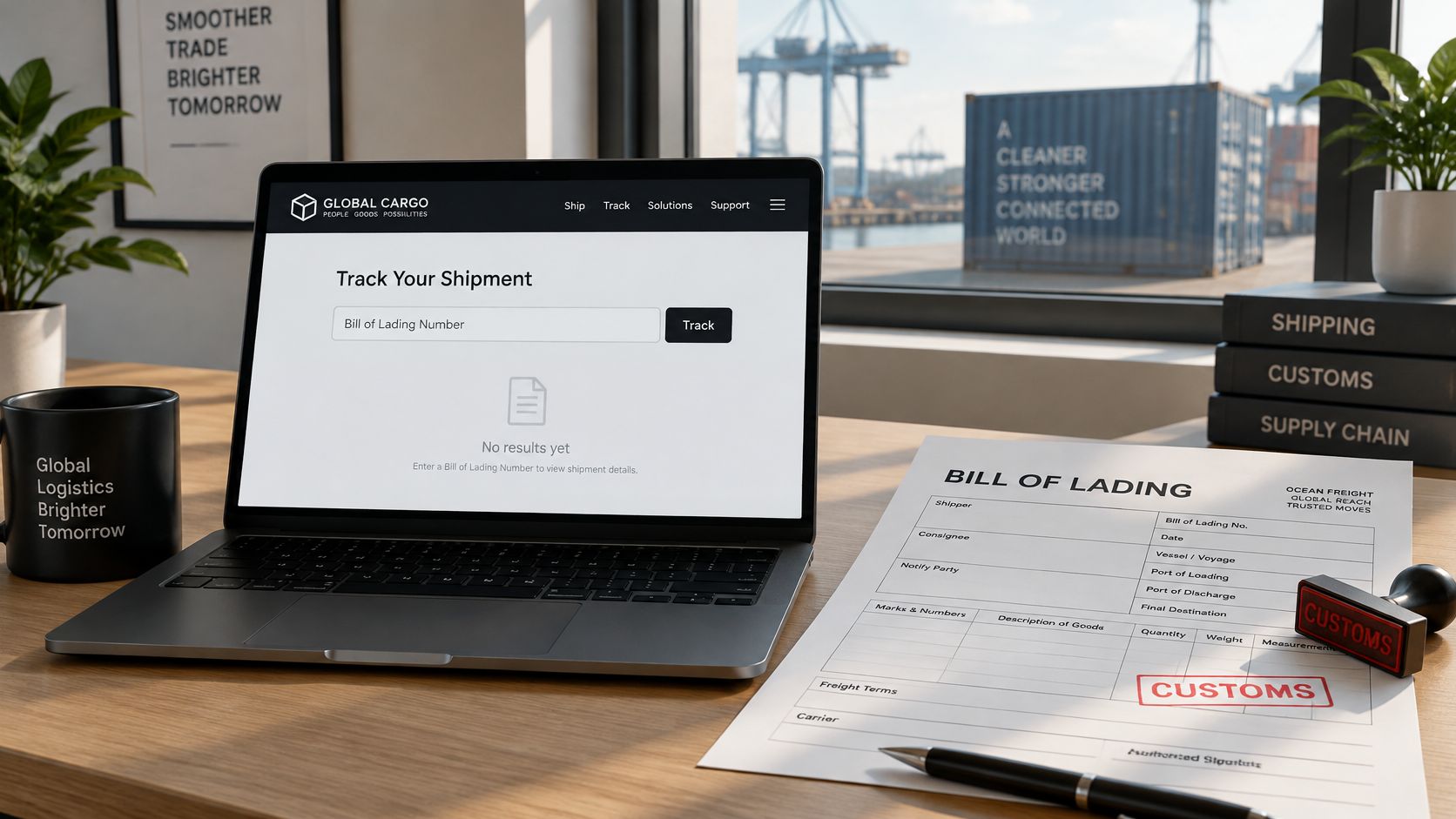
Say an importer receives a forwarder's house bill and wants an arrival update. The forwarder can search its own reference, but the ocean carrier's tracking page may require the master reference.
The practical setup pairs the paperwork with the system that recognizes it.
From tracking to claims
The operations team uses the appropriate number to request shipment status. If cargo arrives damaged, the claims team cites the transport reference alongside container details, relevant dates, photographs, and delivery evidence.
The number links the claim to the transport document. It doesn't replace evidence of damage or establish liability by itself.
For handoffs between service providers, DreamBid's explanation of customs broker and freight forwarder roles helps clarify who handles transport coordination and who handles customs representation.
- Carrier or forwarder: Confirms the transport record and relevant reference.
- Claims handler: Connects the complaint with the document and supporting evidence.
- Customs team: Checks the filing against the manifested shipment.
Customs needs the manifested reference
The CBP Form 7501 instructions require the entry's bill of lading number to be the number assigned on the manifest by the international carrier delivering the goods to the United States, and illustrate the vessel or rail pattern with ABCD1234567.
A correct-looking number from the wrong document can still fail that match. Understanding what a customs declaration contains helps connect the transport reference with the broader filing rather than treating it as an isolated field.
This video provides additional context for the document's role in shipping.
The legal history presented in UNCITRAL's transport-document dematerialization materials includes the UK Bill of Lading Act of 1855, the Brussels convention of 1924, and the Rotterdam Rules adopted in 2008, alongside the Model Law on Electronic Transferable Records' treatment of qualifying electronic records.
Electronic control and transfer mechanisms change how parties handle the document. They don't remove the need to identify it precisely.
Verifying the Number and Fixing Common Mismatches
Use a consistent verification routine before accepting the extracted field:
- Check the issuer: Compare the prefix with the issuing entity's carrier-code information.
- Test the total length and character pattern against the applicable standard.
- Cross-check the shipment: Compare booking, container, shipper, and consignee details.
- Confirm the reference in the relevant tracking system. If a house reference fails in a carrier lookup, obtain the master reference from the forwarder.
- Verify electronic control: Check platform status and current holder rather than relying only on a printout.
Bill of lading number symptoms, causes and fixes
| Symptom | Likely cause | Fix |
|---|---|---|
| Number longer than 16 characters | OCR merged it with a neighbouring booking or invoice number | Recapture the labelled field and split at line breaks; first confirm it isn't a GS1 shipper-created number |
| Prefix is not a known SCAC | Misread letter, courier reference, or internal number | Check issuer information and reread a higher-resolution scan |
| Leading zeros missing | Value stored as a number rather than text | Restore from the document and store as text |
| Two candidate numbers on one page | Master and house references, or courier tracking number | Classify by label and issuer; select by process |
| Carrier tracking returns nothing | Wrong lookup type or house reference used | Try the master B/L and confirm with the forwarder |
| GS1 check digit fails | Misread digit or incorrect standard classification | Route to exception handling; don't create a shipment record |
| eBL number differs from printed copy | Stale copy, wrong version, or mismatched record | Check the platform's document identity, current status, and holder |
| Same number already posted | Duplicate scan or resent document | Inspect the existing record and distinguish duplicates from amendments |
A transfer or control change doesn't automatically imply that the number should change. Investigate the platform record instead of assuming either version is correct.
Electronic records need more than OCR
The DCSA adoption guidance describes member carriers' commitment to 100% electronic B/L adoption by 2030, while the cited 2025 snapshot reported only about 12.8% electronic B/Ls and identified the first standards-based interoperable eBL transaction that year.
Paper and platform records therefore need reconciliation, not blind preference for whichever arrived last. Confirm issuer, provenance, document type, and control status.
Posting safeguard: A highly confident OCR result can still be the wrong business identifier.
Apply form validation best practices to the full workflow. Attach a reason to each failed check so reviewers can distinguish transcription errors from missing shipment relationships.
Automating Extraction With Validation Rules
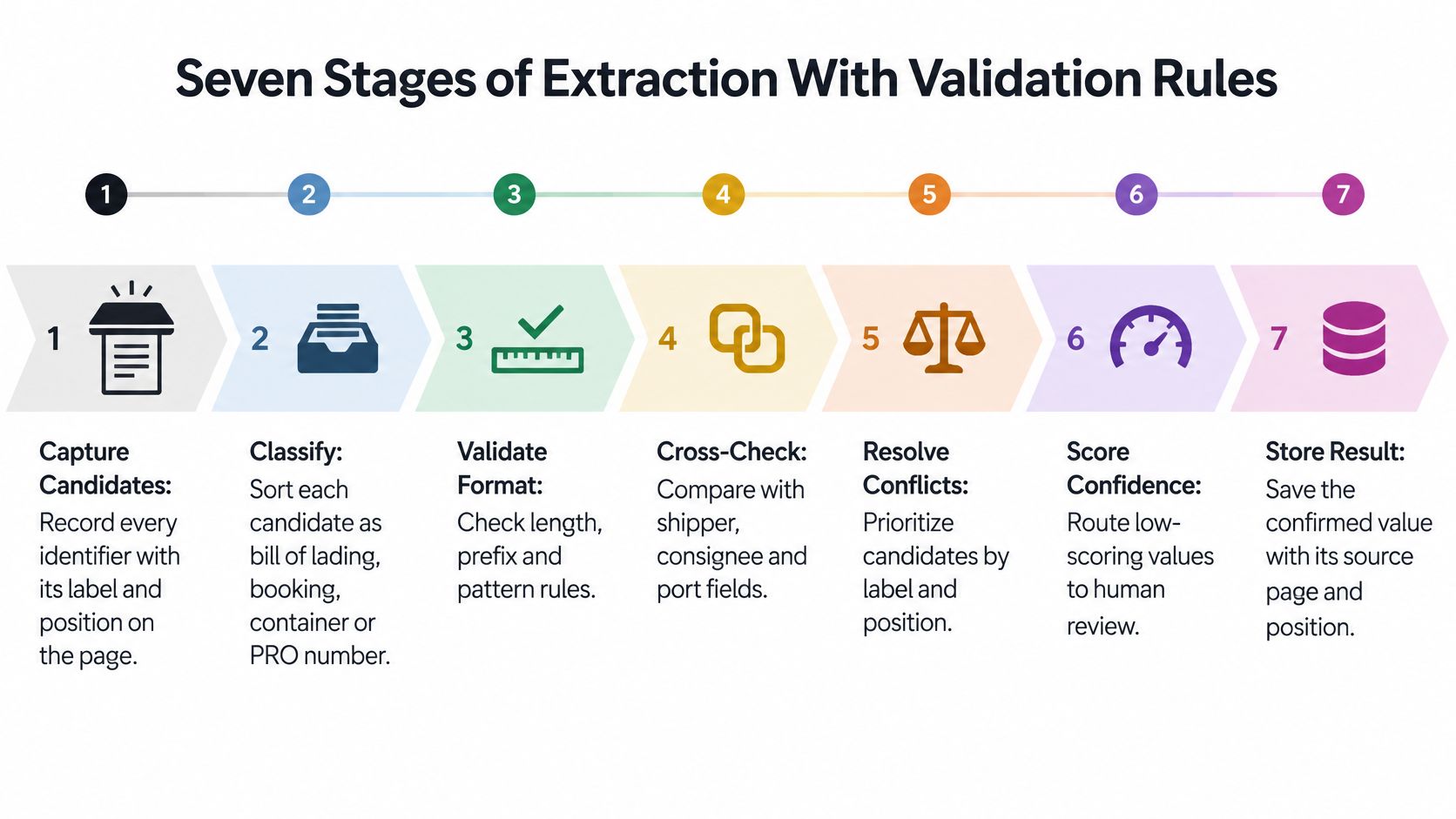
OCR that stops at transcription produces a string of characters, not a usable identifier. A perfectly read booking number mapped into bill_of_lading_number is still a business error, and someone in operations pays for it downstream. Document data extraction closes that gap: classification assigns each candidate a role, validation tests it against the rules for that role, and automation decides what happens to the result.
Build a controlled extraction pipeline
Treat the B/L number as a control field that has to earn its place in the record. The GS1 US Bill of Lading guideline defines the shipper-created number as 17 digits, comprising a 16-digit numeric value plus a check digit, encoded using GS1-128 Application Identifier 402, while carrier SCAC/PRO data uses 9012K. A pipeline that ignores which identifier it just read will pass the wrong one through.
- Capture candidates: Record each identifier with its label, page, and position on the document.
- Classify candidates: Assign roles using issuer, document type, barcode symbology, length, and nearby carrier fields.
- Validate format: Apply the carrier-issued or shipper-created rule set that fits the document, not a universal validator.
- Verify the check digit: Calculate the GS1 check digit where that standard applies; a failed result stops automatic posting.
- Cross-check references: Compare booking, container, and invoice relationships against the shipment record.
- Check existing records: Look for duplicates, amendments, and pages already linked to a shipment.
- Route exceptions: Send unresolved values to review with the failed rule and source crop attached.
Every stage writes its decision to the record, so a reviewer can trace any stored value back to the rule that fired and the crop it came from.
Handle edge cases explicitly
Clean documents are the easy part. The cases below are where pipelines quietly create bad records.
- Repeated pages: Link recurring numbers to the same document instead of creating a shipment per page.
- Amendments: Preserve versions and separate corrections from new transport records.
- Consolidations: Maintain master-to-house relationships so a house B/L never overwrites the master.
- Poor scans: Resolve ambiguous letters and digits against the source image before accepting a value.
- Mixed languages: Classify document roles without relying on an English label alone.
- Seaway bills: Retain document type so downstream users don't mistake them for negotiable originals.
Matil.ai is one option for running this pipeline through a simple API that combines OCR, classification, validation, and workflow orchestration, with pre-trained logistics document models and custom schemas for rapid personalization. Its AI-based data extraction overview describes accuracy above 99% in multiple use cases; measure field accuracy and exception rates on your own documents before assuming that performance transfers unchanged. The platform also lists zero data retention and GDPR, ISO 27001, and AICPA SOC compliance, so check those terms against your organization's requirements.
Apply the same controls across document sets
- Invoices: Extract references and amounts, validate totals, and reconcile charges with the shipment record.
- Delivery notes: Capture SKU and quantity fields so goods receipts match what the shipment record describes.
- Payslips: Classify payroll documents and validate required fields before export to cut rekeying.
- KYC documents: Extract identity fields, check completeness, and route unresolved discrepancies to compliance.
- Customs declarations: Keep DUA references separate from the B/L number and reconcile both before posting.
Automation earns its keep when clean cases post without touching a human. Strict validation raises the exception count; permissive validation lowers it by pushing the correction work onto finance, operations, or customs. Pick the trade-off deliberately.
Confirm the Number Before You Post the Shipment
Start with a controlled pilot rather than switching off manual review across the entire workflow.
- Define validators: Use issuer prefixes, applicable length rules, and GS1 check digits where appropriate.
- Route failed checks to an exception queue with a clear reason and source evidence.
- Test representative paperwork: For a pilot, use 50 to 100 real bills, including multi-page documents, electronic B/Ls, and seaway bills.
- Measure exceptions and reviewer corrections, then refine rules where errors cluster.
Separate field-reading accuracy from successful shipment matching. A system can read every character correctly while assigning the reference to the wrong record.
If manual checking has become the bottleneck, evaluate an extraction platform using your own documents and receiving-system requirements. Include security terms, auditability, and amendment handling in that evaluation.
A wrong key is harder to fix after a shipment record is posted. Confirm the number before posting.
Matil combines document OCR, classification, validation, and workflow automation to turn shipping paperwork into structured records. If you're evaluating B/L extraction, visit Matil and test whether its API captures the right identifier, preserves its source, and routes mismatches for review.


